




Abstract
When Polikovskaya died, there was speculation of government involvement, an international outcry and various posthumous awards for her investigative work. Yet in Russia there was no scandal, no mass protests. She was mostly deemed a "crazy loner", one of a very rare breed of reporters who believed in press independence.
A decade later, we have a better understanding of Politkovskaya’s significance for Russian journalism. Like many of her generation, she was a product of the perestroika years of 1985-91, and remained faithful to its ideals in the years that followed, when a majority of her colleagues “tired of freedom”. In the 25 years after perestroika, neither freedom of speech nor other political freedoms have been much prized by the majority of citizens of this new Russia.
In the 2000s, Politkovskaya’s stance was regarded as extreme. Who was there to fight against anyway? For what? The years of plenty were at their peak. Sooner or later economics would win and everything would sort itself out. Even liberals believed that.
It is important to understand the tradition to which Anna belonged. For her, being a journalist meant serving society, a tradition of self-sacrifice dating back to the 19th-century Russian intelligentsia. In the Soviet period this tradition was inherited by dissidents. In Russia, the line between journalism and social activism remains blurred, and not because Russian journalists are unprofessional, but because independence of the press has remained the ideal of rare characters such as Politkovskaya. There is no long-standing tradition of media independence. Each generation of journalists instinctively chooses between fusing completely with the state, which means producing propaganda and giving loyal support, or remaining steadfastly professional and inwardly dissident. Working as a journalist in Russia is not so much pursuing a profession as living an ethical, existential choice.
Investigative journalism had already disappeared from other publications. It is expensive as well as dangerous. Investigation is labour-intensive, it calls for a large team and takes a lot of time. The speed of modern media obliges editors to churn out instant copy. That, however, is not the main reason why there are so few investigations in the Russian media. And the disbanding of the top team at RBC after it launched a series of investigations into senior state officials sent a signal to other media.
Most resonant investigations of recent years though have not been the work of journalists, but of politicians of one kind or another. The flagship of investigative journalism in Russia remains the Anti-Corruption Foundation (FBK), a non-profit foundation created in 2011 by the opposition activist Alexey Navalny. It conducts the most high-profile investigations of corrupt senior officials, and they are carried out by a highly professional investigative team of 20 to 30 lawyers, specialists and volunteers.
Similarly, the first person to write in 2014 about the secret funerals of Russian paratroopers when the military conflict in the Donbass region was escalating was Lev Shlosberg. Although Shlosberg publishes Pskovskaya Gazeta, he is primarily a politician.
We can also classify as journalistic investigative reporting, the 2008 document, Putin: The Results: An Independent Expert Report written by opposition politicians Boris Nemtsov and Vladimir Milov. The report described President Putin’s abuse of power and widespread corruption in government.
The paradox is that, in Russia today, no amount of scandalous revelations of corruption at the highest level sways public opinion. For most people, the findings remain unknown, because 80% of the population get their news only from television.
TV aside, the most popular form of journalism in Russia today is the topical opinion column. Until the mass protests against Putin in 2012, it was thought this, too, was defunct and that nobody was interested in the personal opinions of a journalist. Yet it was the columnists who, that year, restored journalism’s intellectual respectability by starting serious and engaging conversations about freedom and human rights. Many of them have since become important public figures.
In Russia, the side dish has become the main dish. For example, Slon.ru, a business, economics and politics website founded in 2009, consists entirely of opinion pieces, which sometimes turn into mini-investigations, particularly when the author is Oleg Kashin.
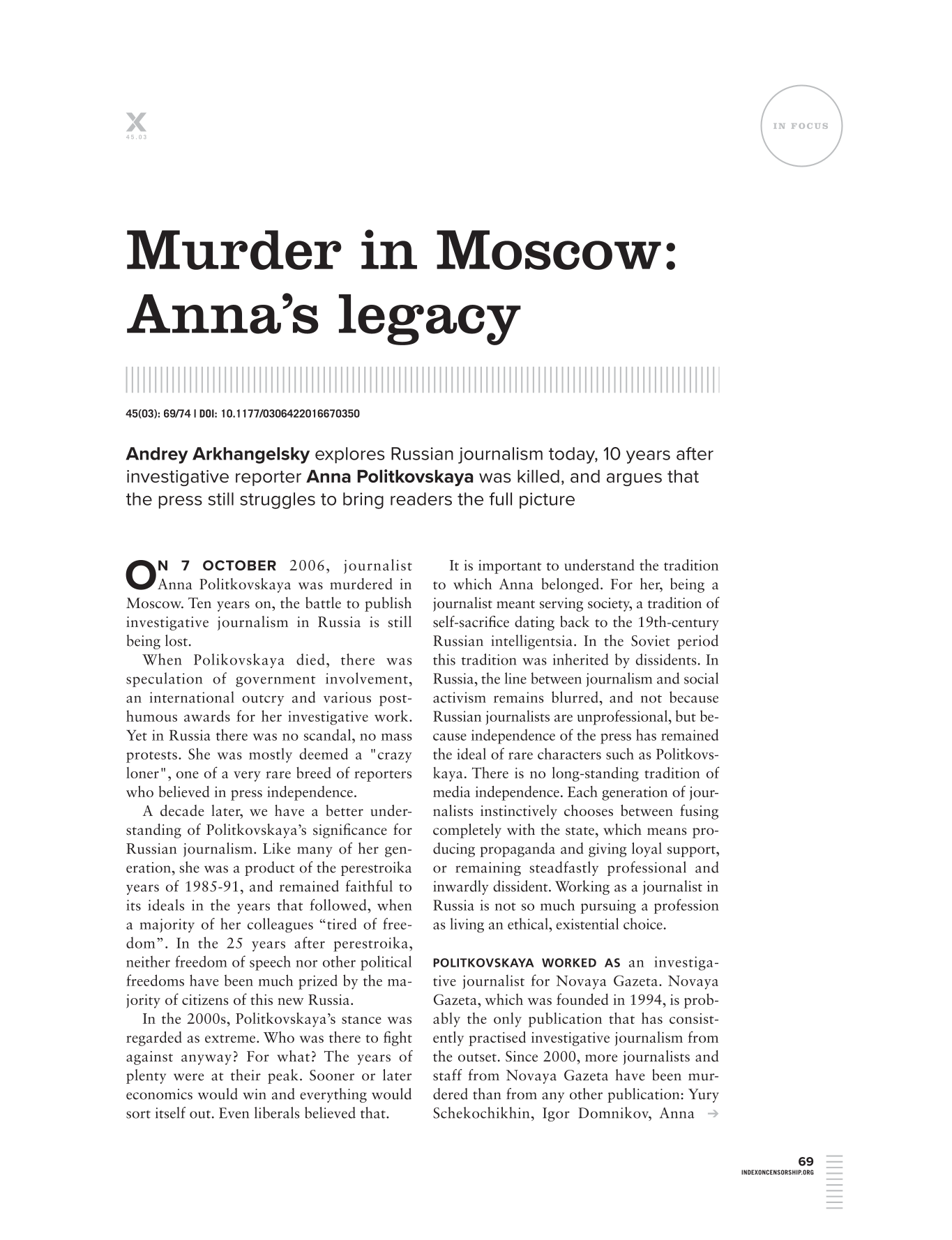
A man lays flowers near the picture of murdered journalist Anna Politkovskaya, during a rally in Moscow in 2009
CREDIT: EPA / Alamy Stock Photo
Kashin is a good example of this new trend of favouring individual writers over newspapers – a trend which has grown largely thanks to social networks, especially Facebook and Twitter. Kashin showed the power of self-publishing by building the audience of his own website via social networks. Journalist and writer Arkady Babchenko, who carried out a one-man investigation into the shootings on Kiev’s Maidan Square in 2014, has the same approach.
This method is one way to survive, as journalists increasingly find it impossible to maintain an independent point of view while working for state owned, or even privately owned, media. What other ways are there? Besides the already well-established route of emigration from Russia to Ukraine, a route taken by Yevgeny Kiselyov, Savik Shuster, Matvey Gannpolsky, Ivan Yakovina and the recently murdered Pavel Sheremet, there are more exotic choices. The Medusa media portal, an independent Russian language socio-political network publication, is registered in Latvia. Galina Timchenko founded it in 2014, together with a group of former staff members, after she was sacked as editor-in-chief of Lenta.ru, the Moscow-based online newspaper.
Two processes are taking place in Russia almost simultaneously: restriction of free speech, and technological progress in the media sphere. This creates a strong sense of absurdity. In 2008-12, during the presidency of Dmitry Medvedev, there was a major breakthrough in new media technology, which coincided with the growth of the middle class. New standards were set, as a demand rose for stories about politics, human rights, migrants and problems in society. This was seen not only by business publications like the business daily Vedomosti, the liberal business broadsheet Kommersant, and the Russian edition of Forbes magazine, but also by cultural and listings magazines such as Afisha, which is now published mainly online and Bolshoy Gorod, which closed down in 2013.
This complication of this scene culminated with the appearance of a new kind of publication, Openspace.ru, a news site for Russia’s creative vanguard, founded in 2008 by Maria Stepanova and Gleb Morev. Since 2013 the two partners have also been running the cultural magazine and news site Colta.ru. The internet seems to have given journalists more freedom and even made it possible to raise funds independently. A paid subscription scheme was successfully introduced for the first time by the Slon.ru, who started their project by crowdfunding.
Before the 2012 protests, the Kremlin did not see internet publications as a threat: its total control of television ensured the loyalty of 70-80% of the electorate. When Medvedev came to power this balance even shifted slightly in favour of channels with smaller audiences. The Dozhd channel, dubbed “Television for intelligent people”, targeted the middle class and was founded in 2010. Part of Medvedev’s liberalisation project also included an independent and non-commercial public television channel (OTR), which he set into motion but which only started broadcasting in 2014.
It is significant that the main weapon of the “conservative restoration”, after Putin returned for a third term in 2012, was the traditional media of television and radio. There was not only a counter attack by those with anti-liberal values but also by the traditional media. Technology on its own proved inadequate for resisting the mechanisms of the state: that could be done only by people who had opinions.
Publishers and investors used to think that if they played by the rules and avoided open criticism of the Kremlin, no one would touch them. The rules are, however, constantly changing, and they aren't written down anywhere. One can only second guess them. This Kafkaesque situation gives rise to a general sense of nervousness, but also tells us something about freedom of speech: anyone who voluntarily agrees to partial curtailment of their freedom will sooner or later have it taken away completely.
While resolving its practical problems by introducing new censorship laws, by emasculating such leading information platforms as Lenta.ru and the Russian-language news agency RIA-Novosti, by blocking such sites as Kasparov.ru and Polit.ru, and removing a number of editors-in-chief, the regime also accomplished a symbolic task. It managed to discredit the very notion of an independent press in the eyes of the general public. The conservative restoration in Russia since 2012 has been a struggle against anything that is “above” the state, specifically, against the idea of universal values and freedom of speech.
Most media have already lost the battle. Journalists have no experience of closing ranks to defend their rights, and most private owners are willing to abandon freedom of speech in order to retain their businesses. The disbanding of teams of journalists in 2013-16 was generally explained away as being for commercial reasons: “the unviability of the publication”. Only in two cases did the Kremlin not get away with this ploy. The Dozhd television channel and the radio station Echo of Moscow put up a spirited all-round defence involving the editors, the staff, and the viewers or listeners. Amazingly enough, in both cases, the regime was unable to get them to abandon their critical stance.
The main target of government attacks in the future is likely to be the internet, with an attempt to take control of social networks. The recently adopted Yarovoy law increases the burden of responsibility for anyone whose internet postings could be deemed “extremist”, and obliges communications operators to keep recordings of all calls and messages, metadata, exchanged between users for six months. The same applies to internet service providers, who are obliged to keep metadata for three years. The presidential adviser on the internet industry, Herman Klimenko, appears to be considering the option of an autonomous Russian internet, analogous to that of China. “If we close our borders now, I mean virtually, all our sites will benefit,” he said in a recent interview with the BBC Russian service.
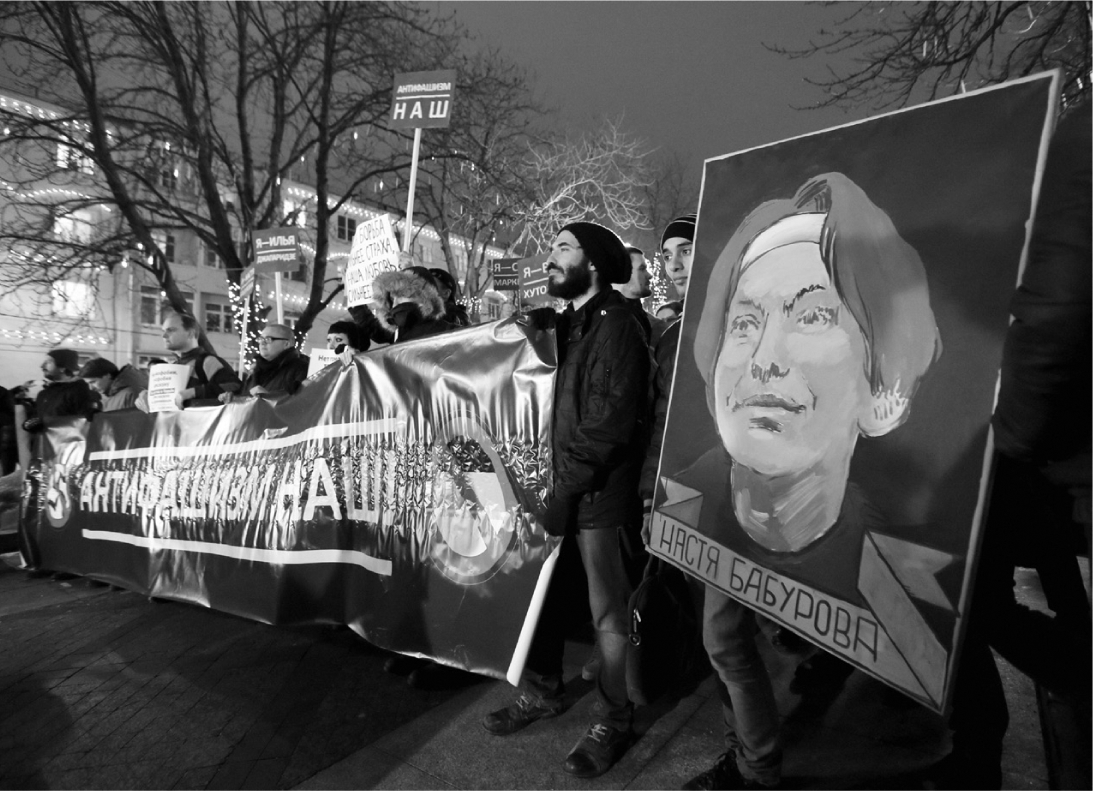
A portrait of journalist Anastasia Baburova is held during a gathering in memory of her and human rights lawyer Stanislav Markelov in Moscow in January 2015. They were murdered in 2009
CREDIT: EPA / Yuri Kochetkov
Under these conditions, journalism in Russia is often simply unable to perform the basic function of journalism, which is to inform the public about what is happening. Independent journalism does what it can, and by the very fact of its existence reminds people that alternative opinions about universal human values are possible. It provides an alternative to propaganda. The only good thing about the profession today is that people working in journalism are forced, much sooner than others, to make a moral choice where the line between good and evil is to be drawn.
Ten years after her murder, the example of Anna Politkovskaya is relevant to all of us.
Violations against the press in Russia
Josie Timms and MMF correspondents
Source: Mappingmediafreedom.org
Into the future, and into the past
Vladimir Putin has said that Russia will not allow foreigners to finance our civil society, but now we have no domestic investors to do it, which is a tragedy. If we continue like this, 100 years years from now there will be no civil society in Russia.
Tragically, our most active democrats are on the Left. I cannot bring myself to vote Communist because the distance between their progressive and repressive instincts is too short, but Putin’s regime is a great recruiting ground for the Left, particularly among the young.
The media will share the fate of the rest of the country. My newspaper, Novaya Gazeta, will do all it can to stay open, but there are no grounds for optimism. Two years ago, we had points of contact with Putin; now there are none. He said, "We will fight our enemies" so it’s either him or us. "Us" meaning the "voice of protest".
The Union of Writers consists of people who show they are writers by chumming up to the Kremlin. As an organisation that receives perks from the government it is an absolute non-starter, a relic of the USSR. If Russia develops democratically, there will be no Writers’ Union in the future, just a professional trade union for writers. Traditionally, we have needed film directors, artists and writers to tell people what a great country they live in. But that has nothing to do with writing or intellectual endeavour, or with the effort to depict life as it is.
I love my country but I don’t want it to have a "Special Way". I want it to be just like other countries where there is democracy and the police protect people from criminals instead of oppressing them. I want us to be like everyone else. People who talk about a "Special Way" usually want to oppress somebody.
I hope there will be no registration system in the future (the system under which the USSR controlled its citizens by registering them in a particular place). In a country the size of Russia you can’t hope to keep track of everyone. Registration is just a system for extorting bribes and without it a person becomes a nobody: no education, no medical help, no pension. It has brought us so much suffering that if we develop into a democracy I cannot imagine it surviving.
The full article can be found in the Index archive: ioc.sagepub.com
Footnotes
Translated by