




Abstract

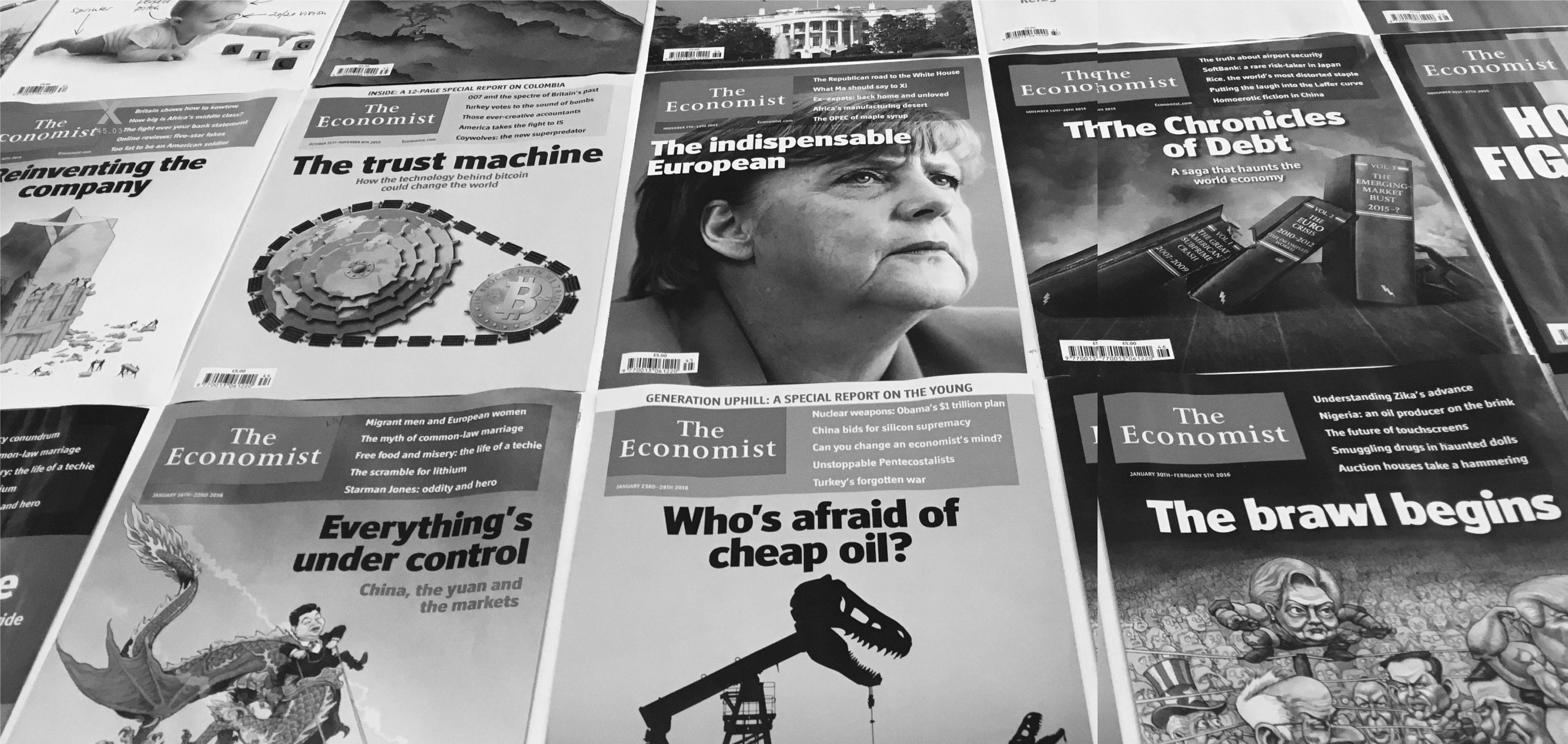
Recent covers of The Economist
CREDIT: The Economist
Anonymity saves time and hassle. Creating a byline that allocated credit fairly among half a dozen people who may have contributed to the article would be cumbersome (and of little interest to the readers). Anonymity removes the problem and spurs collaboration. You don’t barge in front in the hope of a star billing. You lean in, in the knowledge that the people who matter most – your colleagues and bosses – will be keenly aware of what you contribute.
But it also reflects the way we write. Articles are conceived, reported (sometimes in half-a-dozen places) written, rewritten, rewritten again, fact-checked, copy-edited, and tweaked. They may stem from an idea by one author, be mostly written by a second, owe their polish to a third and their memorable sparkle to a fourth.
Anonymity filters out the egomaniacs so often found in other reaches of journalism. They will head for the bright lights of television, or for the kind of written media which offers large picture bylines. They will not find The Economist to their taste. Even if our star writers, the columnists who write Bagehot, Banyan, Bello, Charlemagne, Free Exchange, Lexington and Schumpeter, are away or indisposed, their places can be seamlessly taken by colleagues. Nobody is irreplaceable and we all know it.
You can still become famous as an Economist writer. You can write books. You can broadcast and pontificate, chair conferences, give speeches, moonlight at a think-tank (or all of the above). Our press office, tasked with telling the world that we are not as dull as our name suggests, tries hard to get the authors of our most provocative and important articles on to television and radio. Our online-only pieces, which are mostly less heavily edited and more personal, usually have initials: it helps the reader to connect articles to others by the same writers – even without knowing who they actually are. But in the print edition, anonymity reigns unchallenged.
It may seem a quaint throwback, or even an affectation. But it works. Our circulation is strong and our profits healthy; we have no difficulty in hiring or keeping talented staff. Anonymity was ubiquitous in journalism when we published our first edition in 1843: putting your name on an article was seen as showing off. Admittedly it is rare now: in the UK, only Private Eye follows the same practice. But few if any of the 100-plus staffers and stringers who now write for the paper (never, ever a “magazine”) would want it any other way. It is a blessing, not a curse.