




Abstract
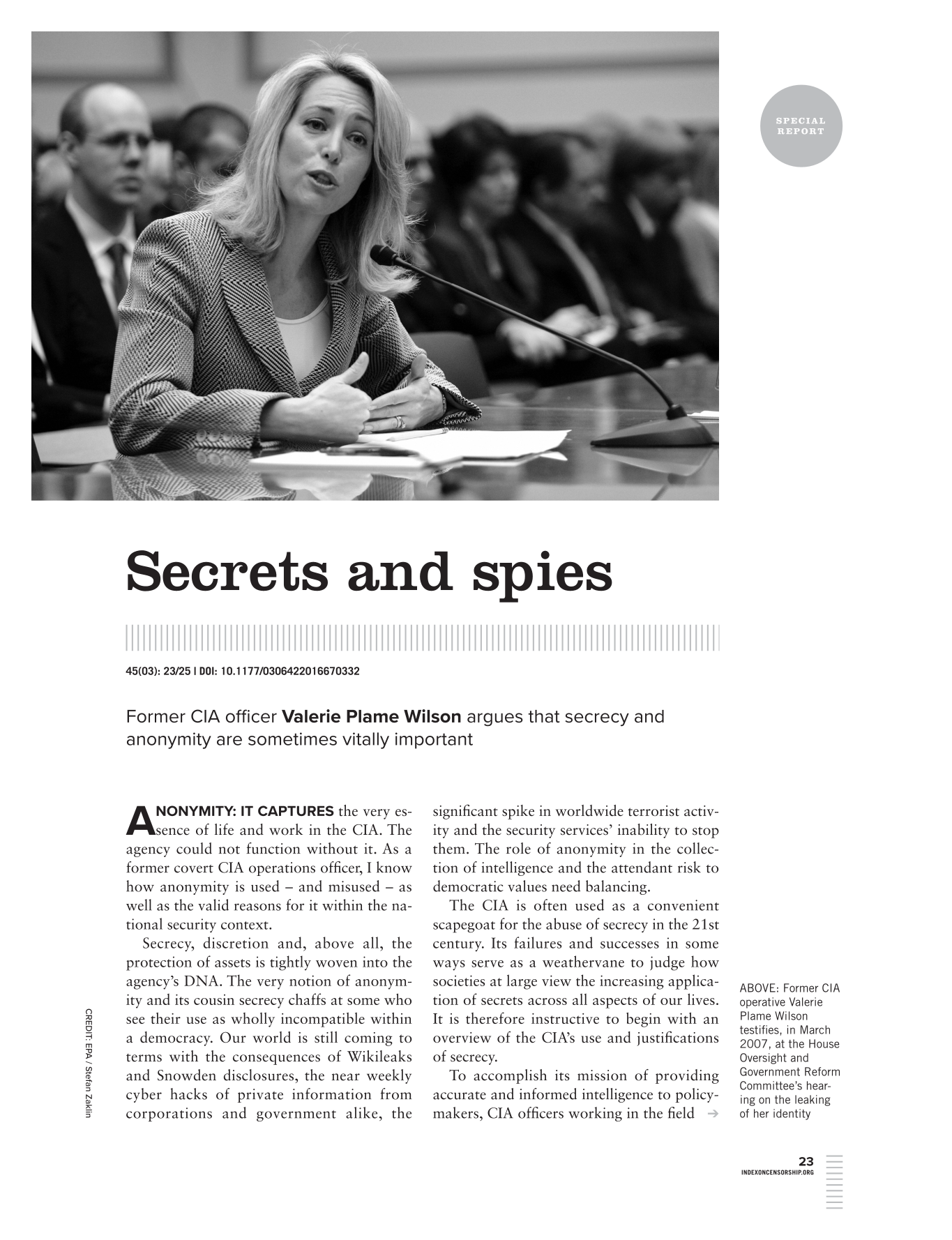
Former CIA operative Valerie Plame Wilson testifies, in March 2007, at the House Oversight and Government Reform Committee’s hearing on the leaking of her identity
CREDIT: EPA / Stefan Zaklin
Former CIA officer
Secrecy, discretion and, above all, the protection of assets is tightly woven into the agency’s DNA. The very notion of anonymity and its cousin secrecy chaffs at some who see their use as wholly incompatible within a democracy. Our world is still coming to terms with the consequences of Wikileaks and Snowden disclosures, the near weekly cyber hacks of private information from corporations and government alike, the significant spike in worldwide terrorist activity and the security services’ inability to stop them. The role of anonymity in the collection of intelligence and the attendant risk to democratic values need balancing.
The CIA is often used as a convenient scapegoat for the abuse of secrecy in the 21st century. Its failures and successes in some ways serve as a weathervane to judge how societies at large view the increasing application of secrets across all aspects of our lives. It is therefore instructive to begin with an overview of the CIA’s use and justifications of secrecy.
To accomplish its mission of providing accurate and informed intelligence to policy-makers, CIA officers working in the field employ a variety of covers of varying depth to conduct their operations securely. That is, they ostensibly work for companies or other entities in order to live and travel internationally. While gathering intelligence and recruiting spies they play “the grey man” (or woman), outwardly boring, able to blend into a crowd while simultaneously working it. Secrecy, inherent to covert action, provides the US government “plausible deniability”, which is useful in keeping diplomatic channels open and intact when secrets are being exchanged.
The agency has a long-standing policy prohibiting the use of journalists, the clergy or NGOs for cover purposes. These entities have made it abundantly clear over the decades that any CIA affiliation – real or perceived – would irrevocably harm and undermine their work and reputations internationally. Nonetheless, in 1997 the US Congress inserted language into a bill allowing the president or the director of central intelligence to waive this policy when deemed essential. There have been some occasions when the CIA has ventured into these arenas for cover purposes, but it generally didn’t end well. Legitimate interests were compromised.
Working under cover, my anonymity meant everything to me. Unlike those in military uniform or diplomats who are well known to local intelligence services, I moved around cities with relative ease. Taking certain precautions, I met with assets, or potential ones, without attracting undue, unwanted attention. For the most part, it looked like a typical date to the casual observer.
Even more importantly, the foreigners whom CIA officers seek to recruit to do the actual spying and obtain secrets – the assets – must likewise be protected with anonymity by the use of code names or cryptonyms. Only essential CIA officials with a genuine “need to know” are able to see the true names of these assets. The reason for this is obvious; if assets were known to be co-operating with US intelligence, it could be fatal for themselves and their families. An early example of the value of anonymity is Eduard Schulte, a prominent German industrialist who traveled frequently to Switzerland during World War ll and was the first to report to the CIA about the Nazi’s “Final Solution” using concentration camps. Had Schulte’s identity been known, he would have been killed.
The motivations for spying are as varied and vast as there are individuals themselves. From financial concerns, to ideological affiliations, egotistical yearnings, and every combination between, the CIA officer’s first job is to determine the right combination of these to recruit a spy and run him in a secure operation. While it is abundantly true that the CIA is not the Boy Scouts and some of its assets are deeply flawed human beings in all the ways that humans can be, my experience has been that CIA officers hold as dogma the absolute need to protect their sources and methods. If one fails at that, the consequences are profound.
The most critical question facing Western democracies today is the appropriate balance of security versus privacy. There has always been a historic dynamic tension between the two poles, but since 9/11 and the Iraq war the stark contrast between the two and defenders of each has never been greater. Is meaningful accountability of secret government programmes even possible without compromising legitimate national security needs? It is, but the judiciary, in an automatic reflex, sides with the government and its claimed national security needs. It is time to embolden and support independence and skepticism in the judiciary to truly weigh the issues at hand within the context of the Fourth Amendment.
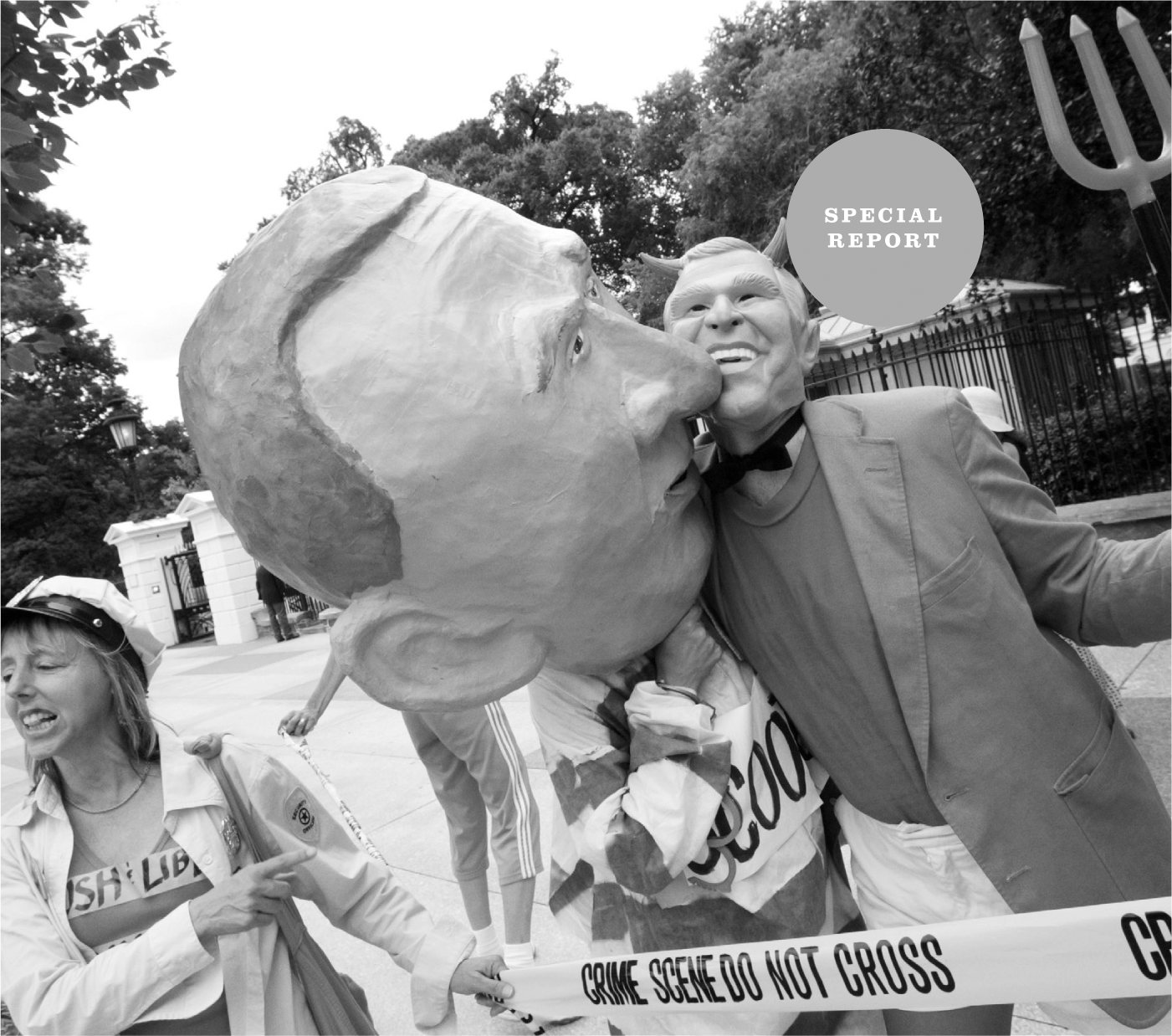
A 2007 protest against President Bush commuting the prison sentence of I. Lewis “Scooter” Libby
CREDIT: AP Photo/Ron Edmonds
On a personal note, I took my anonymity for granted until it was abruptly ripped away by senior Bush White House officials in 2003 in the service of a nakedly partisan agenda. I found Andy Warhol’s prediction that in the future, “everyone will be world famous for 15 minutes” to be mortifying. Professional satisfaction in my CIA job came from my colleagues’ acknowledgement. Finding myself to be a public figure in the wake of the political scandal was deeply disorienting. And, of course, after my CIA affiliation was betrayed, continuing my covert operations was impossible. In a world of nation-states, of conflicts and deeply different goals, obtaining intelligence is a necessary reality. Anonymity is an essential ingredient in that effort and I was proud to be part of it.
The life of a spy: a timeline