




Abstract

Foreign correspondents often rely on “fixers” to help them report from war-torn
countries. But, as
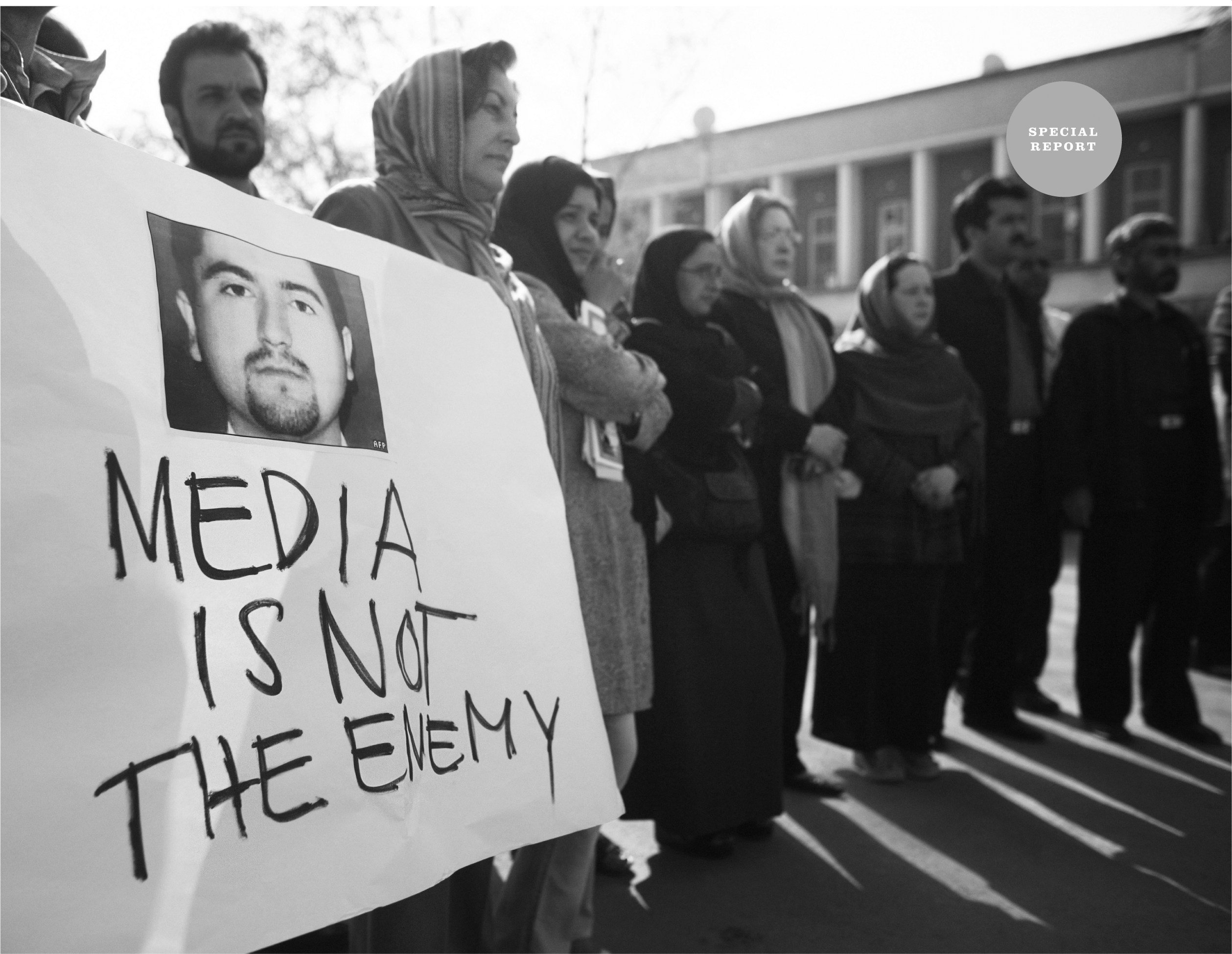
Afghan journalists hold a picture of fixer Ajmal Naqshbandi, who was beheaded by the Taliban, at a protest in front of the Afghan parliament in Kabul April, 2007
“Let’s imagine IS comes to Erbil, the first people they will look for are the fixers,” Rawand, who has worked with Vice News and Time magazine, said. “After every report the fixer remains in the country, while the reporter has a foreign passport and can leave,” he added.
Fixers manage logistics for foreign correspondents, including translating and guiding, but they also research stories, develop contacts, arrange interviews and travel to front lines. Most are freelancers and are highly vulnerable to threats and reprisals, especially once their foreign colleagues leave. According to the Rory Peck Trust, an organisation which supports freelancers around the world, the number of local freelance journalists targeted for their work assisting international media is increasing.
“The majority of requests for our assistance comes from local freelancers who have been threatened, detained, imprisoned, attacked or forced into exile because of their work,” Molly Clarke, head of communications at Rory Peck, said. “We regularly support those who have been targeted specifically because of their work with international media. And in these instances the consequences can be devastating and long-term – not just for them but their families too,” Clarke added.
The Committee to Protect Journalists reports that 94 “media workers” have been killed since 2003: that was when the CPJ started to classify fixers separately in recognition of their growing importance to foreign news reporting. In June this year, Zabihullah Tamanna, an Afghan freelance journalist who was working as a translator for US’s National Public Radio, was added to CPJ’s list of those killed when the convoy he was travelling in was bombed in Afghanistan.
Many fixers start as inexperienced amateurs, desperate for paid work in economies damaged by conflict. They are rarely given training or long-term support by the international organisations they work for, and are often responsible for their own safety. Rawand has learnt to keep a low profile in Erbil. He seldom chooses to put his name on a report or article to which he has contributed. “Having my name attached to stories means I am not anonymous. There might be suspicion against me and I will be treated as a spy,” he said.
Being accused of spying is an occupational hazard for many fixers working with foreign journalists. For those working on the front line of the war between Ukraine and Russian-backed separatists it is a daily threat. In 2014, Anton Skiba, a local producer based in Donetsk, was abducted by separatists and accused of being a Ukrainian spy. He had spent the day working for CNN at the site where the Malaysian airlines flight MH17 crashed in separatist-held eastern Ukraine. Skiba, who has also worked for the BBC, was eventually freed, after a campaign by journalist colleagues. “It is really important to stay balanced while you have access to both sides of the conflict – otherwise there is a high chance of being oppressed by one of the sides,” he said.
Skiba tries to protect himself by being careful about the people he works with and which stories he covers. “It is my country and I must continue to live here after journalists switch to another conflict. I do not want to risk my life for a story which will be forgotten the next day. That’s why I try to avoid journalists who are not professional or use fixers to get ‘hot’ stories,” he said.
Another Donetsk fixer, Kateryna, obtained press accreditation from both the Ukrainian authorities and the opposing separatist Donetsk People’s Republic to avoid accusations of favouring one side of the war over the other.
But this has not stopped the threats and harassment against her. She does not publicise that she works with international journalists but a Ukrainian website, Myrotvorets, recently revealed the names, email addresses and telephone numbers of around 5000 foreign and local journalists who have worked in the DPR and Luhansk – breakaway areas not controlled by the Ukrainian government. Kateryna, 28, was featured several times on the list, published in May 2016, because she has worked with the BBC, Al Jazeera and other media.
Kateryna has regularly been held and interrogated by Ukraine’s security services because of her work. “After two years of work with foreign media you are in the security services’ spotlight,” she said. “And it is better not to underestimate their power. They are smart enough to play with your life.”
She now feels exposed in Donetsk and would like to find other work. “Once a TV crew leaves, that’s it,” she said. “Only once I felt care from the international media. This May, one BBC colleague asked me if I needed support after my name was published on Myrotvorets. I refused any help because it was the least of what could happen to me.”
Few fixers are eligible for compensation if they are injured or killed while working. Nor are they given the de-facto international protection which is usually extended to foreign journalists working abroad. In Afghanistan alone, dozens of translators, drivers and local producers were killed between 2003 and 2011, some caught in fighting, others, including Ajmal Naqshbandi, a journalist, and Sayed Agha, a driver, were executed by the Taliban for working with foreigners.
Saira, a fixer in Kabul, Afghanistan for the last nine years, can only work if she hides not only her identity, but also herself. As a woman she is constantly threatened and abused. She is so fearful of retribution she would not give her real name for this article. The 26-year-old, who started working for foreign journalists to help fund her studies at Kabul university, said she only feels secure when her face is covered. “I have travelled to some risky places with foreign journalists. I had to fully cover my face with a burqa so I would feel safe,” she said.
“It is always dangerous for a woman to work, even in Kabul, they get bad comments from society and no respect. Many people blame you and even call you infidel as you work with a non-Muslim,” Saira said.
Fixers in conflict zones considered too dangerous for foreign reporters are increasingly being hired to write and file stories directly to international news desks. “There is a greater reliance on local freelancers for stories, news and images in countries and areas where it is difficult – or too dangerous – for [international reporters] to gain access,” said Clarke. “We don’t have any specific facts or figures, our evidence is mostly anecdotal from what we’ve heard and observed through our work.”
Almigdad Mojalli was a fixer who became a reporter when war in Yemen forced many foreigners to leave the country. Mojalli, 34, spoke good English, knew the right people, was respected and in demand.
Mojalli preferred to work anonymously. “He liked being a fixer because it allowed him to tell stories he couldn’t safely tell in Yemen,” said Laura Battaglia, an Italian journalist who worked with him and became his friend. “With his agreement we kept his name off difficult articles, to protect him.”
But when Mojalli started reporting alone he encountered problems with the Houthi militia, a rebel group which controlled Sana’a, Yemen’s capital. Almost his very first story, filed to newsdesks in Europe and the US under his own name, angered the establishment. He was immediately arrested and threatened by government agents. In January this year he was killed in an airstrike while on assignment for Voice of America. He was travelling in a dangerous area in an unmarked car with no indication that he was a journalist.
Mojalli’s death also raised questions of responsibility. He was a freelancer, but working in the field for international news organisations. Mike Garrod, co-founder of World Fixer, an online network that links local journalists and freelancers with international reporters, believes some media groups are starting to take their role in the safety of the freelancers they employ more seriously.
Garrod hopes to set up an online training programme for local journalists and fixers. The course will include risk assessment, security and journalistic standards and ethics. “Fixers are largely untrained and vulnerable in hostile environments. As their use as more than just translators and logistics becomes more prevalent there is a real need for them to understand, and be able to prove they understand certain concepts,” Garrod said. The BBC, CNN and Reuters were asked about their fixers’ policies for this article. None of them choose to comment.
However, the behaviour of some individual journalists who employ fixers in the field is harder to regulate, according to Garrod. He related the story of a young student, hired by a foreign reporter to go to Iraq’s front line when he was 17. “There is so much the industry can do to encourage journalists to act more responsibly in regards to this, but I worry the will is not there to scrutinise how a story is gathered,” he said.
Zia Ur Rehman, 35, worked with foreign correspondents in Karachi, Pakistan, between 2011 and 2015. He said that while local journalists in the city understand the dangers facing journalists there, some foreign reporters ignore their advice. “Some cameramen and photographers are bad-mannered and rude and treat the fixer as their servants. As they do not know the complexity and sensitivity of situation, they make films or take photos without consulting the fixer and it has caused big problems for the team, especially for the fixer,” Rehman said.
There have been cases where fixers have been abducted, beaten and even tortured by Pakistan’s security services because of their work with foreign journalists. Rehman said he rarely works as a fixer anymore, if he does it will only be for a reporter he knows.
More training and support from international organisations employing fixers is crucial to their safety, but it is unlikely to make a difference in areas still controlled by IS, which is determined to silence journalists, especially those working with foreign outlets. In June this year the CPJ reported that IS had executed five freelance journalists in Syria. One was tied to his laptop, another to his camera, both packed with explosives and then detonated. They had been accused of working with foreign news and human rights organisations. IS released videos of their killings as a warning to others.
Footnotes
*
Some names in this article have been changed for security reasons