




Abstract
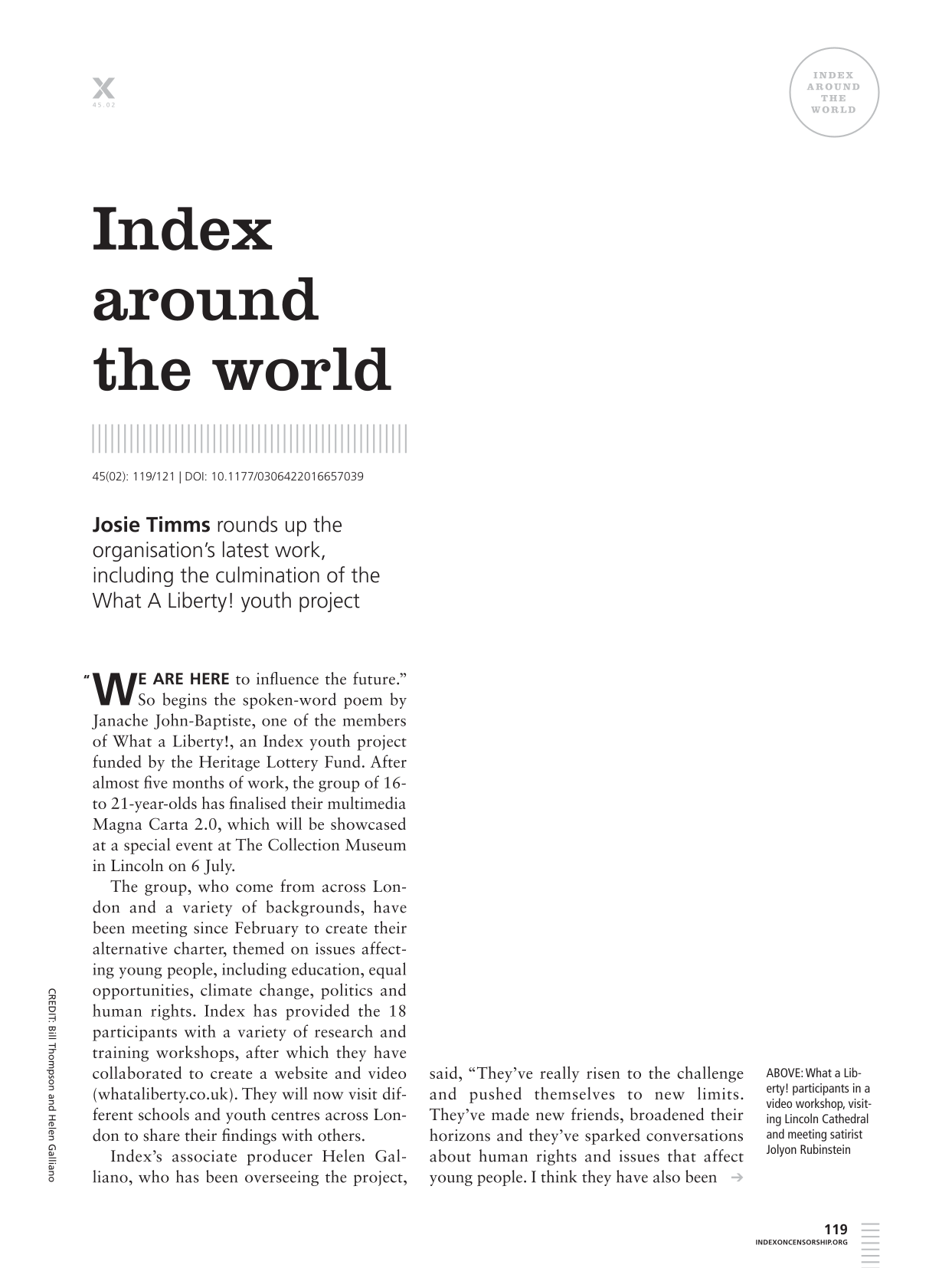
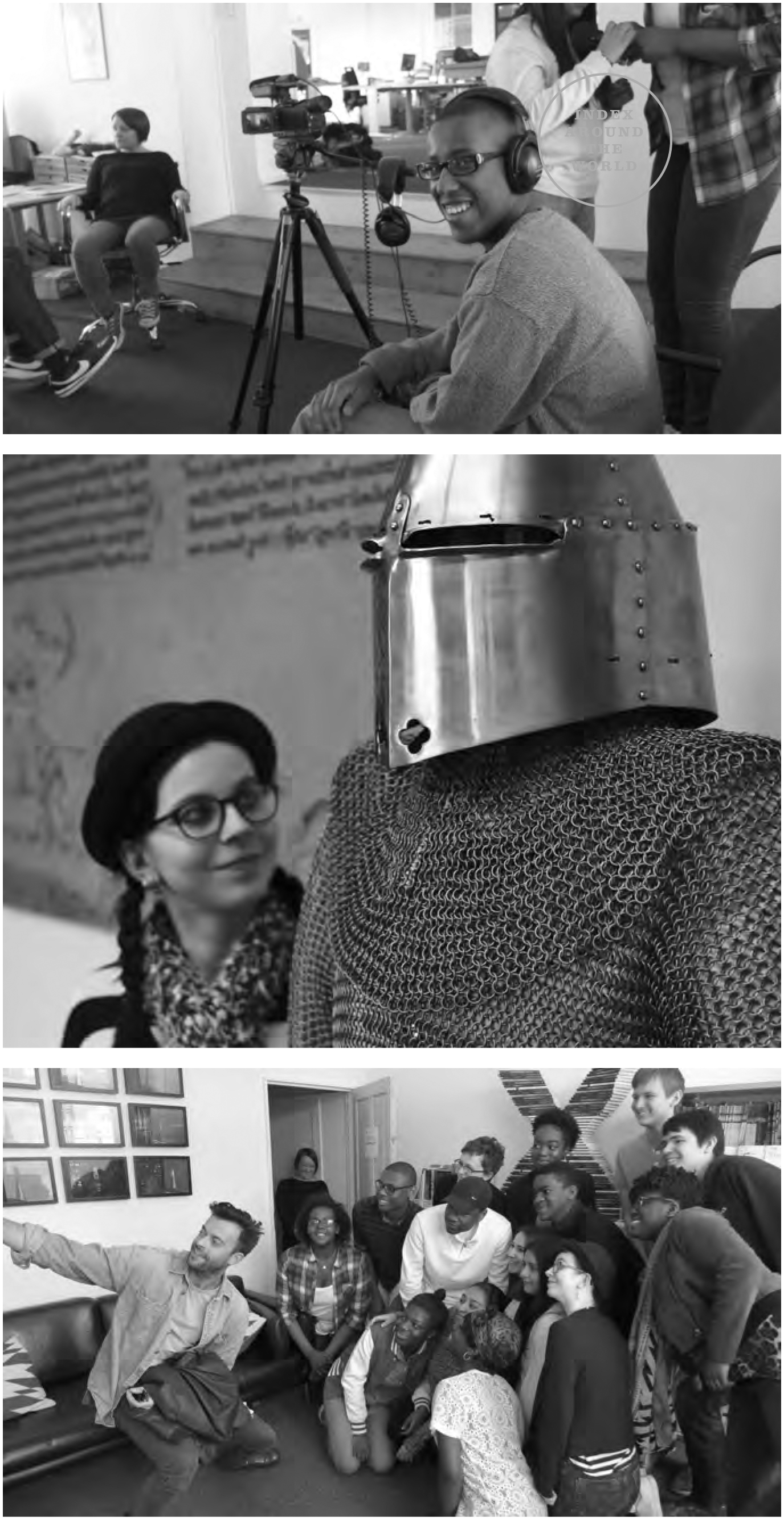
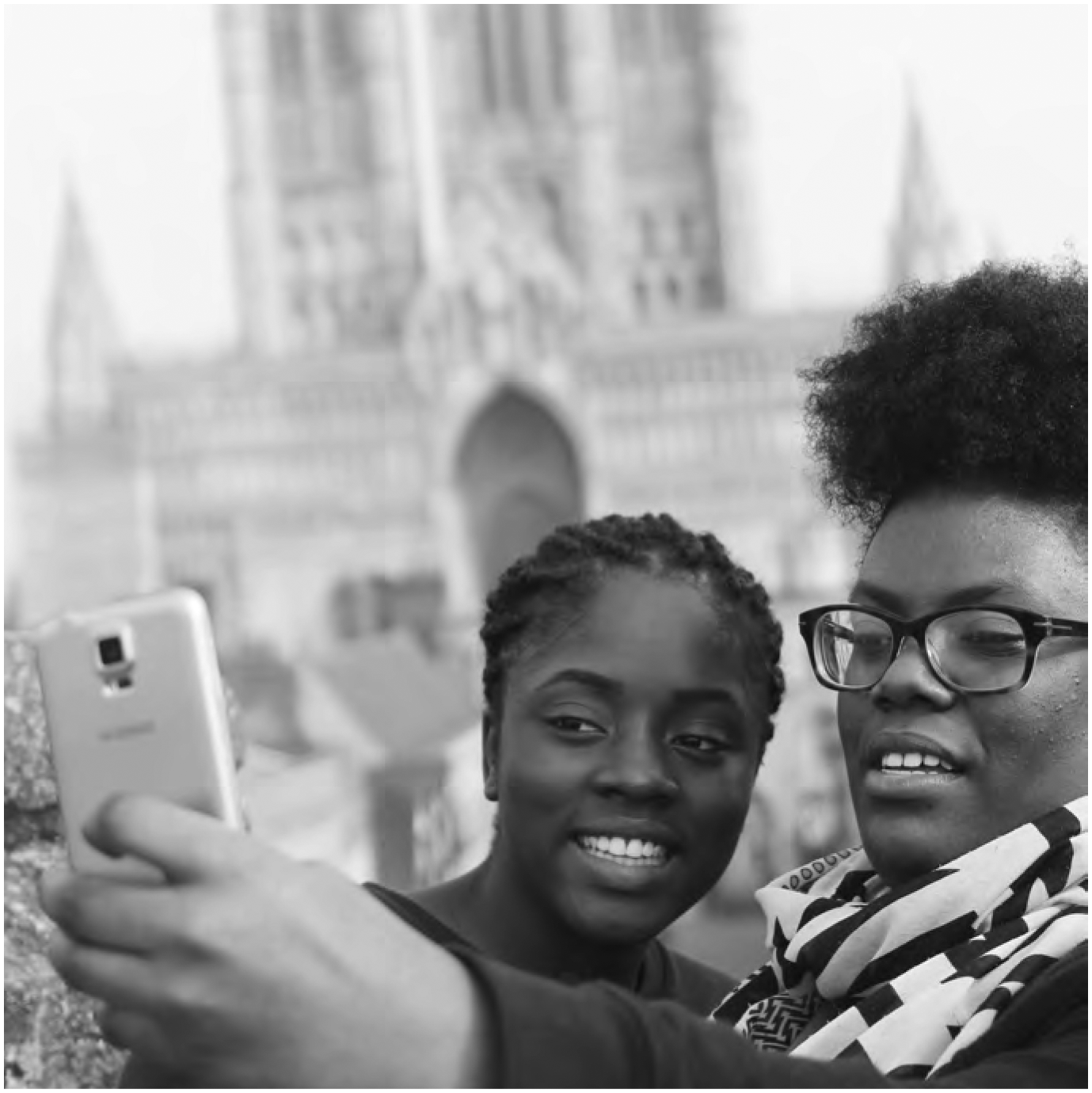
What a Liberty! participants in a video workshop, visiting Lincoln Cathedral and meeting satirist Jolyon Rubinstein
CREDIT: Bill Thompson and Helen Galliano
The group, who come from across London and a variety of backgrounds, have been meeting since February to create their alternative charter, themed on issues affecting young people, including education, equal opportunities, climate change, politics and human rights. Index has provided the 18 participants with a variety of research and training workshops, after which they have collaborated to create a website and video (whataliberty.co.uk). They will now visit different schools and youth centres across London to share their findings with others.
Index’s associate producer Helen Galliano, who has been overseeing the project, said, “They’ve really risen to the challenge and pushed themselves to new limits. They’ve made new friends, broadened their horizons and they’ve sparked conversations about human rights and issues that affect young people. I think they have also been surprised at how much history actually affects us today.”
What a Liberty! participants, who have been work to produce their multimedia Magna Carta 2.0
CREDIT: Bill Thompson
One member of What a Liberty!, Alisha Kelly, has been inspired to set up workshops teaching girls in her local high school about politics and law. Kelly has been offered a grant of nearly £500 from vInspired, a youth volunteering charity, to organise the workshops, which will begin in September.
Galliano added: “The whole group’s passion and motivation to move forward is really inspiring. I hope they will continue to work together and get more people involved.”
Index is also currently recruiting its next multinational youth board. In a recent meeting, held via video link, the current board spoke to Vanessa Berhe, a 2016 Freedom of Expression Awards nominee, based in the USA. When she was 16-years-old, Berhe set up the campaign One Day Seyoum to fight for the release of her uncle, Eritrean journalist Seyoum Tsehaye, who has been imprisoned there since 2001. Following the meeting the youth board wrote a joint letter, calling for the release of all Eritrean journalists, which was released on 3 May to coincide with World Press Freedom Day.
World Press Freedom Day also saw the release of Index’s Mapping Media Freedom quarterly report, which highlighted a dramatic deterioration in press freedom across 40 countries. Between January and March 2016, 301 violations of press freedom were submitted to Mapping Media Freedom’s database, a 30% rise from the fourth quarter of 2015.
The data was widely covered in the press, including in The Guardian. Hannah Machlin, Mapping Media Freedom project officer, said: “Media violations are regularly being reported from countries with strong democratic institutions and protective laws for journalists.”
Since its 2014 launch, MMF has verified over 1,800 incidents of pressure against journalists and news outlets – ranging from censorship to government takeovers, physical assaults to assassination. The project has been granted renewed funding by the European Commission to ensure it can continue through 2016 and 2017.
Over in Sweden, Index’s CEO Jodie Ginsberg was invited to be keynote speaker at the annual Swedish Library Association meeting in May. The event had a free expression theme to mark the 250th anniversary of the abolishment of censorship in Sweden. Ginsberg spoke about how to balance privacy and free expression rights in the information age, and took part in a panel on how Swedish libraries can walk this balance.
Ginsberg said: “It was interesting to see how one of the highest rated countries for free expression still faces challenges. It is important for Index to build relationships with the countries where free expression is guaranteed as well as where it is not. This visit was part of maintaining that.”
Also in May, the first Tehran Book Fair, Uncensored was held at London’s Free Word Centre to coincide with its Iranian counterpart. The event, curated by UK-based NGO Small Media, brought together seven independent Iranian publishers from across Europe, who showcased books that would not be permitted at the Tehran version. There were also discussions about censorship in Iran since the 1979 revolution.
Deputy editor Vicky Baker attended the event and gave a speech about Index’s work across the Middle East. “Index on Censorship has done a great deal of work on the Middle East and it was great to get the opportunity to draw it all together for a new audience. Looking through the archive, I found the first full feature on Iran was poet Reza Baraheni’s brutal account of being tortured in an Iranian jail. It was sent to Index in 1975 (see page 124, Endnote) and it seemed to really kickstart the magazine’s work on the region. Now if type Iran into our online database of magazine articles, you get over 800 results. And that is just the magazine. The website’s content is counted separately.”
Lastly, the Shakespeare special issue of Index on Censorship magazine released for the 400th anniversary of his death prompted a debate at Hay Festival in June. Editor Rachael Jolley attended the world-famous literature festival on behalf of Index, where she was a panellist on two debates on Shakespeare and dissent, and offence. She was joined by The Times columnist David Aaronovitch, who is also the chair of Index on Censorship, actor and theatre director Simon Callow, and founder of the Everyday Sexism Project Laura Bates, among others.
Freedom of Expression Awards 2016
“This award is for the journalists and citizen journalists still taking this dangerous, difficult path, sacrificing everything, playing hide and seek with death to get the stories of the Syrian people out,” said Zaina Erhaim in her winner’s speech at Index on Censorship’s Freedom of Expression Awards 2016 in April.
Erhaim was collecting the journalism award for her courageous work training citizen reporters in Syria. Other awards, presented at a gala hosted by comedian Shazia Mirza at London’s Unicorn Theatre, went to Murad Subay, who uses his street art to protest Yemen’s war, corruption and forced disappearances; Bolo Bhi, a women-led digital campaigning group who fight attempts to censor the internet in Pakistan; and Great Fire, an anonymous group who campaign against China’s strict web censorship.
Musician Serge Bambara – aka Smockey – from Burkina Faso was awarded Index’s first-ever Music in Exile fellowship. In 2015, Index partnered up with the producers of documentary They Will Have To Kill Us First to launch the Music in Exile Fund to help support musicians who face censorship in their home countries. The fund will now work with Smockey to help him continue his work. He will be performing at the Esperanzah Festival in Belgium in August and the Power of Hip Hop event, which is co-produced by Index, in London in July.