



Abstract

It has been more than 10 years since I stopped working for the ministry of information. In that period, it has evolved into a centre of terror, more militarised than ever and more overtly interfering in journalists’ lives.
In April, exiled journalist Bekeret Abraha gave an interview to Ethiopian radio station Radio Wegahta. Abraha, who has been jailed three times, confirmed that state journalists now had their performance measured mainly by the military, and many journalists have been imprisoned as a result. Since 2012, journalists have also been required to attend military drills and guard government offices.
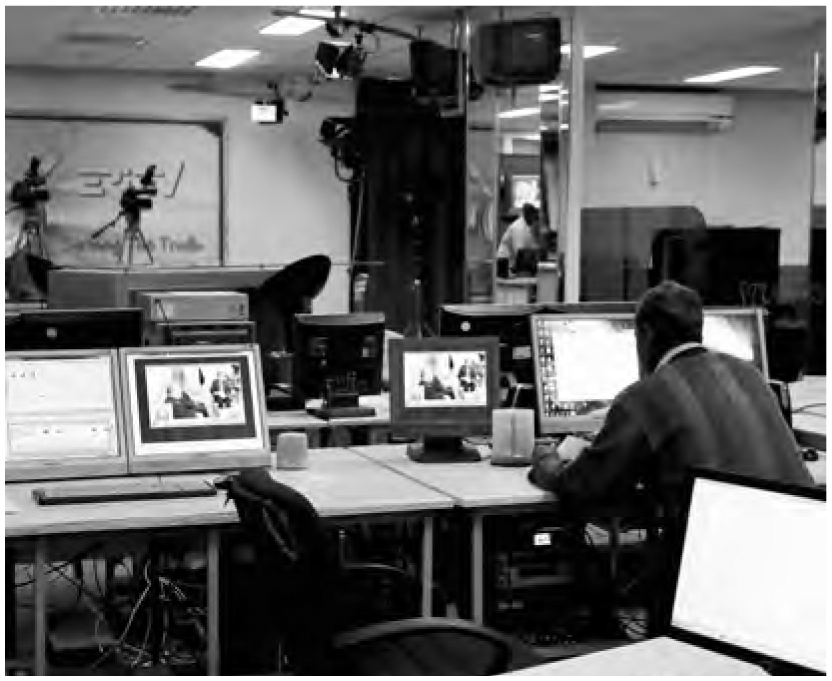
Newsroom at Eri-TV, a state-owned Eritrean television network run by the ministry of information and based in the capital, Asmara
CREDIT: (left) Reuters/ Thomas Mukoya, (right) Yonatan Tewelde
Eritrea currently ranks last (180th) in the Reporters Without Borders’ World Press Freedom Index. The Committee to Protect Journalists has called it the world’s “most censored country”.
I was young when independent newspapers still operated in Eritrea, before they were banned in 2001. I was an active contributor to one of them, Zemen, during my last year of secondary school. The editor-in-chief, my mentor Amanuel Asrat, had promised me a job when I finished my journalism degree, but he was jailed before I graduated and never heard from again. The prospect of independent newspapers ever reopening seemed highly unlikely, so I started a weekly column on the government newspaper, Had-dass-Ertra, in April 2003.
My column, entitled Today’s Agenda, sought to communicate certain messages at a symbolic or abstract level while covering literature, philosophy, arts, youth, politics and issues of governance. Somehow, I managed to continue the column for three years, walking a delicate tightrope between being deliberately vague and incorporating the Eritrean context.
I learnt to follow the same basic routines. The editor – who was known for his loyalty to higher authorities – would ask me what I had written about and I would summarise the content, emphasising whatever angle was favoured by the newspaper. If I was quoting world figures, I’d qualify the material by stating: “The writer is disfavoured in the West.”
Every week, when I brought in my latest article, my editor would only mention the previous week’s article if it had contained something that had irritated or angered the authorities. (Otherwise, I never received any feedback through all the years.) His implied message was: “I have family to look after so do not get me in trouble.”
Out of the 16 A3-size pages of the government daily (including two pages for classified ads), only the first three pages discussed issues related to Eritrea, and these articles were invariably dry and filled with clichés, such as longwinded pieces about a new dam project and how this proved Eritrea was progressing despite what the West might say.
The rest of the stories were either translated international articles that had little relevance to the country, or others, like my column, that stealthily sought to communicate ideas without drawing attention from the bosses.
If journalists stepped out of line, even slightly, they faced arrest and would only be allowed to resume their work after being “rehabilitated”. Information Minister Ali Abdu was also sending journalists to be jailed in army prisons, the most brutal in the country. The ministry of information had also introduced a very convoluted payment system that required freelance journalists to visit 13 offices in two ministries to collect their fees.
For a long time I played safe. I was getting along well with the editor-in-chief and was valued as a prolific journalist who was available in emergency situations. This was until the newspaper published a letter that attacked my column, saying it was undermining Eritrean society. Knowing the system, I realised it was a warning.
I was fairly certain the complaint had come from Information Minister Abdu. In my three years at Haddass-Ertra, I never had any personal contact with Abdu. I never approached him for a favour or approval, which was no doubt an unforgivable offence in his eyes. I was quite aware of his reputation for reading and approving all local news, and monitoring international news with an almost pathological fixation. I suspected he did not appreciate my articles. So the day after I read this letter, I handed my resignation letter to the editor-in-chief.
Abraham T. Zere worked for years as a journalist in Eritrea. His mentor was jailed and never seen again

Subsequently, Abdu’s dissatisfaction with my articles became evident after I started writing for the ruling party’s magazine, Hidri, which was not under his control. Twice he attacked me in the national newspaper and identified me as a security threat.
My requests for permission to leave the country and take up a scholarship at a US university were repeatedly denied. I finally used my contacts to get approval for a study trip to South Africa in 2012 and from there travelled to the USA, where I remain today.
Information Minister Abdu also fled Eritrea in 2012 and sought political asylum in Australia.
“The ministry of information is a dead in-stitution on funeral procession,” said Abraha in his radio interview in Tanzania. Meanwhile, Eritrean journalists live in perpetual limbo.