



Abstract

European journalist
These stories glorify high-powered investigations and uncompromising watchdog journalism as if they were the norm. Actually, they are the exception. And whatever nostalgic souls may think, they have always been. In the 1970s, allegedly the golden age of critical and hard-hitting journalism, the Watergate investigation was an aberration, the outlandish enterprise of two rookie reporters on the Washington Post city desk. It was a “third-rate burglary”, Nixon’s press chief Ron Ziegler famously said and old hacks and erudite pundits’ first reaction was to nod in assent.
This rule continues to this day. Conventional news hierarchies regularly lead the media to sideline or underrepresent people and communities whose voices are not heard, which goes against against the fundamental principles of public interest journalism, as stated in the 1947 Hutchins Commission on Freedom of the Press.
Although the media love seeing themselves as watchdogs, major stories of imperative public interest are often not properly investigated, depriving the public of crucial elements to judge and question authorities. Original, independent and groundbreaking reporting on the failures and potential risks of key infrastructures is the exception. While “the deeper mission of the press”, as US journalist Bill Moyers put it in a 2008 speech, “is to uncover the news that powerful people would prefer to keep hidden” top officials are often left off the hook while formatted spokespersons are sent to front for them and face the cameras. Here in Belgium, coverage of railway workers’ strikes or technical incidents is mostly limited to opposing partisan views – the union leader versus the company mouthpiece mixed with vox pops of angry passengers – without taking the time to assess or fact check contradictory arguments. Deep and sustained coverage on rail safety only occurred when a dramatic train collision in Buizingen, close to Brussels, resulted in 19 deaths on 15 February 2010.
The underreporting of Belgium’s ailing nuclear industry is another example of a form of journalism excessively focused on breaking news at the expense of long-term investigations. When earlier this year Germany, the Netherlands and Luxembourg expressed their concerns about Belgian nuclear plants’ safety, Belgian media mostly took their statements as an opinion instead of actively using them as sources of information to be doggedly dug into and researched. The detailed work, the graft and the grind that takes days, is just not being done, or at least not often enough.
“Some stories are not even touched because it would take too much time and distract us from the buzz-feeding machine. We are less and less able to add value to our reporting”, a frustrated political journalist told Index, asking for anonymity because she feared reprisals for her critical comments. But this pressure does not come only from the top. When I was an editor-in-chief I often had to battle with the newsroom and push back against blasé reporters grumbling that “we did that story already”, although it had been buried in a paragraph deep into the magazine, or “it did not interest our readers at all”. These attitudes from reporters tend to mean that they think it would require too much work or carry too many risks of upsetting cosy relationships.
Decisions by newsrooms or individual reporters should be to master the news agenda instead of servilely following it, to decide what is important and what should be covered and investigated, instead of just reacting to breaking news. In the US, for instance, the press has prospered in times of turmoil and anger, such as in the early 20th century when reformist politicians Theodore Roosevelt and William Howard Taft converged with muckrakers Ida Tarbell or Lincoln Steffens to challenge the robber barons and corrupt urban political machines. It bloomed in the 1930s and 1940s during the Great Depression and World War II, with I.F. Stone at The Nation and Michael Straight at The New Republic. It surged again in the tormented 1960s and 1970s, with its civil rights, Vietnam war and Watergate controversies.
Journalism has moved towards churning out stories without leaving the office
CREDIT: iStock/KatarzynaBialasiewicz
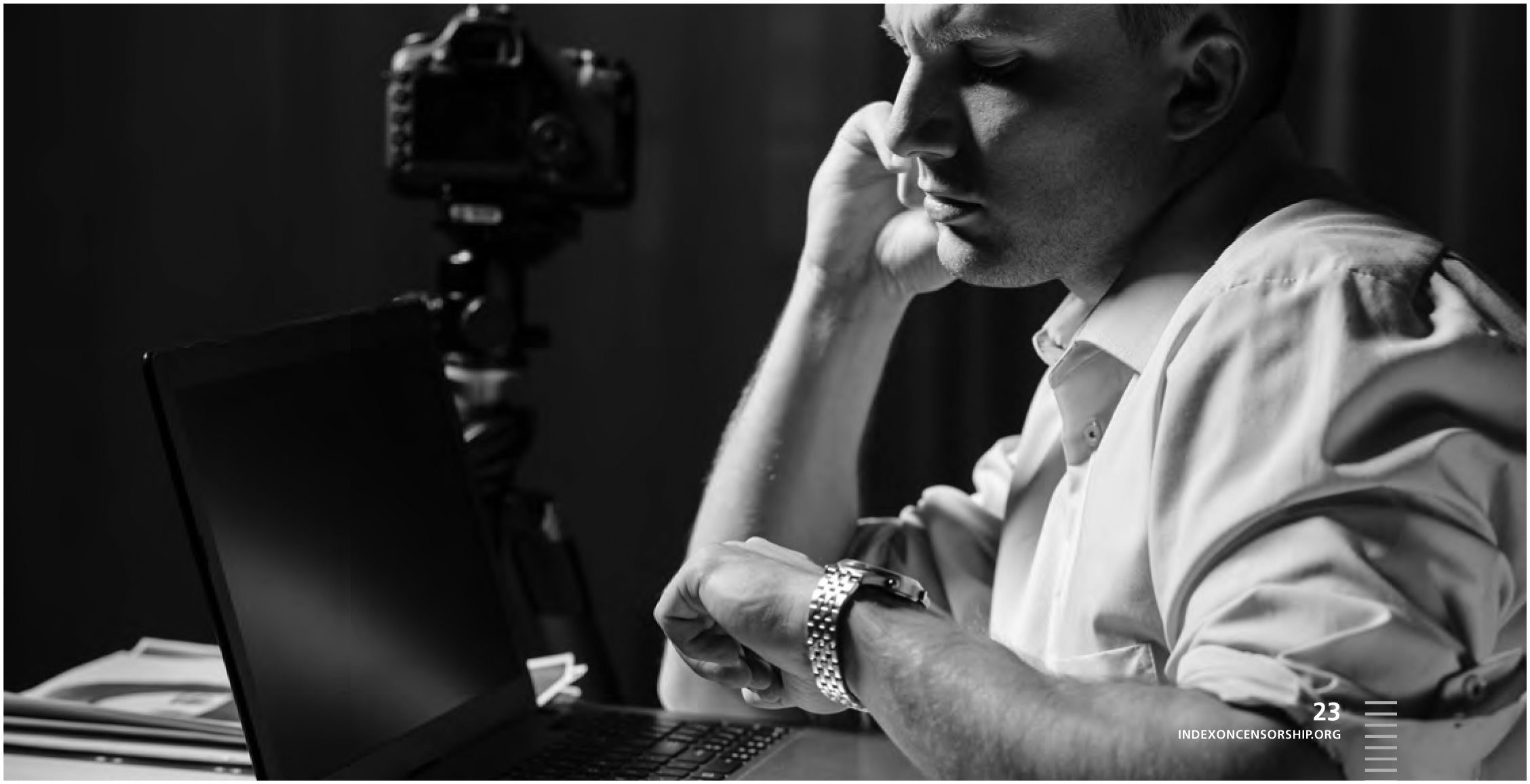
“The reality is that most journalists at most newspapers do not spend most of their time conducting anything like empirically robust forms of evidence gathering,” write the authors of the 2014 Tow Center report on Post-Industrial Journalism. The report said: “The belief in the value of original reporting often exceeds the volume at which it is actually produced.” However, original reporting on issues of public interest defines journalism’s role in society: its claim must be not to let its agenda be determined by spin doctors or powers-that-be, its ambition must be to act as a steward and an arbiter in the confusing carousel of news.
According to a recent report by the Reuters Institute for the Study of Journalism, “Twice as many UK journalists believe that their freedom to make editorial decisions has decreased over time as believe it has increased.” The report argues,“this could be a result of the increasing influence of audience research and pressure to ‘keep up with the competition’, with negative consequences for the diversity of news output.” As Doug Underwood wrote in his book When MBAs Rule the Newsroom, during the 1980s and 1990s a drift towards more infotainment and soft news accelerated – and many journalists fell asleep. On the eve of 9/11, “The big news stories were about shark attacks, wildfires and a missing Congressional intern named Chandra,” said ABC News. “By the summer of 2001, few had ever heard of al-Qaeda or Osama bin Laden.”
The 2007-8 financial crisis also came as a shock because, as Dean Starkman, the editor of Columbia Journalism Review, wrote in his 2015 book, “The watchdog did not bark.” The indicators of a major crisis were blinking but most journalists did not look behind the boosterism of Wall Street celebrities. The same pattern repeated itself in other countries, especially in the field of terrorism: in France or Belgium most media were caught unaware, and their confusion while covering breaking news reflected a systemic under-investment in the serious and sustained reporting of issues of public interest.
The rise of internet and social media has compounded these trends. On 2 May at a talk at the Naumann Foundation in Brussels, Wolfgang Grebenhof, the vice-president of German journalists’ association Deutscher Journalisten-Verband described a media landscape dominated by under-staffed, overworked, under-funded newsrooms increasingly barred from seriously reporting on matters of public interest. “There are less and less people working and less and less money to do good journalism,” he said. Staff reductions have indeed been brutal in many media organisations while the diversity and complexity of subjects, and the multiplicity of platforms have substantially increased. The Reuters Institute report states: “UK journalists typically produce or process ten news items a week, although that number doubles for journalists who work exclusively online.
A still from the film Spotlight, which tells the story of the Boston Globe newspaper’s exposé of child sex abuse in the Catholic church
CREDIT: Everett Collection/REX/Shutterstock

“A large majority believe time for researching stories has decreased and the influence of profit-making pressures, PR activity, and advertising considerations has strengthened.”
“With reporting resources cut to the bone and fewer specialised beats, journalists’ level of expertise in any one area and the ability to go deep into a story are compromised,” the Project for Excellence in Journalism warned in its 2013 report on the state of the news media, while in an increasingly globalised and complex world, the need for serious journalism has never been more acute. How does the press cover the Byzantine European Union, which contributes significantly to its 28 member states’ legal systems and economic rules? How does the public get reliable and meaningful information with fewer specialist reporters who actually understand the material that has been made public?
This de-specialisation means that the balance between newsmakers and news reporters has tipped in favour of public and private powers. “Knowledge is essential to cover an issue seriously. If not, you are vulnerable to spin doctors and shoved between half-truths, the ‘he said/she said’ trap,” said Anne-Marie Impe, a Belgian journalist who for one year enrolled in, and graduated from, a school of retirement home management, before publishing a few months later a 14-page article on this particularly knotty issue.
The atmosphere has also become more uncertain for journalists tempted to cover corruption in high places. Ricardo Guiterrez, general secretary of the European Federation of Journalists, said: “Journalists are increasingly worried about legal retaliation when they cover fraud or abuses in state institutions or private corporations. The legal costs are so high, even when you win in the courts, that many proprietors and reporters refrain from covering certain stories.”
On 18 November 2015 the launch issue of a new Belgian investigative magazine Medor was blocked by a court in Namur at the request of a pharmaceutical company which claimed that it had been wrongly accused in one of the articles. Even though a judge lifted the injunction on 11 December, citing the “long-term undertaking” behind this article and “the prohibition of censorship” it sent a clear message to would-be investigative reporters.
Alain Lallemand, Le Soir’s correspondent for the International Consortium of Investigative Journalists, said: “Journalism is framed by economic rules. In Europe a number of media don’t have the resources to dig deep. The media are also afraid of a backlash if they cover stories which hurt business interests or their own country. No Luxembourg paper took the lead on Luxleaks.” Self-censorship has become such a major challenge for journalism independence and integrity that the Council of Europe recently commissioned a European survey which will be based on the interviews of 1,000 journalists in its 47 member states.
The digging up of difficult and demanding stories will not come from insecure and stressed journalists in strained commercially driven media.
But there are rays of hope; a growing awareness in crucial parts of society that the watchdog role of journalism is essential to good governance and democracy. New projects have emerged inside and outside of journalism, in the business and non-profit sectors. Foundation money has been flowing to new reporting initiatives, like ProPublica and the Marshall Project, devoted to covering issues of major public interest neglected by the mainstream media. And, as Alain Lallemand said, “the media which took part in the Panama Papers knows that this project has been beneficial to their sales and, above all, their name branding.” In other words, there is an economic argument to run such stories which go behind the scenes of the theatre of news.
There is a political argument too. “The present crisis of Western democracy is a crisis in journalism,” Walter Lippmann wrote in his 1920 essay Liberty and The News. That idea still resonates. In the last decades the traditional checks and balances have been gravely undermined by European integration, globalisation, hectic technological developments and, in many countries, the sagging powers of trade unions, which have lost membership and influence, or of national parliaments, which have been sidelined by the executive and by EU bodies. And the press, as a Fourth Estate, has also been affected in its capacity to do critical reporting. However, journalism seems to be much more resilient than other institutions. A growing number of voices, breaking ranks with “churnalists” (see sidebar) and noise makers, claim that “journalism matters” and are engaging in its reconstruction. Even if it is being done outside of conventional media houses.
Risking reputations
Pressure to churn out stories leaves some young reporters fearing mistakes could cost them their careers, writes
Young British journalists are not blind to the financial risks they are taking as they try to bat off the competition and wedge their foot in the door of the office of whichever editor will take them. Unpaid internships, job insecurity and low salaries – some local newspapers pay only the legal minimum wage for trainees – are the reality for most young writers.
Standing up to an editor is harder than it has ever been for fledgling reporters, according to Alex MacDonald at the National Union of Journalists, and the lack of job security plays a large part in this.
When Peter Oborne resigned from his position as chief political commentator at the national newspaper, The Telegraph, last year, MacDonald said he was impressed by the journalist’s firm moral stance. Oborne left after condemning a perceived lack of critical coverage of the HSBC bank, one of the paper’s key advertisers. But MacDonald, a 26-year-old journalist who is a volunteer activist on the NUJ’s National Executive Council, worries that younger journalists wouldn’t be able to stand up to editors on ethical issues. He told Index it is “very difficult” for journalists still building a reputation if the choice is between writing a report “which makes you feel dirty” and “being out in the street with no job”.
Oborne agrees with the analysis: “It is right to say a young journalist couldn’t do what I did. This is partly because almost nobody knows or cares who they are, but mainly because it might wreck their future career.”
He added: “I was only able to do what I did at The Telegraph because I was old and smelly.”
Since 2005 the NUJ has been pushing for the introduction of a conscience clause in journalists’ contacts with their employers. This would give journalists the right to refuse unethical assignments and would introduce contractual protections to prevent journalists being fired for taking a moral stand. Such an amendment has still not been made to the Independent Press Standards Organisation’s editors’ code of practice.
The demands of “churnalism”, the high-speed repackaging of press releases and wire stories with little time for fact-checking or additional research, are creating risks for young journalists, who find themselves pumping out ever-increasing volumes of content (see main story).
A 2016 report from the Reuters Institute for the Study of Journalism revealed that despite working longer hours – 38% of journalists say working hours have “increased a lot” in the past five years – 86% feel they do not have enough time to work on their stories. According to the authors of the study, some reporters are writing, processing or editing between 50 and 75 stories a week.
Getting a foot in the door of a news organisation is extremely competitive. The estimated number of workers who describe themselves as journalists fell by 6,000 in the two years to June 2015, according to the government’s Labour Force Survey. National newspapers are also struggling to survive in the digital age. The Independent closed its print version in March. In the same month, The Guardian Media Group announced that it will be cutting 100 editorial jobs.
Tom Slater, deputy editor of online political magazine Spiked, emphasises the importance of staying true to the profession’s core principles. He said these are, “good solid writing, objective news reporting and having an editor”.
Slater attended and now teaches at the Young Journalists’ Academy, a free summer school for state-school students in London. Its focus is on instilling core principles in journalists at an early age. “We don’t just teach the students skills,” said director Viv Regan. “More and more now we teach them the first principles of good journalism.” Foremost among these is the need to protect a free press.
The real struggle is coping with the thirst for quick content and managing the risks that this brings. In past work experience, London-based journalism student Peter Yeung has experienced pressure to turn out stories at a rate of one per hour, “including stuff about dogs and big whales,” he said.
“Inevitably people make mistakes on such short deadlines,” said Yeung. “It’s not really journalism at some points. Sometimes you have to put your reputation on the line.”