




Abstract

Marie Colvin’s outstanding career as a foreign correspondent ended when she was killed in Homs in 2012. Award-winning journalist
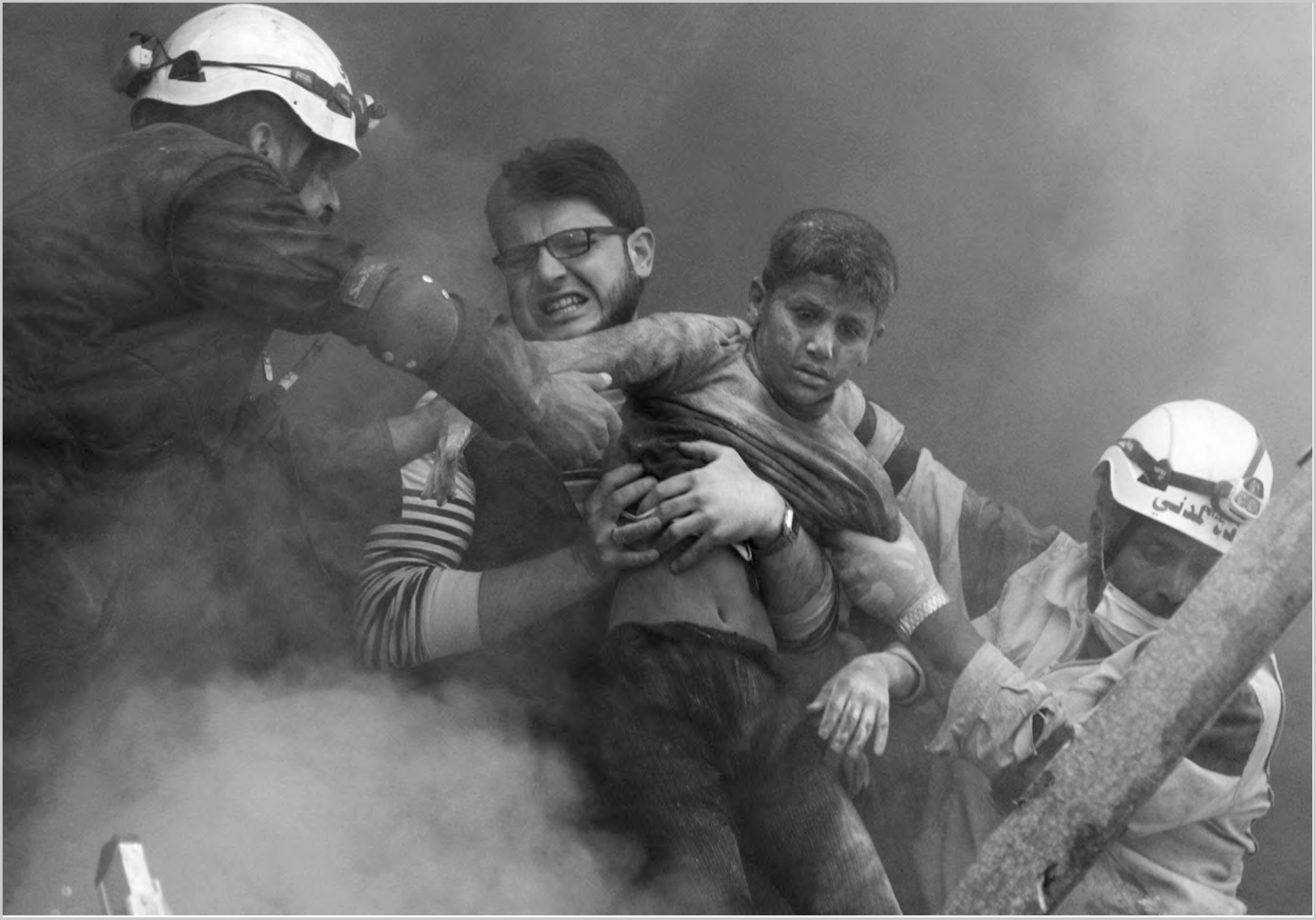
Men rescue a boy from under the rubble after explosive barrels dropped by forces believed to be loyal to Syria’s President Bashar Al-Assad, in the Al-Shaar neighbourhood of Aleppo in 2014
CREDIT: Hosam Katan/Reuters
I understand what she meant: old-fashioned journalists like us put a premium on being there, rather than sitting in a newsroom piecing together bits of footage uploaded by activists and journalists more daring or foolish than ourselves. Yet we have to acknowledge the power as well as the limitations of this new kind of reporting.
At Channel 4 News we employ a Lebanese journalist who is a specialist in sourcing video. He knows who uploads the pictures of barrel bomb damage, who destroyed hospitals in Aleppo, who to Skype for a reliable account. Marie might have sniffed, but it’s become an integral part of our coverage – in early May the inmates of Hama prison were filming with their mobile phones and sending out pictures even as government forces tear-gassed them.
It was compelling television, yet left many questions unanswered. The Hama prisoners showed the army about to attack, but not the guards they had themselves taken hostage. We knew their demands, but little of the background – and we weren’t there to probe further.
As Western media organisations cut costs by slashing foreign bureaux, and succumb to pressure constantly to update online, the temptation is to pull it all together in London or Paris or New York rather than venturing out. Danger forms another part of the calculation. Kidnap and beheading is the most extreme form of censorship. In Syria, US photojournalist James Foley was murdered in 2014, several European journalists were later kidnapped and ransomed and the British photographer John Cantlie is still held by IS.
Yet, whatever the risks, in the end being an eyewitness will always be the most honest form of journalism. It is still essential. In Rwanda, in 1994, I watched as the genocide unfolded around me. I reported what I saw: the drunken red-eyed men with machetes at the roadblocks, the blood running in the gutters. And what I heard: Rwandans calling me up to describe how the murderous gangs were banging on their doors and breaking through their windows. There was no substitute for being there.
More recently, travelling on a Syrian government visa, I was among the first journalists to visit the ancient city of Palmyra after regime forces took it back from IS. Beyond the normal journalistic enthusiasm to get to where the story was happening, I feared being used for propaganda. But in fact we were able to move reasonably freely. I could see – and the cameraman could film – the destruction that IS had wrought on the ancient city, and the parallel devastation that government and Russian forces had wrought on the adjacent, modern town of Tadmur. We even managed to film government troops looting people’s houses. None of this could we have seen or understood if we had reported long-distance.
In a speech at London’s St Bride’s Church, often a hub for journalists, in 2010, Marie said: “We always have to ask ourselves whether the level of risk is worth the story. What is bravery, and what is bravado?”
That is a difficult question. Few mainstream news organisations are willing to let their journalists cross the border from Turkey into Syria these days, because the risk of kidnap is so great. Most editors now understand that they should not buy material from freelancers in places where they would not send their own staff because of the danger.
It’s progress – there was a time when broadcasters and newspapers routinely used freelancers without taking any responsibility for their safety. But it means we are left with the information from prisoners in Hama and citizen journalist reports from Aleppo – better than nothing, filmed by brave people, but frequently incomplete, often confusing, biased, not always easy to interpret.
In February 2012, Marie and photographer Paul Conroy crawled through a sewer to get to Homs, as the Syrian regime’s bombs turned the buildings of rebel-controlled Baba Amr to burnt-out carcasses and rubble. In her dispatches, Marie described the makeshift beds on which children slept underground to avoid the bombs, the operations without anaesthetic, the despair of people who felt they had been abandoned by the world. It was classic, old-fashioned eyewitness reporting.
On 22 February, a government mortar shell killed Marie and the French photographer, Rémi Ochlik. Conroy and the French reporter Edith Bouvier were seriously injured.
Marie felt she had a responsibility to report; she refused to leave it to YouTube. Yet, on this occasion, the risk was too great. Was she brave, or – in her own words – was it bravado? Either way, we are all the poorer because Marie Colvin is no longer reporting from Syria.
Weighing up reporting risks
How important is the story? Are we well placed to do a good job of covering it, or are others already doing it well, and in a way that is relevant to our journalistic mission? How important is the presence of our reporters on the frontline in order to get the story we want to tell? Do the people we intend to send have the skills, experience and equipment they need to safely operate in the area in question? Do we have a clear risk mitigation framework? Do we have resources in place to manage risk? Have we provided adequate insurance cover?
Our responsibility to cover dangerous places is in tension with our responsibility for the safety of our people. The only way we can manage that tension is with the help of a clear set of guidelines governing conflict coverage, backed by adequate resources.
These vary with the story, but include communication with the actors in the conflict (security forces, armed groups) and working with local networks, training, limiting frontline exposure. We have recently ordered bulletproof gear, which we did not previously have.
Training is critically important, and I am sorry to say, all but absent outside of the rich world, as is good protective gear and first aid kits for reporters.
Yes. In cases where I thought the risk of serious injury or death could not be adequately mitigated by training, equipment, or other measures we might be capable of providing, I have elected to change the assignment.
Syria, Yemen, Central African Republic.