




Abstract

From a new multimedia project for young people to debate freedom and liberty, to a fundraiser for persecuted musicians,
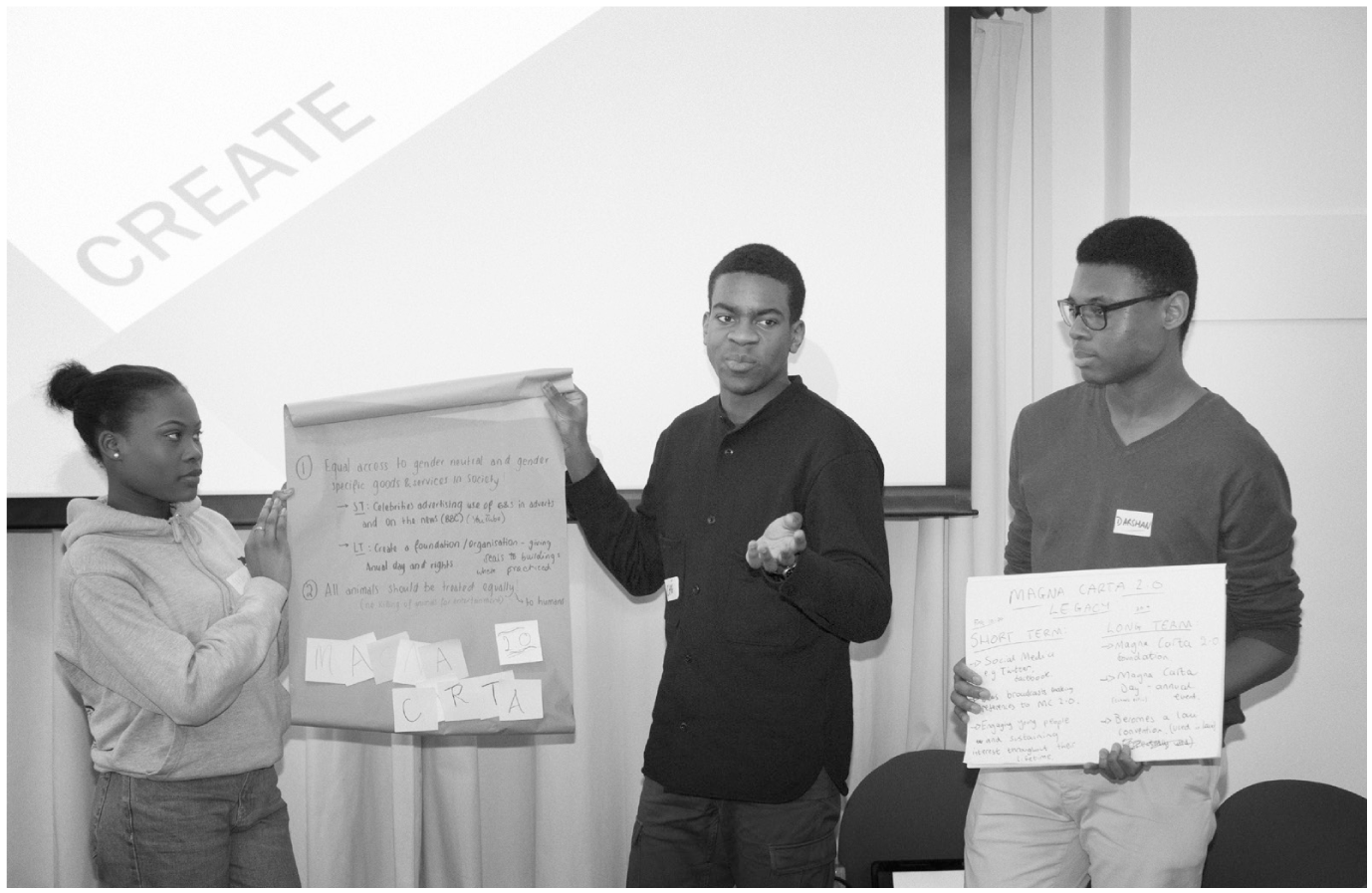
Helen Galliano, producer of What a Liberty!, said: “This five-month project is a fun and innovative way for young people to interact with this ancient document and find out its relevance today. We will be giving the group a platform to discuss freedom and liberty and their ideas of what that means.” Seventeen participants have been shortlisted to receive digital, film and editing training to help them create their own Magna Carta 2.0, a multimedia work inspired by their debates. The 17 also travelled to see one of the oldest copies of the Magna Carta at Lincoln Cathedral, as part of this Heritage Lottery-funded project. Later in the year, they will visit schools and youth groups around London to talk at about their findings.
After the first session, one of the participants, Alisia Usher, 16, said: “It was nice to articulate my ideas about these issues and hear other conflicting ideas, and to compare them to others from my age group. It’s good to be working on a new Magna Carta as you get to see what is important in society.”
Earlier in the year, Index on Censorship magazine celebrated the launch of its What’s the Taboo? special issue, with a debate at the Royal Vauxhall Tavern, London. Special guests included comedians Shazia Mirza and Grainne Maguire, film historian Kunle Olulode, and consultant Max Wind-Cowie, who went head to head on tricky subjects, including suicide and grief, mental health, sex and racism.
Participants in Index’s What a Liberty! workshop, Sarah Michaels, Che Applewhaite and Darshan Leslie, presenting their ideas
Credit: Sean Gallagher/ Index on Censorship
After joking how a mental illness is almost a requirement to be a stand-up comedian, Maguire told the audience: “In certain careers you’re supposed to be macho and mental illness is still seen as a sign of weakness. I just think that’s really depressing and sad. I think you should be allowed to be vulnerable, but I don’t think we are there yet.”
Dealing with offence on social networks was the main talking point at the latest meeting of Index’s youth advisory board, with concerns raised about who bans accounts and how regulation could be misused.
The group hold monthly online discussions to debate current freedom of expression issues from a global perspective. The eight members, from countries all over the world, including Brazil, Germany and Kenya, will hold their seats on the board until June 2016. Applicants for the next six-month intake are encouraged to apply via Index’s website, which also has full biographies of the current board. Members include Mariana Cunha e Melo, an associate lawyer in Rio de Janeiro; Emily Carlotta Wright, an independent filmmaker and journalist working on a film in Bogotá about Colombia’s disappeared; and Ephraim Kenyanito, who is a policy fellow at AccessNow.org in Kenya.
Index’s Mapping Media Freedom project, which tracks media violations across EU member states and neighbouring countries, was upgraded in January and now has an alert feature, so users can receive updates themed by country or type of attack. For example, you could receive an email each time a threat is reported against a female journalist in Germany, if you choose those as your alert terms.
MMF’s quarterly report, released in February, showed that 518 people had lost their jobs at both public and private media outlets across Europe from October to December 2015. Around 188 of these positions were lost in Serbia following the closure of Tanjug, the country’s largest public broadcaster.
Far-right, anti-Islam group Pegida was also highlighted in the MMF report as a growing concern. German journalists have faced rising hostility when covering protests organised by the group. Reports submitted to the mapping project showed cases of assault and equipment being damaged.
In February, MMF project officer Hannah Machlin attended Unesco’s conference in Paris entitled News Organisations Standing Up for the Safety of Journalists, where news editors and media leaders met to discuss best practice. Machlin, who was also there to talk about MMF, said: “One of the talks I attended at the conference was about the ongoing cases of impunity. During this meeting one of the panelists argued for tougher pressure on governments to create economic burdens on countries who are not punishing perpetrators for their crimes against journalists.”
Index is now also part of the Council of Europe research project Journalists At Risk: Part of the Job? The project will launch a survey to gather qualitative and quantitative data about issues, including journalist safety and what leads to self-censorship.
Also in the past few months, Index’s magazine editor Rachael Jolley spoke at the Swedish Library Association Libraries and Democracy conference about why libraries play an important role in giving people a conduit to knowledge, both online and in print.
And as part of Index’s work to help musicians in exile, a special screening of They Will Have To Kill Us First, a documentary about persecuted musicians in Mali, was held at the Bulgari Hotel, London. The event helped raise money for Index’s Music In Exile Fund, which was launched in October in partnership with Index and the film’s producers, and will help a musician or group who are unable to play safely in their homeland.
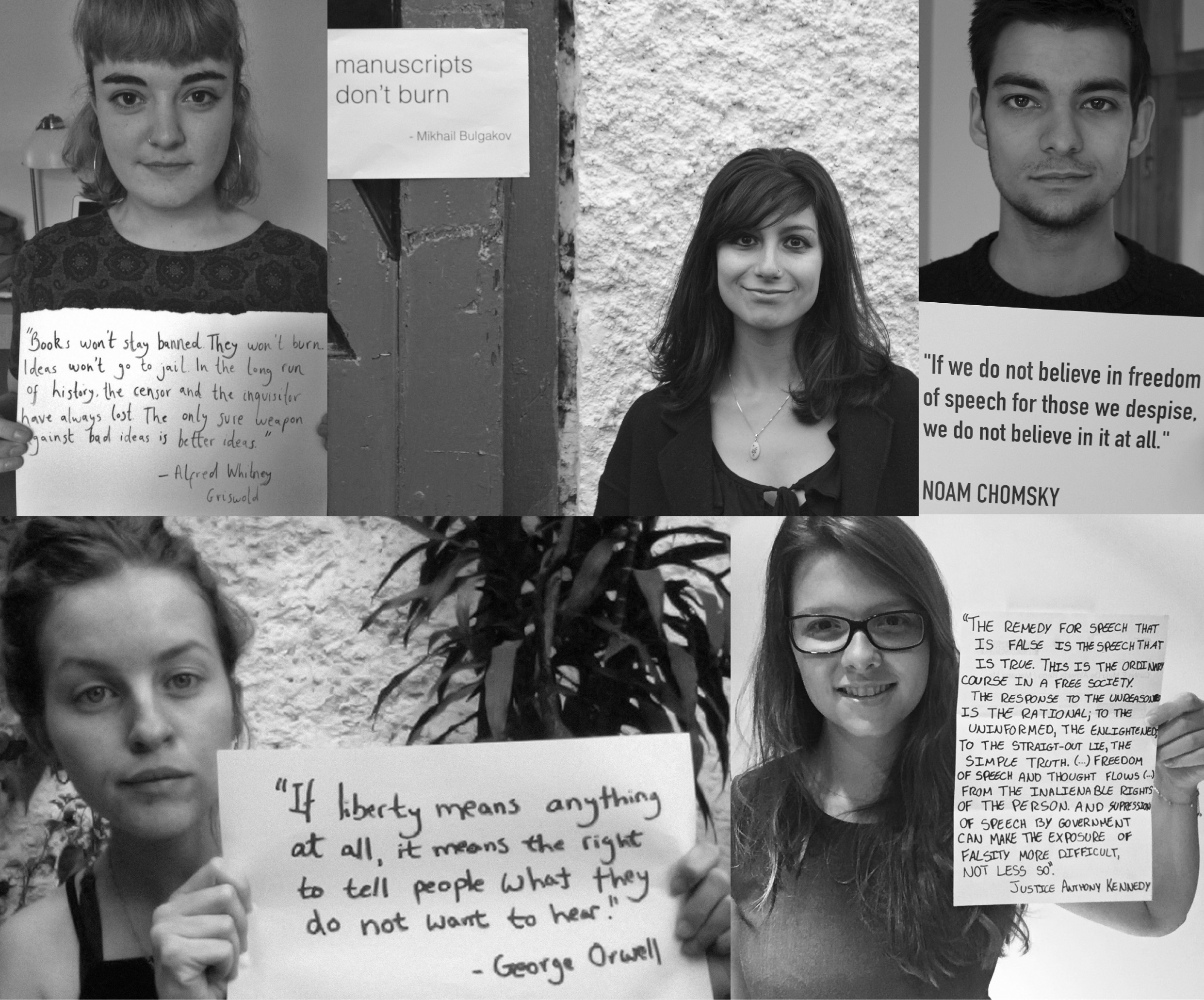
Members of Index’s youth board Madeleine Stone, Layli Foroudi, Simon Engelkes, Mariana Cunha e Melo and Emily Wright (left to-right clockwise) with posters saying why freedom of expression is important to them
Lastly, the Index on Censorship Freedom of Expression Awards will be announced this year on 13 April at a gala evening at London’s Unicorn Theatre. Female stand-up comedian Sakdiyah Ma’ruf, from Indonesia, and GreatFire, an organisation that tracks China’s censorship, are among the nominees. More than 400 nominations were narrowed down to 20 for the 2016 shortlist, which celebrates the courage and creativity of those tackling censorship and fighting for freedom of expression around the world. The winners will also become part of Index’s Awards Fellowship programme, which offers longer term, structured support. To shortlist the last 20 nominees, the first-ever, multi-location judges’ breakfast was held. UK-based judges were able to join others online from Bahrain and Lagos – including former Index award winner Nabeel Rajab, who is currently under a travel ban from the Bahraini authorities and unable to leave the country.
Ahead of the awards gala, last year’s arts category winner, Moroccan rapper and human rights activist Mouad Belghouat, aka El Haqed, told Index what he’d gained from winning his award in 2015. He said: “Through Index, I met many great people from all over the world who share the same principles as me, and word of my case has spanned the breadth of the world.”