




Abstract
When academic
In public statements, the university maintained that it took issue with the tone, not the content, of the tweets, that the problem was Salaita’s lack of civility, but he thought otherwise. Charging breach of contract and violation of his free speech rights, he sued the university the following January. Index reported on the case in Stifling Freedom, (vol. 44, 2: pp. 20-25).
After being jobless for that turbulent year, Salaita currently holds the Edward W. Said Chair of American Studies at the American University of Beirut. He was still bemused by the tumult as he spoke with Index. “Now, being back at work, I go to department meetings, I go to lunch with my colleagues, I teach class, grade papers, I think, man, they were worried I am dangerous? I’m absolutely harmless.”
In reaction to Salaita’s firing, scholars boycotted the university and the American Association of University Professors voted to censure the university. In August after a court upheld Salaita’s lawsuit, the chancellor and the university’s top administrator resigned.
Finally last November the legal case was settled with a reported $600,000 payout. Although Salaita relinquished any claim to his promised job, he said, in a prepared statement. “This settlement is a vindication for me, but more importantly, it is a victory for academic freedom and the First Amendment.”
While the final resolution may come this June, when the AAUP revisits its previous censure decision, this argument, like many over what can and cannot be said, was a stand-in for a deeper tension, namely the relationship between what teachers profess as private citizens and what they teach in the classroom.
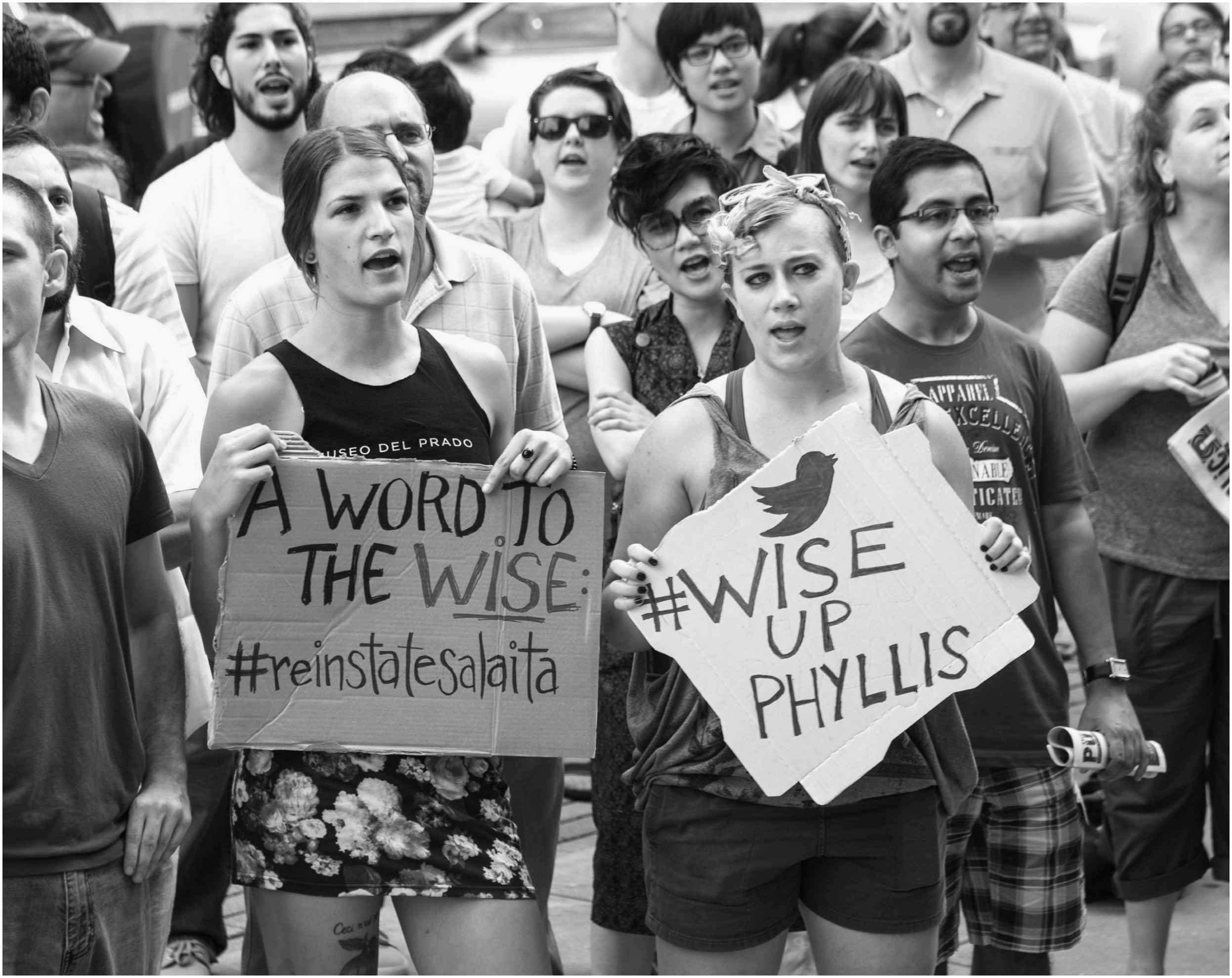
Protesters at the University of Illinois at Urbana-Champaign campaign against the firing of professor Steven Salaita. Academics also voted to censure the university. The university’s chancellor, Phyllis Wise, sent a mass mail to students, defending the decision and saying classrooms need to be safe spaces
Credit: John Dixon / AP / Press Association Images
Salaita, an American of Jordanian and Palestinian heritage and an organiser of the Academic and Cultural Boycott of Israel, finds the teaching and attitude towards academic freedom at AUB similar to that at the US universities on which it’s modelled. “Once inside the classroom the same set of dynamics prevail,” he said.
In his classroom, the dynamics include political discussions, but he explicitly urges his students to work out and defend their own ideas, rather than ascribe to a particular point of view. Still he likes to mix it up. “One thing I bring into the classroom is a desire to have interesting debate. I think students can handle rigorous discussion. In fact, I think they enjoy it and find it very useful. So in my classes, we tend to have something of a freewheeling set of discussions,” he said with a wry laugh. “But we always come in on friendly terms and leave on friendly terms.”
In response to Salaita’s firing, then UIUC Chancellor Phyllis Wise sent a mass mailing to the campus community called Principles on Which We Stand. She wrote that while debate is important, a classroom needs to be a safe space (which Salaita would not contest). She implied that his tweets would translate into intimidation and harassment of students holding opposing opinions. That, he argues, is nonsense; despite efforts to find evidence to the contrary, reviews of his teaching are said to be stellar.
What constitutes a safe space, however, is more complex than positive student evaluations. A classroom, as every student knows, is not a democracy, and even if a teacher doesn’t state his or her politics explicitly, they can usually be intuited. Students, in thrall to authority or out of eagerness to please or fear of reprisal, may feel pressured to agree or keep silent. So a professor’s speech inside and outside the classroom is probably never clearly separated. What is different now is that external speech acts are readily available for everyone to see and react to through social media.
Laura Markwardt, media and communication strategist for AAUP, wrote in an email, “In recent years we have found that faculty members are more frequently finding themselves in trouble for extra-mural speech disseminated on the internet, especially in social media.” This was Salaita’s fate. He continues to be a busy user of Twitter and finds it a liberating, but not trouble-free platform, given that passions of the moment are recorded there in perpetuity.
His tweets, he agrees, were intemperate and angry, as his detractors charged, because they reflected how he was feeling at the time. “How are we supposed to act in the face of injustice?” he asked. “Sometimes we need to articulate a sense of political anger in relation to injustice, and particularly in cases where we’re either directly or indirectly implicated.”
Still, Salaita has no difficulty distinguishing what he tweets from how he teaches. “The context of teaching and the context of commenting as a private citizen on Twitter are completely different,” he insisted. “I would never dream of speaking with students using the same tone and language and rhetoric that I would use on Twitter.”
Yet, as Salaita observed, “A speech act is never a neutral thing and how people react to a speech act is not neutral either.” This is at the heart of debates over what constitutes a safe space, the current cri de coeur, and one of Salaita’s on-going concerns.
He believes that any worthy instructor wants to create a rewarding learning environment where all students can speak freely without fear of being ridiculed, devalued or ostracised. And, he noted, the issue isn’t restricted to an individual classroom. “The idea of safe space, or student comfort, or trigger warning attaches itself to the idea of student empowerment and I think we need to be attentive to what they want to achieve without being dismissive and find ways to make it jive with our responsibilities as educators.”
The problem, as he sees it, arises when an emphasis on safety – or civility – is used by administrators, and sometimes unwittingly by students to limit or invalidate ideas, perspectives, or pedagogy. In Uncivil Rites, Salaita’s recent book about the UIUC controversy and its fallout, he writes, “[Civility] is the pretext of the oppressor”. Expanding on the idea now, he said: “Civility as maintaining professional decorum is deeply important, but that’s not how upper administrators use it. There is something discomfiting about the articulation of politics that are at least tacitly tied into the maintenance of normative viewpoints and hierarchies.”
“This”, he concluded, “is my beef with the term civility.”