




Abstract

At a time when many countries are phasing out blasphemy laws, in Ireland a similiar move is low on the political agenda.
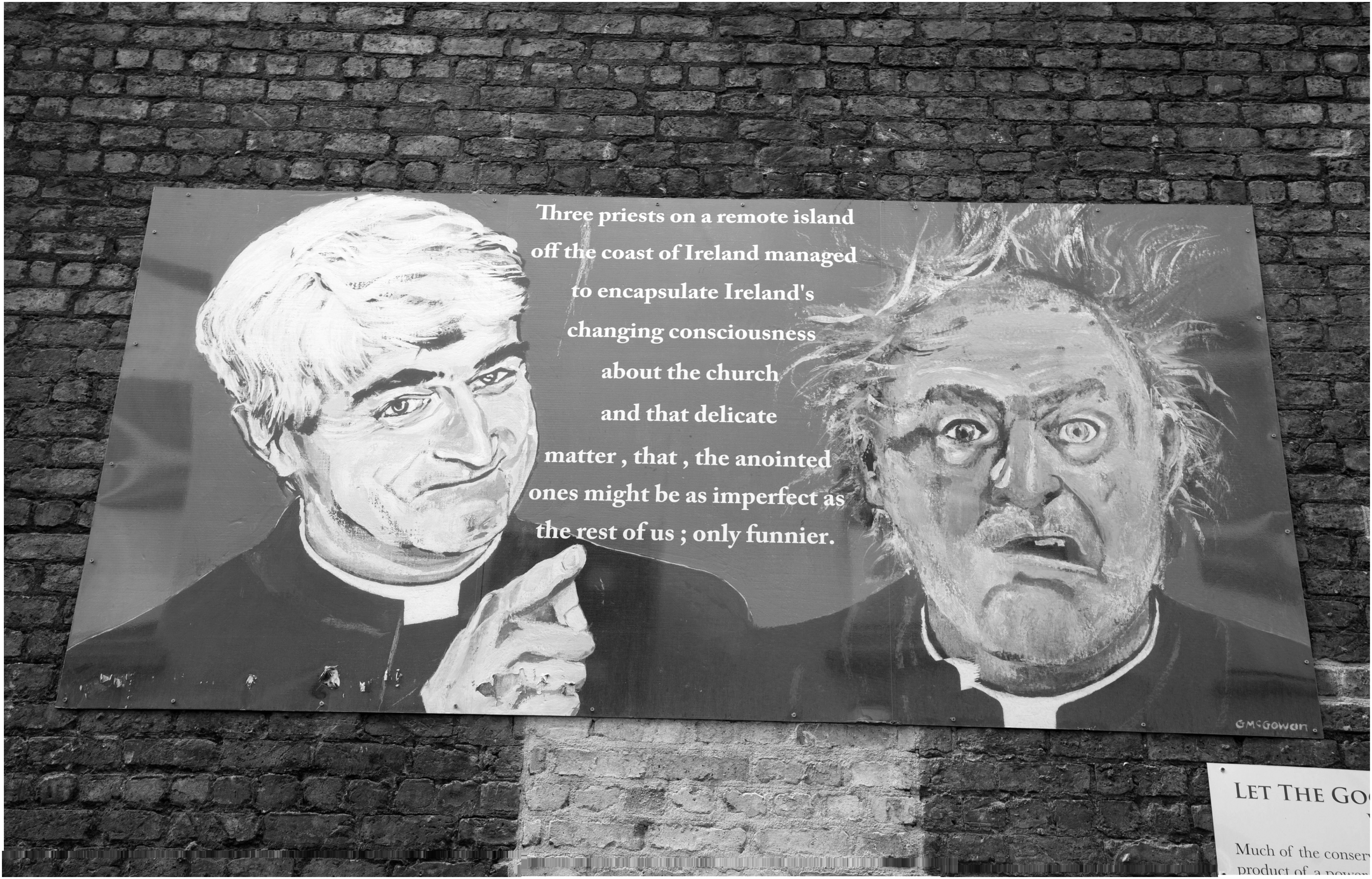
Dublin artwork inspired by 1990s television comedy series Father Ted, which was about a group of dysfunctional priests., and which offended some Catholic viewers. In 2014, RTÉ, Ireland’s public broadcaster, refused to show a comedy sketch, called Wild Nuns, which saw nuns oggling a semi-naked Jesus on the cross, as a parody of a Diet Coke advert
Credit: Kevin George / Alamy Stock Photo
The Proclamation of 1916, issued at the beginning of the Rising, set the tone for the church’s influence in the affairs of independent Ireland. “In the name of God,” it began. It was a marked break from that of 1867, in which the Irish Republican Brotherhood called for the “complete separation of church and state”.
A hundred years on, many of the hangovers from the days of church influence on moral matters seem to be disappearing in Ireland. Same-sex marriage was legalised in 2015 following a nationwide referendum, and opposition to the anti-abortion laws is growing. But the campaign against the country’s anachronistic blasphemy law has not yet picked up the same kind of momentum.
The government ruled out a referendum on the blasphemy law before this year’s general election, which was brought forward suddenly to February. With the new shape of the government still being discussed as Index went to press, it was unclear what will be debated this year. Outgoing Taoiseach Enda Kenny agreed, back in January 2015, that a referendum was needed; the government had released a statement, three months prior, saying they first had to find an “appropriate date” to hold it.
Back in 1937, when the Irish Free State was declared, Éamon de Valera – Ireland’s “founding father”, and the only 1916 leader not executed by British forces – set about supervising the drafting of a new constitution. Significantly, it included a clause stating that “publication or utterance of blasphemous, seditious or indecent matter is an offence … punishable in accordance with law”.
Michael Nugent, chairperson of Atheist Ireland, has been campaigning for more attention to be paid to the blasphemy law and its origins. He told Index why the constitution lagged behind the times in modern Ireland: “The 1937 constitution was, and remains, a Catholic constitution, effectively co-written by de Valera and the future Catholic Archbishop of Dublin, John Charles McQuaid. It not only enshrines the right to worship a god, but also the right of that god to be worshipped.”
The constitution’s clause on blasphemy paved the way for the Defamation Act 1961, but it has proved ineffective. The only attempt to prosecute anyone under it came when the Irish Independent published a cartoon inspired by the 1995 divorce referendum, showing three politicians waving goodbye to a priest handing out the Eucharist. The prosecution was unsuccessful as the act failed to provide a clear definition of blasphemy. In effect, the offence of blasphemy, while included in the constitution, was not really enforceable by law.
It would take almost half a century for this ambiguity to be corrected – not by abolishing the offence (which would require a referendum), but by clarifying it. The Defamation Act 2009 defined blasphemous material as “grossly abusive or insulting in relation to matters held sacred by any religion”, when the intent and result is “outrage among a substantial number of the adherents of that religion”. The offence still carries a maximum fine of €25,000 ($28,000).
The Defamation Act 2009 is the only blasphemy law introduced by a Western nation in the 21st century. But using blasphemy laws is not going out of style. Russia passed a similar law in 2013, which allows for up to three years’ imprisonment (Mission Creep, vol 42.04, p36), meanwhile reports from Croatia and Poland show (Fired, Threatened and Imprisoned, vol 44.02, p70) the rising influence of the church to influence government policy. The Irish law was implemented in spite of the Law Reform Commission’s opinion that “there is no place for the offence of blasphemous libel in a society which respects freedom of speech”. Even Dermot Ahern, the minister for justice who passed the law, described blasphemy as an “arcane concept”. So why introduce the act at all?
“The thinking seems to have been that it was unsatisfactory to have a provision of the constitution voided by legislative omission – which seems, from a strict rule of law perspective, to have some foundation,” said Eoin Carolan, a senior lecturer at University College Dublin and an expert in Irish constitutional law. “What was more curious was that the then government did not take the alternative option of seeking to remove the provision from the constitution by referendum, the justification being that a referendum would be too expensive.”
Nugent had another theory on the lack of action: “We’re so immunised to how ridiculous and silly the blasphemy law is that it doesn’t have the same effect on people as, say, the abortion issue.” Not that this has stopped Atheist Ireland from trying. In 2010, it established a campaign to challenge the law and tested it by publishing statements blaspheming all major religions. “If we had been prosecuted, we would have challenged the constitutionality of the act. But as we haven’t been so far, we argue that this undermines its credibility,” said Nugent.
Among Christians, belief in the law’s effectiveness appears to be waning, even if this has yet to translate into a concerted campaign to repeal it. At a Constitutional Convention in 2013, the Irish Council of Churches – speaking for all major Christian denominations in the country – declared that the constitutional ban on blasphemy is “largely obsolete”. “Most Irish Catholics don’t really think of religion anymore, except when it comes to rituals like weddings and funerals,” Arthur Mathews, co-writer of TV series Father Ted, told Index on Censorship. “As the Irish have largely moved into a liberal interpretation of religion, they are open to occasionally being the subject of satire.”
And yet, even as the Defamation Act is failing to inspire widespread protest among the Irish, it is setting an example for others abroad. The Organisation of Islamic States at the UN now cites Ireland’s law as best practice. The OIS is led by Pakistan, a country where Asia Bibi, a Christian woman, is awaiting execution for having drunk the same water as her Muslim neighbours and insulted the Prophet.
A law which punishes anything that causes “outrage” is all too open to abuse. If anything should shake the people of Ireland out of their complacency on this issue, it is examples of such abuse, whether at home or abroad. Just ignoring a law because no one is using it right now means you are forgetting that, one day, someone might.
Acts of faith: blasphemy laws around the world
Canada
Blasphemous libel (the crime of publishing blasphemous materials) is a criminal offence in Canada and perpetrators could face a prison sentence of up to two years, according to section 296 of Canada’s 1982 Criminal Code. The government’s last prosecution for blasphemous libel was in the 1930s, athough the law was invoked in private prosecutions as late as 1979.
Iceland
Until last year blasphemy was a crime in Iceland, with a maximum penalty of three months in prison. The rescinding of the law in July 2015 was supported by the Church of Iceland, but opposed by others, including the Catholic Church of Iceland, and the Pentecostal Church.
New Zealand
Blasphemous libel is criminalised in New Zealand (section 123 of the Crimes Act 1961). The crime holds a maximum prison sentence of one year, although there are no successful prosecutions under this law on record, only one failed attempt in 1922. The act also states: “It is not an offence against this section to express in good faith and in decent language, or to attempt to establish by arguments used in good faith and conveyed in decent language, any opinion whatever on any religious subject.”
Pakistan
Pakistan has one of the harshest blasphemy laws in the world, with prosecution carrying a possible death sentence (section 295 of the 1860 Penal Code). However, these laws could soon be reviewed as Muhammad Khan Sherani, chairman of a body that advises the government on the compatibility of laws with Islam, told Reuters in January 2016 he was willing to review the current penalties.
Saudi Arabia
In March 2014, the Saudi government furthered its harsh penalties for blasphemy, or apostasy – which already included a possible death sentence – by announcing new anti-terrorism legislation that defines atheism as terrorism. In May 2014, secular blogger Raif Badawi received a 10-year prison sentence, a fine of 1 million riyals (£175,000) and 1,000 lashes for insulting Islam and founding a liberal website; he has been detained since 2012.