




Abstract

With its arranged marriages, death sentences and bans on frivolity, Shakespeare’s Measure for Measure has new relevance if you replace the 17th-century Puritans with Islamists.
“
What, though, if a man like Malvolio were to be, not a servant, but a master, and provided with the reins of state? The question was to prove more than hypothetical: for by 1650, Puritans would indeed have seized control of England, and banned both plays and Christmas cake. Shakespeare himself, a couple of years after writing Twelfth Night, offered his own exploration of what Puritanism might look like if it came to power, when he wrote another comedy: Measure For Measure. The play is set in Vienna, and begins when its duke, temporarily abdicating, entrusts the rule of the city to Angelo, a man who – like Malvolio – makes an ostentatious display of his own virtue.
“Were he meal’d with that Which he corrects, then were he tyrannous; But this being so, he’s just.”
Yet Angelo does not prove just. Even as he presides over the clean-up of Vienna, a city rotten with syphilis and prostitution, he succumbs to the very lusts that he is punishing in others. Isabella, the sister of a man condemned to death for extra-marital sex, comes to him to beg for her brother’s life; and Angelo, overwhelmed by desire for this unexpected supplicant, attempts to seduce her. Compounding his hypocrisy is that Isabella’s chastity could not be more clearly advertised: for she wears the habit of a nun. The display of her purity, though, only excites the hitherto pious Angelo all the more. The bargain he proposes is an impossible one: her brother’s head in exchange for her maidenhead.
All along, though, the Duke has been secretly on hand to set things right. At the end of the play, he casts off the disguise he has been wearing for the past five acts, and exposes Angelo in his turn.
“I am sorry, one so learned and so wise As you, Lord Angelo, have still appeared, Should slip so grossly.”
Such a climax is, of course, very much in the grand tradition of English literature. From Chaucer’s Pardoner to Dickens’ Mr Pecksniff, many of its most memorable characters have been monuments to hypocrisy. Angelo’s downfall, though, does not raise much of a smile. Written at much the same time as Othello, a play which takes the tropes of comedy and transforms them into tragedy, Measure For Measure is a comedy shot through with a sense of the tragic. While Angelo’s hypocrisy is that of the theocracy that he aspires to impose upon Vienna, the city is left no less criminal and syphilitic for his exposure. “Like doth quit like,” the Duke declares ringingly at the end of the play, “and Measure still for Measure” – but the play is vastly more ambivalent than this implies. Between licence and order – or between liberty and repression, depending on one’s perspective – there can ultimately be no compromise. Society offers nothing but two rotten extremes.
The unsettling potency of this vision has not lost its ability to fascinate modern audiences, who, rather than being put off by the status of Measure For Measure as one of Shakespeare’s “problem plays”, have tended instead to revel in it. Nevertheless, it is hard to avoid the suspicion that its impact, in countries where theocracy is no longer a viable prospect, and permissiveness has been enshrined almost as a moral good, stands somewhat diminished. What, though, if its setting were to be transferred from Vienna to a city in the Middle East – one where playboys drive their sports cars past Islamists yearning for sharia? Isabella, whose defence of her chastity can often make her appear neurotic and unreasonable to secular audiences, would seem altogether more convincingly agonised as a hijabi.
Isabella (Mariah Gale) pleads with Angelo (Kurt Egyiawan) in a 2015 performance of Measure for Measure at London’s Globe theatre
Credit: Rex /Shutterstock
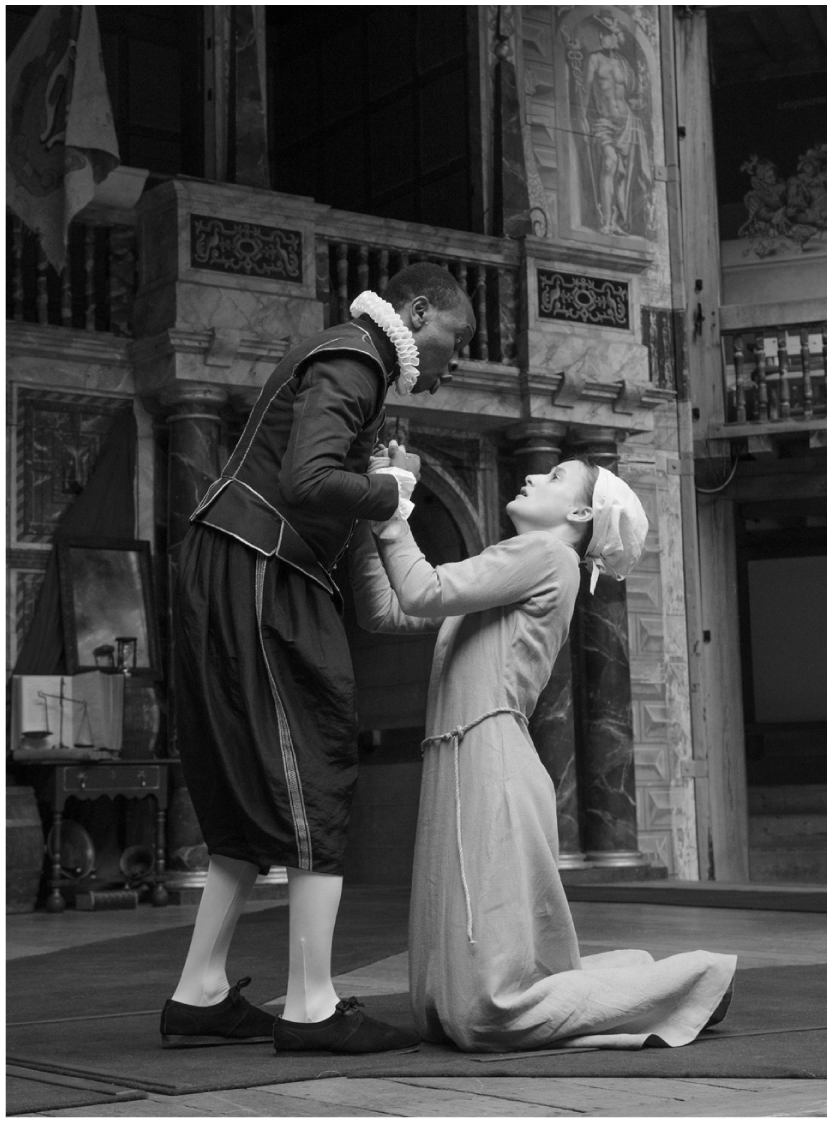
“What’s this? What’s this? Is this her fault or mine?” So Angelo asks himself, as he contemplates his desire for her. “The tempter, or the tempted, who sins most?”
A world where women are condemned for provoking lust in men; where those who fall foul of self-appointed moral arbiters risk decapitation; where arranged marriages are taken for granted: such was the one that Shakespeare portrayed in his most morally ambivalent play. Remote though it may seem to most Western audiences, it no longer, perhaps, appears quite as remote as it might have done a few years back. Touching as it does on topics so taboo that even the boldest contemporary dramatist might think twice before exploring them, the play constitutes startling testimony to the enduring ability of Shakespeare to seem our contemporary. Fingers crossed, we will see an Islamised Measure For Measure soon.