




Abstract
This year India is expecting to add to its own canon of films based on Shakespearean themes and plotlines, but can filmmakers use the plays to circumvent strict, but ambiguous, censorship laws?
“Arshinagar doesn’t quite take direct aim at the state by using Shakespeare,” said Koel Chatterjee, who researches Shakespeare and Indian cinema at Royal Holloway, University of London. “But I’m told the politics in Zulfikar [another film currently in production], based on two different Shakespeare plays, is much stronger, and far more explicit,” Chatterjee told Index.
Zulfikar, a Bengali drama directed by Srijit Mukherjee, is based on Julius Caesar, and Anthony and Cleopatra. Hindi film Veda, based on Hamlet and directed by Onir, is also due for release later in 2016.
“Shakespeare is such a cultural icon in India that his plays remain hugely relevant here even today,” said Chatterjee. “His stories lend themselves so well to adaptation, and we are seeing more and more Indian films being made, either loosely or wholly, based on his works.”
For many years in India, Shakespeare, at least in popular media such as films, was treated with a great degree of reverence, almost as though his stories were to be “wrapped in cotton wool”, Poonam Trivedi, a reader in English at Indraprastha College, University of Delhi, said. There was an element of sacrosanctity to Shakespeare that prevented his plays, as malleable as they were, from being adapted into films with any great creative rigour. This, however, may be changing.
“The younger generations of filmmakers are more prone to using Shakespeare to convey harder, and more political, themes, because we’re no longer as stuck by any colonial hangover,” Trivedi said. “There are so many ideas and statements in Shakespeare which can be used as a means for either dodging censorship or towards stating what might generally be considered offensive.”
India has a long history of censoring films, often for rather feeble reasons. The Central Board of Film Certification has the power to not only classify films, but also to ban the screening of any movie on grounds that can include interests of the sovereignty and integrity of India, the maintenance of the security of the state, retaining friendly relations with foreign states, and ensuring public order, decency and morality. The abstract nature of these criteria often allows the board to exercise its powers for purely political reasons. As a result, films on controversial subjects, especially those that seek to challenge the state, in one manner or another, may be banned. It is here that Shakespeare sometimes serves as a useful way of overcoming both governmental and social barriers.
Filmmaker Aparna Sen’s Mr and Mrs Iyer, featuring actors Rahul Bose and Konkona Sen Sharma
Credit: DDP/Camera Press

In 2014, the filmmaker Vishal Bhardwaj, who had adapted Shakespeare into film on two previous occasions, made his most controversial movie to date. In Haider, he tailored Hamlet to tell a story from Kashmir of the 1990s. The screenplay was tellingly gruesome on occasion, particularly when depicting torture of captured Kashmiri militants by the Indian armed forces.
“We tried to show a different Kashmir, one that has often been ignored in mainstream cinema,” said Basharat Peer, Haider’s screenwriter. “When we looked at the story that we were trying to tell, Hamlet presented itself to us. It felt like the perfect plot. We weren’t consciously thinking of the authorities or how to make the story more agreeable by using Shakespeare, but perhaps it helped in smoothening the process of clearing India’s largely draconian censorship regime.”
Ultimately, Haider was cleared for public viewing after the filmmakers were ordered to make a total of 41 cuts. “We were happy to have got the U/A certificate [unrestricted with parental guidance],” said Peer. “But what’s interesting is that the film was cleared by the erstwhile board, whose members were far more liberal.” A couple of years on, with a Hindu nationalist party in power and a “sycophantic censor board”, he believes the film would now face far greater hurdles.
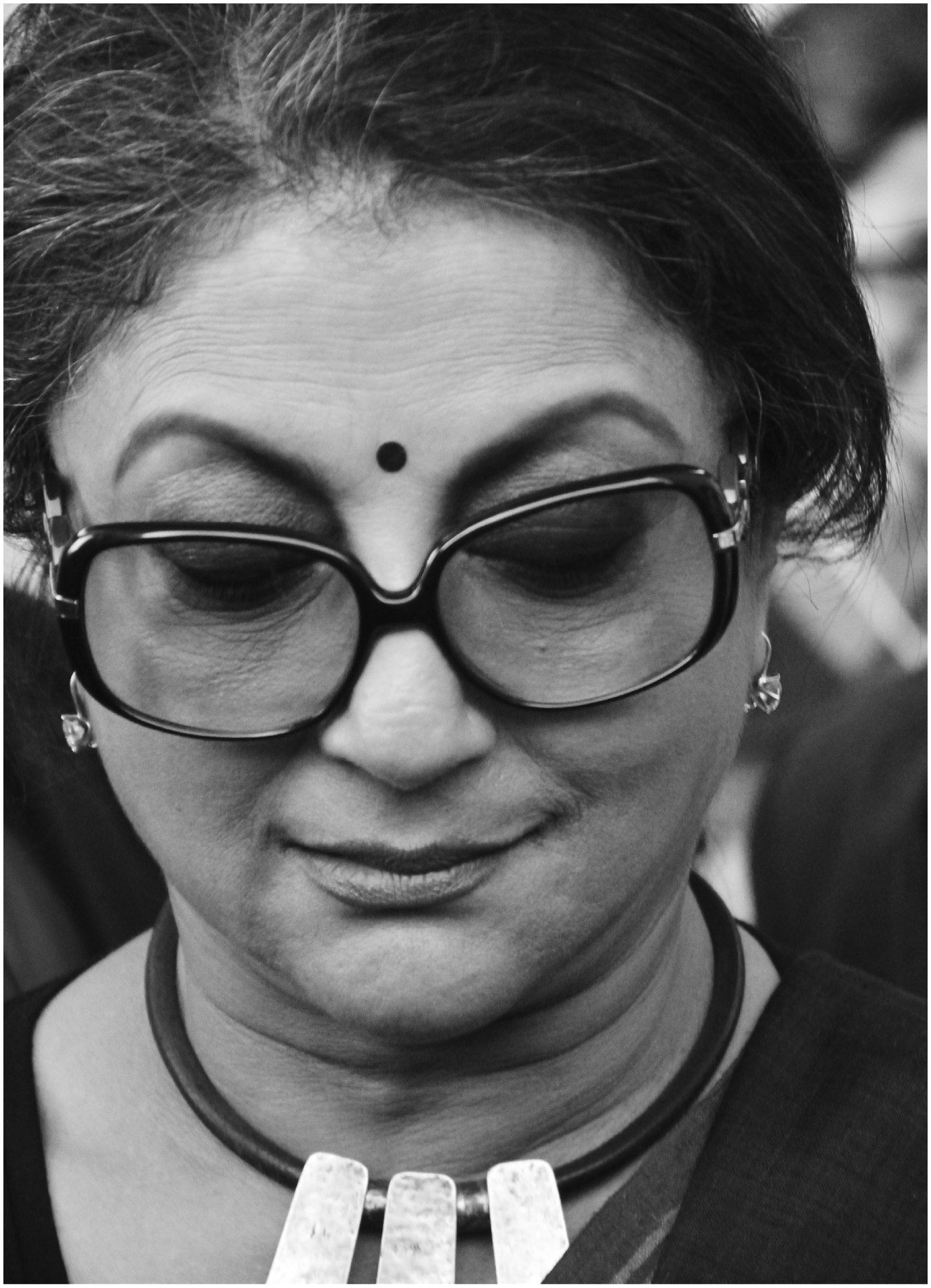
Critically acclaimed Indian filmmaker and screenwriter Aparna Sen during the 38th International Kolkata Book Fair at Milan Mela Complex, Calcutta
Credit: Wikimedia Commons
The impact of a vague censorship regime in India – which is largely dependent on the kind of political party in government – has a notable effect on free speech and artistic expression through films. “You could make a great adaptation of Shakespeare today, but if it touches on subjects that are somehow critical of the present political establishment, you’re in trouble,” Peer said. “I’ve had discussions with a number of producers who would simply not go anywhere near a story which questions the status quo. Today, it doesn’t matter whether the film is based on Shakespeare or not.”
Baradwaj Rangan, a film critic and deputy editor at The Hindu newspaper, said that few filmmakers have dared to put the theory to the test. “Haider is possibly the only Shakespearean adaptation that deals with intensely controversial political issues,” he said. “If you look at Vishal Bhardwaj’s previous movies that adapted Shakespeare, the themes that they dealt with – infidelity and underworld crimes – were not particularly contentious. They didn’t ask any serious questions of the state.”
Perhaps one day as more filmmakers use Shakespeare to tell stories of political purport and depth, and seek to question the state more critically, then India might see the real value in using a classical plot to further free speech and expression. And it isn’t only formal government censorship that Shakespeare and the classics can help overcome. “There is an element of high culture to using Shakespeare,” said Peer, explaining the credibility the Bard can give to controversy. “Othello can be used very subversively, as can The Merchant of Venice. These are stories that can be adapted to talk about the rise of the right in Europe, or the refugee crisis, or the state of intolerance today in India. To use Shakespeare may not be one’s first thought as a filmmaker, but what his plays unquestionably give us is a brand value. It can potentially be used as a clever device to tell uncomfortable stories.”
The age of intolerance
Arshinagar’s director
Shakespeare’s plays were written at a time in the 16th century when there was a sense of rising intolerance, of not respecting the other. I think we’re going through a similar phase in India, whether it’s Islamophobia or other kinds of intolerance. I wanted to therefore transpose the civil strife of the Europe of the 16th century to today’s India.
Every human being has a certain political bent of mind. I have always seen love as a cure to communal disharmony. To me Romeo and Juliet is a play that depicts love in the midst of strife. The intolerance in today’s India is like a disease; it’s endemic. The only antidote to all of this is love. To tell a story of love, I thought Shakespeare’s Romeo and Juliet was most apposite.
I think his plays are eminently flexible. He talks about love, hatred, greed, ambition, jealousy. These subjects are always relevant. There is timelessness and permanence to Shakespeare’s stories. They break all barriers of geography. Romeo and Juliet has been told in so many different ways, and so many different times. That didn’t stop me from making my own movie by adapting the play. I’m sure it can be done over and over again. The possibilities are infinite.
I’d say the answer depends on the kind of story that you make. I have told difficult stories before of communal harmony without using Shakespeare. I did it with Mr and Mrs Iyer [a story of love revolving around a communal strife in India] back in 2002. I could have easily made Arshinagar differently without invoking Romeo and Juliet. So I don’t think Shakespeare necessarily helps us get past the censors. It all depends on the context of your story.
Again, I would say this depends a little on the context of the story. But I can see adapting Shakespeare as being useful in those ways, certainly. There might be stories that are considered political, which might be difficult to tell, that can be expressed well through the lens of Shakespeare.