



Abstract

Egyptian poet
A poet, novelist and former librarian at the Bibliotheca Alexandrina, Hazek was arrested at a protest in early December 2013, shortly after a draconian new law was passed which banned public gatherings without government permission. One month later, he was sentenced to two years in prison and fined 50,000 Egyptian pounds (around $6,300) for protesting without a permit.
Writer Omar Hazek behind bars
Credit: Ahmed Nagy Draz
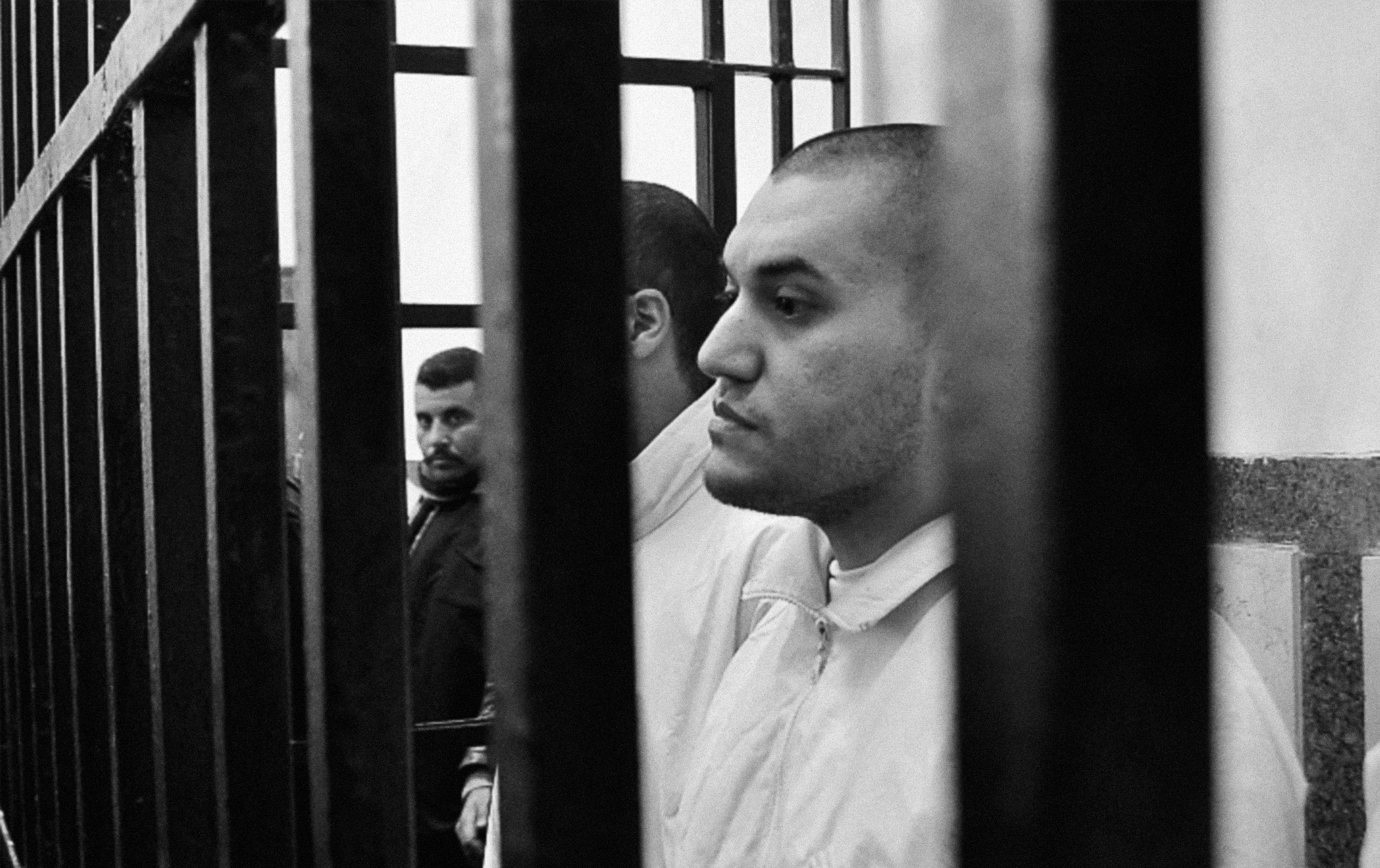
Tens of thousands of people have been arrested since the Egyptian military overthrew former President Mohamed Morsi in July 2013. Since then, repression has worsened, crackdowns on dissent have increased, and Egypt’s prisons have swelled with activists, journalists, writers and other dissidents.
Hazek wrote fiction and letters constantly in prison, despite appalling conditions. He was packed into a 3.5-metre-by-5.5-metre cell with 22 other men, and daily life was marked by violence, beatings and rampant disease. Yet he was often helped by his cell companions. In one letter Hazek described how he was able to write: one fellow prisoner let him squeeze on to his bed, where there was slightly more light to see by, another gave Hazek his chair, and a third invented a primitive candle using oil, tissue paper, an orange peel and the bottom of a water bottle. Throughout his letters, Hazek remained optimistic, a testament to a line from one of his poems: “A poet tames the world but nobody can tame him.”
After nearly two years in jail, Hazek was freed on 23 September 2015, when Egyptian President Abdel Fattah Al Sisi released a presidential decree “pardoning” 100 prisoners.
These are only a fraction of citizens who have been arbitrarily imprisoned in the past year. Given the timing of the pardon – just before Sisi’s trip to the United States to attend a United Nations General Assembly meeting – it seems clear this gesture was a political move. The law that put Hazek in prison is still firmly in place, and freedom of expression and right to assembly continue to be severely constrained in Egypt.
A protester participates in a demonstration against the military regime on the outskirts of Cairo in May 2015

Omar Hazek (right) kept writing in prison, despite the awful conditions
Credit: (left hand page) Xinhua/Alamy; (top right) Ahmed Nagy Draz

These are precisely the conditions that Hazek struggles against as an activist and in his writing. “In these dark times, we have the chance to live by our own light, to live with what we have of love for freedom,” he wrote in one of his prison letters. “In the darkest hours toward which we seem to be heading, a small beam of light still glitters calmly in the darkness.”
In the following poem, Apple, composed in a small beam of light amid the darkness, Hazek writes of prison conditions, the natural world outside his cell, and, ultimately, of humanity.
Apple
By Omar Hazek
Apple, once in a garden
Apple, once in a garden.
An apple, this apple, now here in my hands,
Flees from me, in the dark night of the cell
Shuts, in my hands, its shutters;
Senses my hunger.
Apple, I told it,
There’s nothing to fear
Sleep beside me, while I lie awake
Searching in the darkness for a voice to drink
And sing, how I want, for the warden knows not who I am.
Apple, I told it,
Place your hand in mine,
Don’t walk alone through the night
That wrests from you your lovely red
What would your mother say, apple,
Bleeding, bare, in the drunken rain?
The apple opened a window, just one
Leapt through it into my arms
A wellspring of red
So I sucked the redness from it
And a burst of color passed through my veins.
The apple opens another window
And we look out on the cosmos together
The apple gives me eyes
And memories a wave of forgetting cannot sweep away.
That garden
Those trees in a line
To my left, and right,
Heavy with blossoms,
Lines longer than the eye can see
And I, that flower on the highest bough
With sky, like an ocean of milk, so blue
Birds swim therein
With the sun ambling past, a great apricot,
Clouds shower me with fresh rain
When they sense I am thirsty.
A bee brings me pollen
We chat, it tells me of other flowers’ fragrances;
Of fig, pomegranate, and plum blossoms.
The bee strikes a beat with its wings,
A breeze dances with me,
Dewdrops descend upon me,
The grand apricot warms me,
Thousands of leaves ripple around me,
Hundreds of branches.
And I, this flower on the highest bough,
Serenely, the apple condenses within me
Grows with my sap
My roots reach into the depths of the soil
Nourishment, the pulse of the earth, greetings from the joyful grass
A bird, beside us on the branch
Soon departs
And I sing in whispers, so not to wake the nestlings
The bird returns, beak laden,
Laughs at me;
The apple fills me until I’m jostled
On to the next branch.
* * *
The apple opens another window for me
Gives me a voice I bind myself to
I leap from the dark night of the cell;
Words leap in my mind
Fish leap in the river waters,
Dewy green leaves fly from my head
And the apple, two hearts beating within.
The apple, and I, we scream, we scream sweet words
Into the dark night of the cell
Until the bars above me melt.
Alarm bells ring
Dazed guards drag themselves after our songs
Find us sweeping away the crumbled bars,
Daubing the dark of our nights with coloured stars
When they try to catch us, they go mad;
None of them know which of us is an apple
And which is human.
By Omar Hazek
Al-Gharbaniat prison, Borg El-Arab
Ward 23, cell 5
31 January 2015, dawn
Translation by Elisabeth Jaquette