




Abstract

Fifty years ago, Chilean author
“Perhaps because I was so full of the music of the day, the positive songs of betrothal, that counter-image visited me that morning,” Dorfman said from his current home in the USA, where he is soon to celebrate his golden wedding anniversary with his wife, Angelica. The words he hastily scribbled down that morning were lost in Chile’s 1973 coup, when he was forced into exile, having supported the ousted president Salvador Allende and worked as his cultural adviser.
But the image of the lone musician never went away. “Only recently, I understood how to write it,” he said. “It was not only about the man who plays the trumpet but about what stays behind him, how the singer may die but not the song.”
Illustrations by Eva Bee
Dorfman has always been interested in music as a form of resistance. He remembers Ode to Joy, from Beethoven’s Ninth Symphony, being sung in the streets of Santiago as a protest against Pinochet. Groups would assemble outside prisons to sing over the walls, and inmates who survived the torture there later spoke of the strength it gave them. Dorfman’s 1990 play Death and the Maiden, which was first published in English in Index on Censorship magazine, tells of a sadistic doctor who rapes a political prisoner to the sound of Schubert’s String Quartet No. 14 in D Minor, known as Death and the Maiden.
“Death and the Maiden echoes the horror that the commanders of Nazi concentration camps adored Beethoven,” he said. “I have been reflecting for a long time on music as a meeting place with those who are our adversaries and even enemies. That music is a territory that we share with many whose views we disagree with.”
In All I Ever Have, one of the most powerful moments comes when the soldier quietly whispers “You are not alone” to the dissenting trumpeter, just out of earshot of the anonymous general. Dorfman said the moment was informed by his years writing about human rights and talking with victims of torture. “I am always moved by a moment – an almost invariable moment – when each of them [the victims] says that, in jail, or after having been tormented, they realise they are not alone, not only because there are other prisoners nearby, but because the guards suddenly change their attitude, the guards become wary, as if they know they are being watched. This solidarity is almost like a physical wave that can be felt by those in need. It’s as if we were sending songs to the injured and insulted of the world, and they hear the songs, they really do.”
All I Ever Have
A fable by Ariel Dorfman
The song came flooding into his mouth and mind, it came to the trumpeter yet again in spite of the fear of imminent death, it came to him as soon as he felt his hands being tied behind his back by the young soldier.
“Are the ropes too tight, sir?” the young soldier asked, that’s all it had taken for the song to return, the kindness of the fingers and the deference of the delicate question. “I’m sorry if they’re too tight.”
He said nothing to the man, did not acknowledge the question or the apology. Partly it was so the young soldier would not get into trouble. The Captain was looking at both of them from 30 metres away, standing next to the other members of the firing squad, watching the scene with his hawk eyes that could not see the lips of the young soldier whispering those words of consolation, but would have caught a reply from the trumpeter and harshly punished any contact between the prisoner and a member of the troop about to execute him. But it wasn’t only that, only a matter of protecting a young man foolish enough to make a condemned prisoner’s last minutes on earth a bit more bearable, a little less lonely. It was also the song itself, how it grabbed the full attention of the trumpeter, grabbed him by the throat, with gentle savageness grabbed his throat and left no space for anything else, grabbed his tongue and his bowels and his still beating heart, took over the trumpeter’s existence as it had done just yesterday, as if the song had a life of its own, could come and go as it pleased without asking permission or caring that it was tormenting him yet again with its melody, when all he wanted to do was forget it.
The trumpeter had managed to do so, to forget it, all his life. Almost all his life, that is.
He had first heard the song from his father. He was a boy then, hardly taller than a bush, perhaps five years old, perhaps six. He had been sleeping despite the fires raging in the city and the bang bang bang of gunshots in the streets, he had fallen asleep the way children fall asleep in the midst of catastrophes, so intensely that his father’s voice had seemed to reach him from faraway, as if part of a dream, from a time when the people of that country had been free.
“Let him sleep,” he heard his mother say. “Heaven knows the boy will need it.”
But the boy was already awake.
There was something imperative in his father’s voice that dawn, something also soft and sad and wet in the urgency of his father’s fingers stroking the boy’s hair.
“What is it, Papa?”
“I’m going away, child. I’m going away and it may be many years till I see you again, maybe never.”
“Are you going to the mountains, Papa?”
“The less you know about where I am, the better for you, child, for you and your mother. Forget you ever had a father, forget we ever spoke like this, forget the song we sang only yesterday, before the Army rose and took power, forget everything about me.”
“I’ll never forget you. I’ll never forget the song you used to sing.”
“Oh yes you will. For your own good, for your mother’s good, so they won’t kill her, you will, you must forget our song.”
The trumpeter had never seen his father again. And just as his father had predicted, he had forgotten the song, had buried it so deeply inside his memory that it had been lost to him, fading away into the mist, vanishing so completely that he had not only erased the melody but its very existence. For decades he forgot that last conversation with his father, forgot he even had a father.
It was the price to pay for living. It was the price to pay for thriving in that land where the military and the foreign companies now ruled. It was the price to pay for being admitted to school and then being able, at the age of 10, to learn how to play the trumpet and finally receiving the news, as an adolescent, that he had been selected for one of the army bands.
It was a small band, adjoined to a remote brigade in an insignificant border village constantly on alert, but he could play music all day, what more could he wish for, what an honour for someone like him who was a member of a cursed and persecuted and subversive family, what better way of spending his life, now that his mother had died, than dedicated to the Fatherland and its patriotic hymns, what need was there for a father if he had a Fatherland?
The Captain’s bark interrupted the trumpeter’s thoughts.
“What’s taking you so long, soldier? You don’t need to tie his feet, he’s not going to run away anywhere.”
The young soldier had dropped to his knees. The trumpeter looked down at him. It was almost as if the young man was praying there, a sign of reverence in the dust. Though it did not last long. The Captain was growing impatient, the soldier quickly scrambled up, managing one last message as he turned away.
“You’re not alone.” The young man’s voice came to the trumpeter like a bird landing on a fragile branch and then taking flight before it could be caught, only the swaying of the branch, the flutter of the wind, proof that the bird had come visiting, that the soldier’s voice had come visiting and now was gone.
Just like the song his father had sung and that was forbidden day and night and needed to be forgotten, here for a few instants and then disappearing into the abyss, that’s how it was supposed to be, a melody never to be remembered, never to be repeated, never to surface in him again, that’s how it was supposed to have been.
Except that the song had not died.
It was waiting for him on the dark corner of an alleyway in the capital.
By then the trumpeter had triumphed. He had risen in the ranks, changed his old instrument for a new and shinier one, had pursed his lips and filled his lungs and blown the joy of official anthems and commemorations into the air of ever larger towns as part of ever more important military units until the purity of his sound and the strength of his convictions and the range of notes high and low and in between had caught the ear of the Commander of the Presidential Band. At the tryouts for that Supreme Band, the best and finest in the country, the trumpeter had gusted away the competition. The others vying for the post had broken all protocol, were in such awe of this prodigy, that they been unable to refrain from bursting into applause at the end of his performance, involuntarily guaranteeing his appointment.
Nothing could stop him now on his path to glory. They started him at the back of the Presidential Band, in the humblest position, but his trumpet would not be denied, his music brought cheers and chants and even tears to the crowds that came to watch the troops march by, and it was not long before he was leading that march, at the very top of the parade, his trumpet stirring and caressing the sky, urging the wild animals in men’s souls to fight for the Fatherland, die for the Fatherland, defend the frontier, conquer the barbarians, crush the enemy, march as one under a severe but benevolent God, it was not long before he was serenading the Head of State himself at banquets and ceremonies and inaugurations and weddings.
And the trumpeter had his rewards. Not only the pleasures of a life devoted to music, what he most loved in the world, but a steady promotion in the ranks, a decent salary and free housing and warm and succulent meals and, eventually, something just as warm and succulent, the woman who served those meals in the canteen who always offered him the largest breast of chicken and the juiciest leg of lamb and soon enough offered him her own breasts and her own legs and juices and a mouth that played with him, as if he or she were also musical instruments that did not need to be tuned, only played over and over again.
“Are you ready, men?”
The Captain, once more. The Captain and the firing squad.
The trumpeter tried to quiet the forbidden song surging inside him, tried to remember the face of his wife and the laughter of his children and the flowers in the garden of the house from where his family would now be expelled, tried to remember what he would never see again, what would within less than a minute be taken from him. But it was the song, the damn song, that kept coming back, that would not leave him alone, the song that filled him as his eyes met the eyes of the young soldier 30 yards away, across the barren ground of the prison yard, the 10 rifles being lifted to the shoulders of those men who would kill him, and kill as well the song that had found its way back to him.
It had been there, on that corner, in that voice near the alleyway, and he wanted to believe now that it was an accident, that it would have been enough for him to have passed the corner five minutes earlier or later, that it would have been enough to have strolled home that day by a different route, stayed behind for rehearsal a bit longer, tarried a few minutes extra at breakfast that morning, stopped to breath in the mountains or the sun, any slight deviation, that’s all, he said to himself, that’s all it would have taken to have saved him from crossing paths with his father’s forbidden song. But it wasn’t true, the song would have found him some day, some night, the proof was here, at this moment of his oncoming death, when it had rushed into him again, unawares, when it insisted in lilting into him even as he heard the cocks on the rifles clicked back into the firing position, he knew that he could not have avoided the song any more than he could avoid taking these last breaths from lungs that would never blow into a trumpet again.
Before he reached the corner he had already heard snatches of it.
He ordered his feet to stop, to turn in the other direction, to heed his father pleading with the boy that the trumpeter had once been to forget father and song and even their final conversation, but it was useless, the feet did not listen to his commands, they walked towards the melody and their destiny, even if they knew they were also walking towards this firing squad and that Captain and the young soldier who did not want to pull the trigger but would do so because there was nothing else he could do, just as the trumpeter could not stop himself as a child from forgetting the song, just as the trumpeter could not stop himself as a man from going towards the corner and the dark alleyway where the song ambushed him.
A beggar was singing it. An old woman too stupid or too drunk or too poor or too old to be afraid.
The trumpeter recognised it right away. As if no time had passed since the dawn his father had woken him to say goodbye, as if he were still that child and the old beggar woman was his father and all the intervening years were an illusion. The military marches: an illusion. The cheering crowds: an illusion. An illusion, the patriotic slogans and the commercial ads. The rewards and promotions and praise, all, all, an illusion, like the pit of a pirate ship. Only the song, real and rich and perfect. And forbidden.
He knew it, said it to himself once more as he staggered away, leaving the beggar woman behind, she was suddenly reduced to muteness, as if her throat could rest now that she had transmitted the song like a soft plague to someone else, now that she had unburdened herself safely and burdened him unsafely with it, now she could forget it and survive just as he had for so many years only to find himself unable to get rid of it as he searched for the labyrinth of lanes that would guide him home.
It did not leave him when he kissed his wife or when he sat down to supper or when he told his children a goodnight story of monsters and heroes. Nor when he went to bed that night. It was the last thing looping through his brain before he fell asleep and the first notes that welcomed him the next morning.
That was all right, he told himself. As long as this song stays inside me, nobody can know, nobody can guess, nobody can read my thoughts, I will be safe. I forgot it once and I can forget it again.
And for a while, for a short while, his strategy seemed to work.
He thought that he had the song tamed like a tiger that you bring into your house and pretend is a kitten. Like a tiger that you bring into your house.
“Aim for the heart, men,” the Captain called out. “I want 10 bullets, all in the heart. Those are my orders and if one of you disobeys, you’ll be the next one up there.”
The young soldier looked away for just a split second, less than a second, as if his eyes refused to witness what he was about to do.
The trumpeter nodded at him, encouraged him, told him with that nod that it was all right, he had also obeyed, he had also tried to forget, he had also commanded his lips not to sing and his mouth not to bring forth the music.
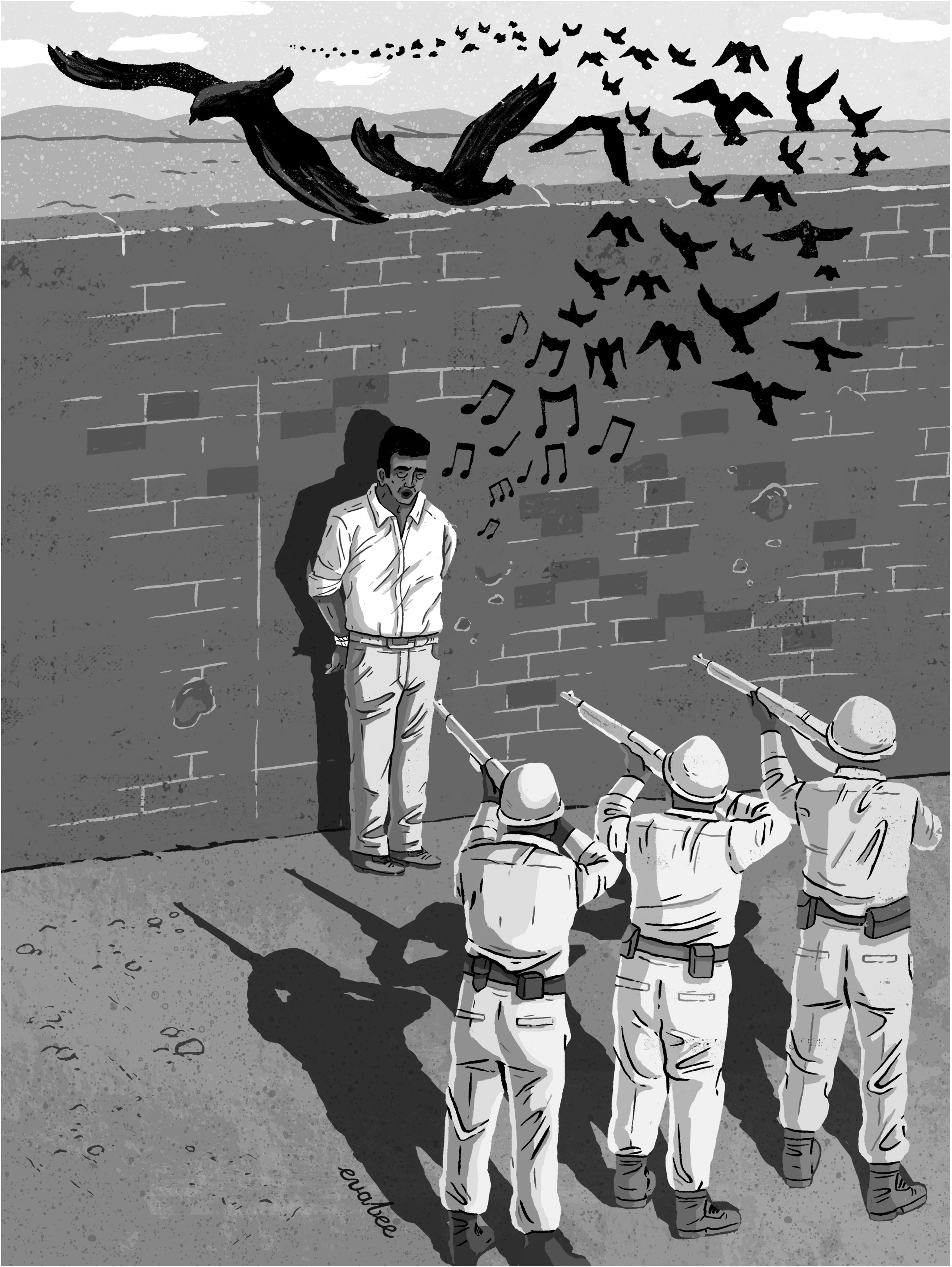
The song began to come out of him now, in front of the firing squad, surge like a gentle volcano from inside, unstoppable as fire, like a star that refuses to die, the song larked out of the trumpeter’s throat, just as it had sallied forth from his trumpet yesterday, at the Presidential Palace, in front of the President and all the Ministers and all the visiting dignitaries, the song had burst out loud and clear and clean, reaching every ear, spreading through radio and television waves, into each house of the land, above and beyond the drums and horns and tympani and the blare of the military march and anthem, the song of his trumpet swept the square and the country and drowned out any other sound.
Proscribed for decades and yet memorably alive.
So daring and unexpected its illicit appearance, yesterday, at the Presidential Palace, that no one knew what to do, so entranced by it that the other musicians had stopped playing and could only listen in fascination and dread, so strong that the guards surrounding the Supreme Leader, had not ventured to react, just as the 10 soldiers of the firing squad hearing the trumpeter’s defiant voice were now paralysed, their fingers frozen, their arms, their legs, their torsos, frozen, frozen, everything frozen except their unwilling and desperate and glorious ears, even the Captain momentarily stopped in his tracks as the President yesterday had been seized by stupefaction, seized by the song, shaken to his roots by the song, that went on and on, yesterday through the notes of the bugle, today lodged in the trumpeter’s tongue and throat and teeth and gorge, the same banned song that nobody remembered and everybody recognised.
“Fire, damn it!”
And they did. They had to fire and they did.
The trumpeter slumped to the ground and yet for one final moment it was as if the last notes of the song, echoing through the air, rebounding from the walls of the prison yard, washed back into the river of him one last time and held up his body, still refusing to let go, still inhabiting his penultimate dying breath.
And there was silence.
It was silent in the yard and silent in the prisoner’s dry mouth and silent the blood and silent even the sound of shovels heaving earth on to the quiet body and all over the city, silence, and in the towns and the fields.
He did not say a word, the young soldier, all the way home. He didn’t say a word to his lover when she greeted him at the door, nor a word while he toyed with his dinner without eating it or stripped his clothes off and got ready for bed. And did not say a word when he went to say good night to his sleeping daughter.
The girl must have been five, perhaps six.
The young soldier stroked his daughter’s hair slowly, hoping not to wake her.
And then, from his mouth, the song had come forth.
Low, his voice so low, one could almost have supposed it did not exist.
The child, however, heard it. The child awoke and rubbed her eyes and looked at her father and smiled.
“What song is that, Papa? I’ve never heard it before.”
The young soldier sang it for a while longer before stopping. He did not want to stop but there was something he needed to tell the girl.
“You’ve never heard it before, my child, that’s true. And you won’t readily hear it again.”
“When will I hear it, Papa?”
He thought about the nine other soldiers in the firing squad. Was any one of them, more than one of them, murmuring the song right now, flowing it, humming it to a brother, to a wife, to an aunt, to a friend, to a father, to a stranger, perhaps to a daughter, perhaps to a son?
“When will you hear it again?”
And the young soldier hoped he was not only speaking for himself when he answered:
“Someday. Someday soon.”
Support musicians in exile
Index on Censorship has launched a fund for musicians in exile in association with the producers of award-winning documentary They Will Have To Kill Us First, which followed musicians in Mali in the wake of a jihadist takeover and subsequent banning of music in the country’s north. Money raised will contribute towards Index on Censorship’s Freedom of Expression Awards Fellowship, a year-long structured assistance programme to support those facing censorship. You can donate at indexoncensorship.org/musicinexile