




Abstract

A supporter holds a radio during a protest against the dismissal of Mexican journalist Carmen Aristegui, outside MVS Radio’s building in Mexico City
Credit: Reuters / Edgard Garrido
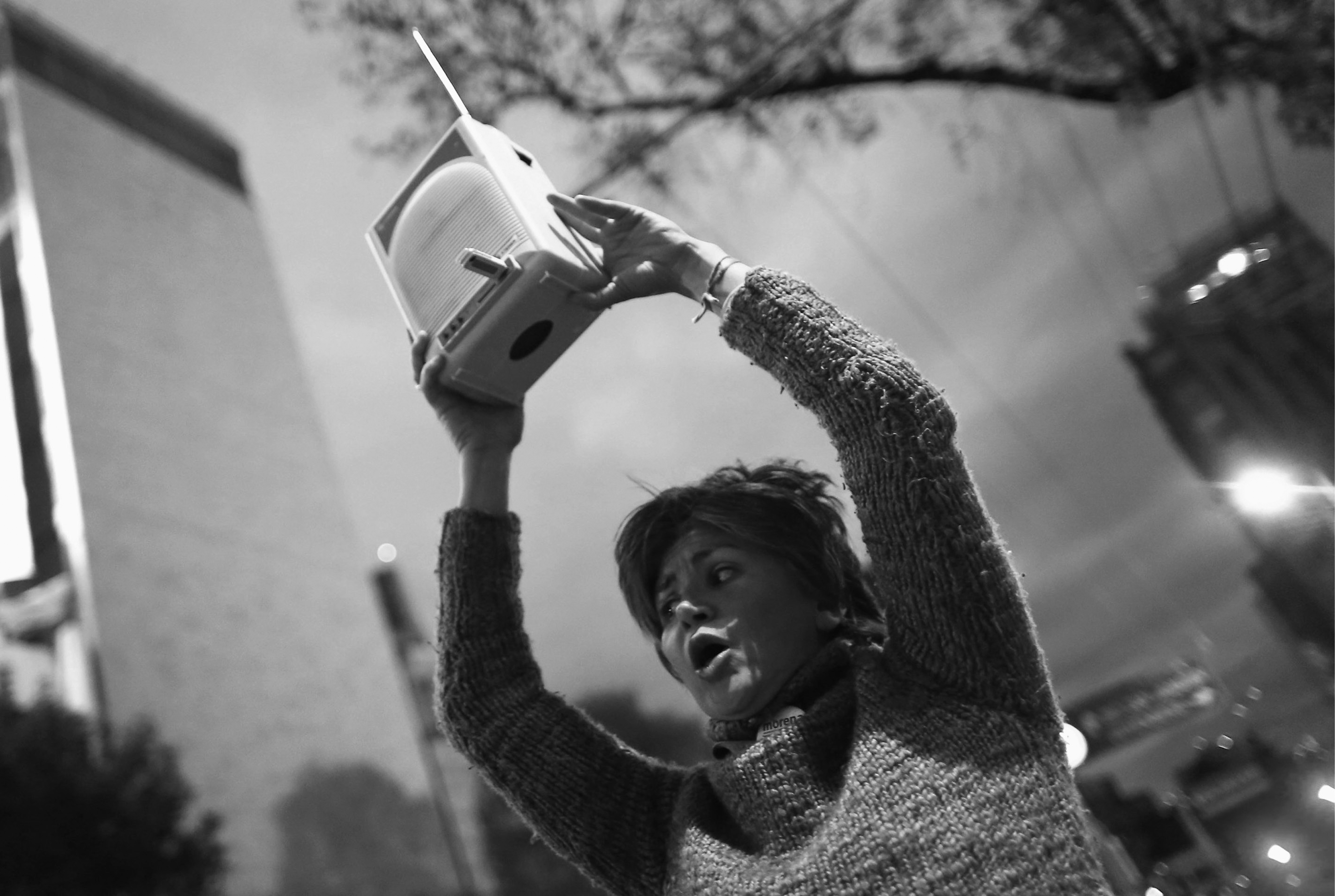
When a team of radio journalists uncovered a story about the Mexican president, they won an award, but lost their jobs, writes
“
One of Mexico’s most respected journalists, Aristegui was widely considered MVS’s star reporter. Her daily news show reached up to 15 million listeners per morning and was one of few mainstream programs to regularly criticise Mexico’s government. Although she still hosts a nightly news show on CNN en Español, Aristegui has not been offered a return to radio.
“In any other context, everyone would be fighting to have a brand like Carmen Aristegui. How can there be no offers [to revive] a programme that had such a big audience and was so successful both commercially and in terms of its impact?” asked Rafael Cabrera, a member of her investigative team, in an interview with Index on Censorship. “This silence feels like a kind of complicity and submission on the part of the media. It leaves a bitter taste in the mouth.”
The level of violence against Mexican journalists has been well documented, but comparatively little is known about the pressures that reporters and their bosses come under when dealing with the government.
Andrew Paxman, a history professor at Mexico’s Centre for Research and Teaching in Economics, said the Institutional Revolutionary Party, or PRI, historically controlled the media through “soft coercion”. Although there were few cases of journalists being attacked, or even directly censored, throughout its first reign from 1929 to 2000, the PRI would buy their complicity through regular subsidies and individual payments to specific reporters, Paxman claimed. While government influence over the press began to wane in the 1990s as Mexico became more democratic, the last two administrations have sought to reassert control by overseeing a “massive increase in spending on advertising”, according to Paxman. “Once your newspaper is reliant upon government income, self-censorship naturally follows,” he added.
After the PRI reclaimed power in 2012, Peña Nieto spent over $882 million on publicity in his first two years in office – more than any other president in history. Cabrera described the government’s strategy as a “carrot-and-stick” approach, rewarding submissive media outlets with advertising money but threatening to withdraw funding from those that are critical. He believes this economic stranglehold over the press is precisely what caused him and his colleagues to be fired.
Cabrera said in the earliest stage of their investigation “MVS received a call from the president’s office saying ‘Who is Rafael Cabrera? And whatever he’s working on about Angélica Rivera and her house, shut it down.’” When the reporters refused to back down they came under increasing pressure. Irving Huerta, another member of the investigative team, said the MVS owners threatened to take Aristegui off the air for endangering their business interests if she published the report.
MVS did not respond to Index on Censorship’s interview requests, but in a statement published on its website in March it denied infringing upon Aristegui’s right to freedom of expression, and claimed to have extended her contract just days after she published the report.
By way of compromise, Aristegui eventually ran the story on her own media site, Aristegui Noticias, instead of MVS. The investigation revealed that the first lady had acquired a custom-built luxury mansion in one of Mexico City’s most exclusive neighbourhoods from Grupo Higa, a favoured government contractor. Dubbed the Casa Blanca (White House) for its pale exterior, the property was valued at over $7 million. Rivera claimed to have bought it at market price using her career earnings as a soap actress, but the news sparked accusations of conflicts of interest given that her husband had granted Grupo Higa concessions worth over $600 million when he was governor of Mexico State.
Moreover, just three days before the report was published, the government abruptly cancelled a $3.7 billion contract for a high-speed railway project it had awarded to a consortium that included Grupo Higa. Rival contractors complained that the bidding process had been rigged in the consortium’s favour and the project was later suspended indefinitely.
The Casa Blanca report spurred further investigations, which revealed that Grupo Higa had another $57 million contract to renovate the presidential aircraft hangar, and that Peña Nieto had enjoyed use of another Grupo Higa property while campaigning for president. It also emerged that Peña Nieto and two senior cabinet members had bought more luxury properties from Grupo Higa and other prominent government contractors.
Faced with mounting public anger and plummeting approval ratings, Peña Nieto eventually appointed an ally of his to investigate the allegations of cronyism. Few were surprised when the investigator exonerated the president and his wife of any wrongdoing in August.
Not one public official has been sanctioned as a result of the investigation, but by March the journalists behind the report had all lost their jobs. MVS first fired Huerta and his colleague Daniel Lizárraga, ostensibly for using the company logo without authorisation to promote Méxicoleaks, a new WikiLeaks-style whistleblowing platform. Then, when Aristegui demanded they be reinstated, MVS said this was an unacceptable ultimatum, and dismissed her and the rest of her team.
A demonstrator stands outside MVS Radio’s building in Mexico City with a poster of news anchor Carmen Aristegui, after her team lost their jobs for investigating property deals arranged by the president and his wife
Credit: Reuters/Edgard Garrido
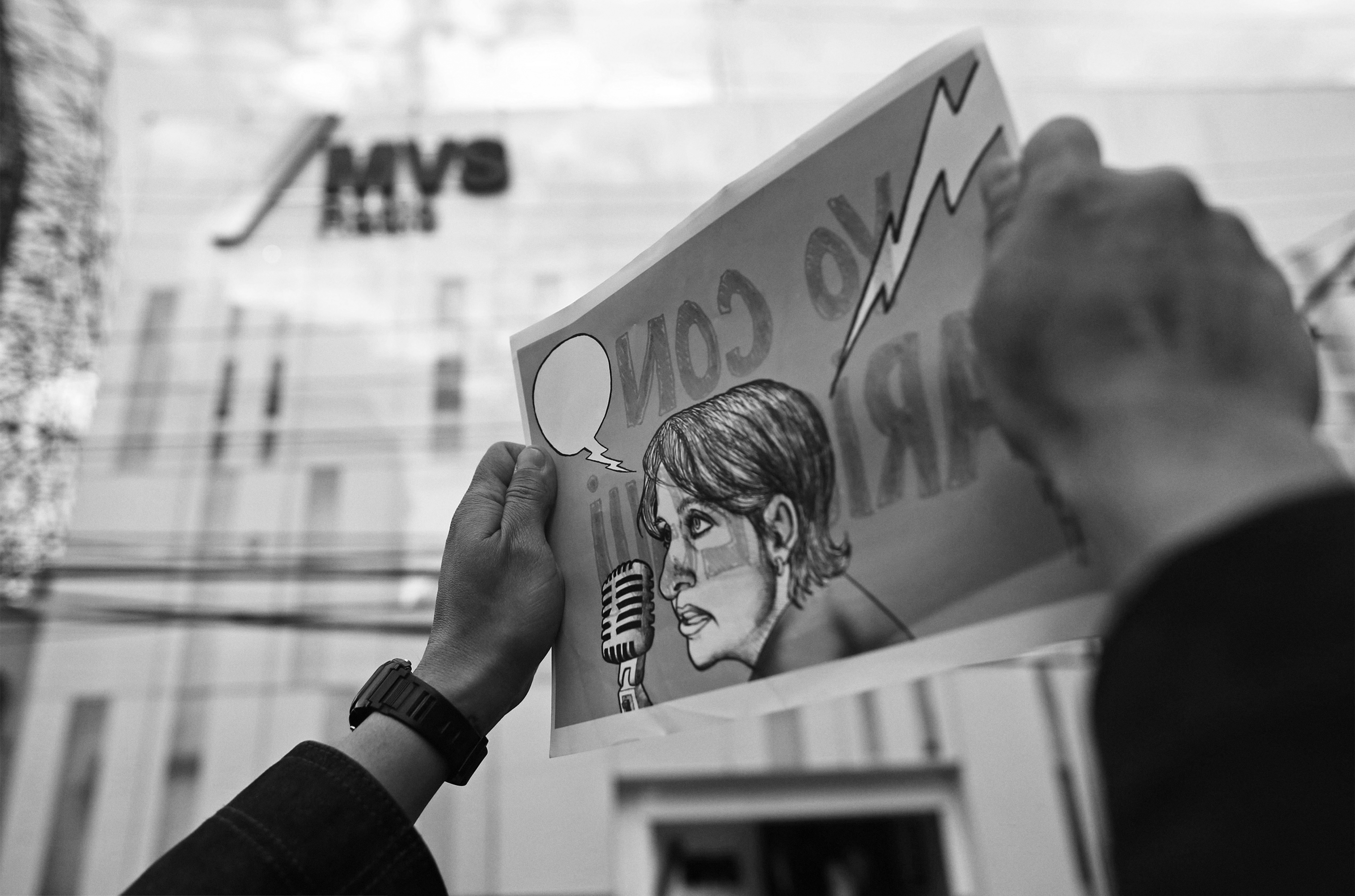
In a bid to prove the dismissals were not politically motivated, MVS claimed that Cabrera, the “true author” of the Casa Blanca report, would continue working with them. Within minutes, Cabrera contradicted the station and tweeted that he had documents that proved he had been fired. Amid mounting speculation that the government had threatened to withdraw funding for the station, MVS confirmed that government advertising accounts for less than 6% of its income. However, Huerta noted that MVS is part of a wider conglomerate including a telecoms network and several major restaurant chains – interests that are also susceptible to government pressure.
Aristegui’s team remain convinced the Méxicoleaks dispute was a minor internal matter used as a pretext to fire everyone responsible for the Casa Blanca report. “Ever since the story was published there was a kind of Cold War between MVS and Carmen,” said Cabrera. The station never sought to resolve the dispute through internal dialogue, he noted.
Months after being fired, the reporters behind the investigation became the target of a strange misinformation campaign. On 30 August, Cabrera received two text messages imitating UnoTV, a company that sends free news updates to millions of mobile phone users in Mexico. The texts said the president’s office intended to sue the authors of the Casa Blanca investigation and could even have them imprisoned. UnoTV swiftly denied responsibility for the texts.
There was no truth to the messages, which contained links promising more information. Cabrera and Huerta interpreted them as either a threat or an attempt at espionage, although they could not determine who was behind it. The links may have contained a virus allowing hackers to access all Cabrera’s data, or the messages could simply have been an attempt to intimidate him, they noted.
After all they have been through, Aristegui’s team are eager to return to work. But above all, they want to see Mexico’s press take a united stand against state censorship.
“The Peña Nieto administration is spending unlimited amounts of money on advertising and self-promotion in newspapers, magazines, television and radio. It’s flooding the media and making sure the press isn’t too critical of them,” Huerta claimed in an interview with Index. “We, the journalists, can’t let this happen. We can’t stay quiet. We have to find a way to keep practising journalism on behalf of a society that needs to defend itself from authoritarianism.”
Case Study
Getting around the violence in Veracruz
Mexico’s journalists continue to face incredible pressures as they do their jobs. The eastern state of Veracruz is by far the most dangerous place for journalists in Mexico, if not the whole of Latin America. According to NGO Article 19, at least 14 reporters from Veracruz have been murdered since governor Javier Duarte took office in December 2010, a dramatic increase from the four journalists killed there in the preceding decade. Duarte, who warned local journalists to “behave” earlier this year, has denied any responsibility for the killings, which have all gone unsolved.
In the most notorious recent case, photojournalist Rubén Espinosa was tortured and murdered inside a Mexico City apartment, alongside his activist friend Nadia Vera and three other women, on 31 July. Espinosa had fled Veracruz after being threatened there. The killings shocked the nation by showing journalists are not even safe in the capital, a place usually thought to be a relative haven for endangered reporters.
Given the level of violence against journalists in Veracruz, one reporter, Fernanda Melchor, has adopted narrative journalism – relating events in a non-traditional literary style – as a safer means of depicting events. In 2013 she published her first book, Aquí no es Miami (This is not Miami), a collection of short stories narrated in first- and second-person and illustrating how drug-related violence has transformed life in Veracruz.
The anthology includes tales of adolescents witnessing an abduction outside a nightclub, a couple buying drugs from a dealer whose days are numbered, and a young child who blames himself after his mother is killed by crossfire. Based on Melchor’s own experiences and events that locals had related to her, the stories were corroborated with multiple sources and recounted without including names or details that could endanger her sources.
“So many stories would go unreported because of fear,” Melchor told Index on Censorship. “I wanted to tell the stories that are happening to normal people like you and me.”
Melchor, who left Veracruz amid the worsening violence in 2012, is now working on more short stories that highlight the level of impunity in the state. Rather than replacing traditional journalism, she believes narrative journalism can complement it by humanising events and providing other perspectives of life in Veracruz.
Footnotes
