




Abstract

For years the debate around sex work was taboo because it just wasn’t something polite people talked about. Our manners are more open now. But it is threatening to become a subject that people are uncomfortable talking about once again, because few people are foolish or confident enough to brave the howls of outrage which typify the way the debate is conducted.
This autumn’s symposium was intended to sidestep that vitriolic public debate and collect evidence to be placed directly in the UK at its House of Commons Library as a reference for lawmakers. Sex workers shared their experiences and academics brought their research. The conclusion of both was that decriminalising sex work could protect prostitutes from violence.
Something is changing in the prostitution debate. A recent decision by Amnesty International to support decriminalisation lent campaigners momentum and recognition, but it was merely the latest in a long list of respected international organisations – including the UN and the World Health Organisation – to demand change. Many sex workers believe it heralds a sea change in global attitudes.
But the respectable political debate takes place against an angry backdrop of smears and abuse. There are ultimately two sex work debates: one, a calm and judicious assessment of evidence among international organisations, the other a censorious and puritanical shouting match between rival feminist factions.
It is typified by two phrases: “whorephobic”, which is used against opponents of sex work, and “pimp lobby”, which is used against those calling for decriminalisation. Both phrases raise questions about the moral character of the people engaged in the debate rather than the content of their argument. This ferocious, highly personalised approach serves to scare people away from the discussion. Who wants to be told they hate vulnerable women selling their bodies on the street? Who wants to be accused of enriching themselves in a conspiracy with pimps? These tactics, designed to scare away moderate voices, mean the debate has become even more polarised.
Amnesty was later branded part of the “pimp lobby” when it voted on its policy. Sources inside the organisation say the reaction was strongest in northern Europe – especially the UK, Scandinavia and France. In places like Germany and New Zealand, where more liberal systems are in place, the debate is less heated. This allows for it to be discussed more widely in the public sphere, with more moderate – and typically liberal – positions adopted. It sucks the venom out of the discussion and brings it back to a harm-minimisation assessment.
Nicki Adams of the English Collective of Prostitutes, which spearheaded the parliamentary meeting, almost laughs at the idea of being funded by pimps, given her group had no funding at all until three years ago and it now receives all its money from a single woman’s organisation in the Netherlands.
“You answer the accusation the best you can, on the grounds that it’s not true,” she said. “We’re completely independent of anyone – the police, political parties, anyone. It’s just a slur. We, as sex workers, aren’t entitled to associate with people. When you’re a sex worker your normal relations become filtered through this prism of illegality and dogma.”
For Adams, the presence of pimps would be a complete mockery of what her group does. Having a pimp in a workers’ organisation is equivalent to “having bosses in the union”, she said. But the accusation of being pimp-funded comes anyway. It is not meant to be accurate. It is meant to discredit reformers and remove their right to speak.
The organisers of the Feminism in London conference this autumn were subject to an online campaign demanding they retract their invitations to respected feminists Selma James, Reni Eddo-Lodge and Jane Fae. The three women weren’t even going to talk about the sex industry, but their views on it meant they were no longer welcome at the event. All were either barred from attending or felt they had to drop out.
“All of a sudden I was being accused of all manner of things which I don’t believe in,” Fae said. “It’s very upsetting. They say I’m in favour of pimps, I’m in favour of trafficking and it wouldn’t surprise me to hear them say I’m in favour of child sex or something. There’s a sense of escalation.
“I felt sad, but also irritated. Here were these people talking about me without paying me so much as the courtesy of asking whether it’s true. It’s like being tried in absentia by a kangaroo court.”
But the demands for censorship are not all one way. They are deployed by those demanding reform just as much as by those opposing it. The phrase “whorephobic” is the direct equivalent to “pimp lobby” – it silences and smears opponents and rules them outside the limits of acceptable discourse.
Comedian Kate Smurthwaite came across the word when she was booked to do a gig at Goldsmiths, University of London, earlier this year. She’s a supporter of the Nordic model, which would prosecute the buyer – but not the seller – of sex. Days before the event, an organiser messaged her to say that the student union was “for sex-working” and to “avoid that area of conversation”. Shortly afterwards, she was disinvited because of the “risk of a picket line”. Since then, she has become a figure of controversy wherever she tries to do a gig.
“I very rarely do a show at any women’s rights event without the promoter getting a load of emails asking them not to put me on,” she told Index. “That includes a rape crisis centre in Bristol. The promoter got emails saying I should be no-platformed.”
Sex workers hold a protest march in London’s Soho Square during 2014 as part of International Day to End Violence Against Sex Workers
Credit: Guy Corbishley / Alamy
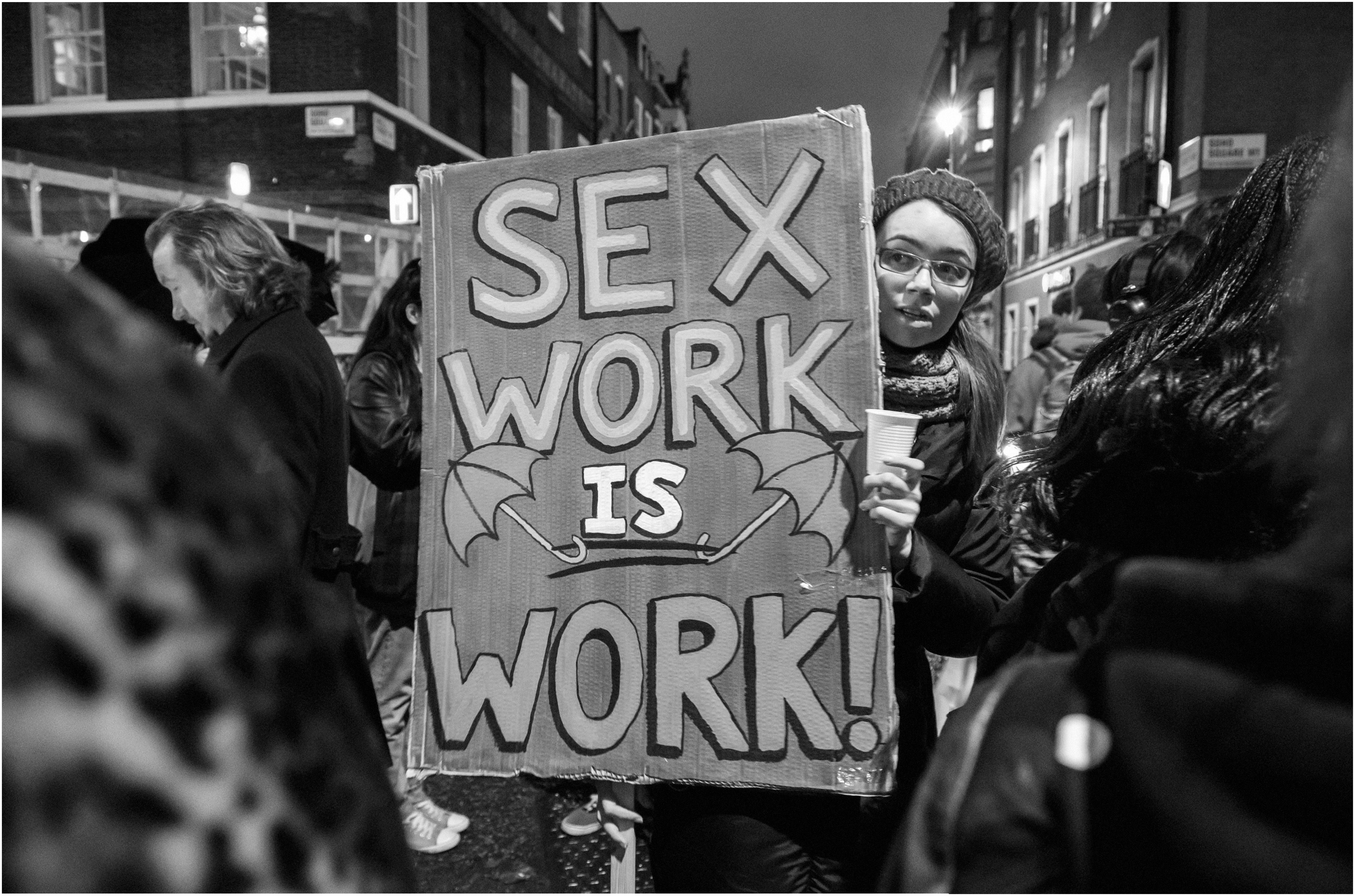
The “whorephobia” phrase performs two specific functions. Firstly, it personalises the dispute, so that the criticisms radical feminists make of the sex industry are redefined as criticisms of sex workers themselves.
“If you propose a critique of commercialised sex, they say: ‘Oh you hate women who sell sex’,” Sarah Ditum, journalist and anti-sex work campaigner, said. “But a critique of sex work is a critique of sex work. It’s not a critique of women in institutions which exploit their body.”
Secondly, “whorephobia” serves as a shorthand for a dismissal of anti-sex work arguments on the grounds of hate speech.
“‘Unsafe’ is the standard criticism,” Ditum explained. “The extended version of the argument is that our position makes women in prostitution less safe. So the endorsement of the Nordic model is therefore an act of violence against women. It’s an extraordinarily long reach. No one ever mentions that it’s the men who make women in sex work unsafe.”
This contorted logic has now become something close to a mantra on many campuses, where feminists supporting sex work usually outnumber those who don’t. Radical feminist and anti-sex work campaigner Julie Bindel has found her views on the trade have made her persona non grata on many campuses.
“They’ve gone crazy,” she said. “It’s actually like a mental illness. They don’t blame men for the shit they do. They’re just clutching at straws, finding anything which can be seen as ‘triggering’ or upsetting for the poor little bell-ends who are quivering over their online ranking.”
Bindel had just gone to Norway to speak at a feminist conference, but the demands that she be excluded had followed her even there. “The organisers have been absolutely harangued about my attendance,” she said.
“Pimp lobby” and “whorephobic” are two sides of the same coin. They call into question the moral motivation of one’s opponent and trigger a rejection of their right to speak. They’ve created a gutted, hollowed-out debate.
The irony is that both sides actually want the same thing: to keep sex workers safe. But they have grown so distant, and they hear so little from one another, that most figures in the debate barely recognise it.
In the House of Commons, the data collected by the English Collective will be studied by MPs. In the ivory towers of politics and policy-making, the debate will continue to be held. But the public debate on prostitution has been all but wiped out by the clamour for censorship which has overtaken both sides. It is a cautionary tale of what happens when demands for censorship overrule argument.
