



Abstract

A man reads Turkish satirical magazines, Penguen and Uykusuz, in Istanbul, Turkey, after the news of the Charlie Hebdo attacks
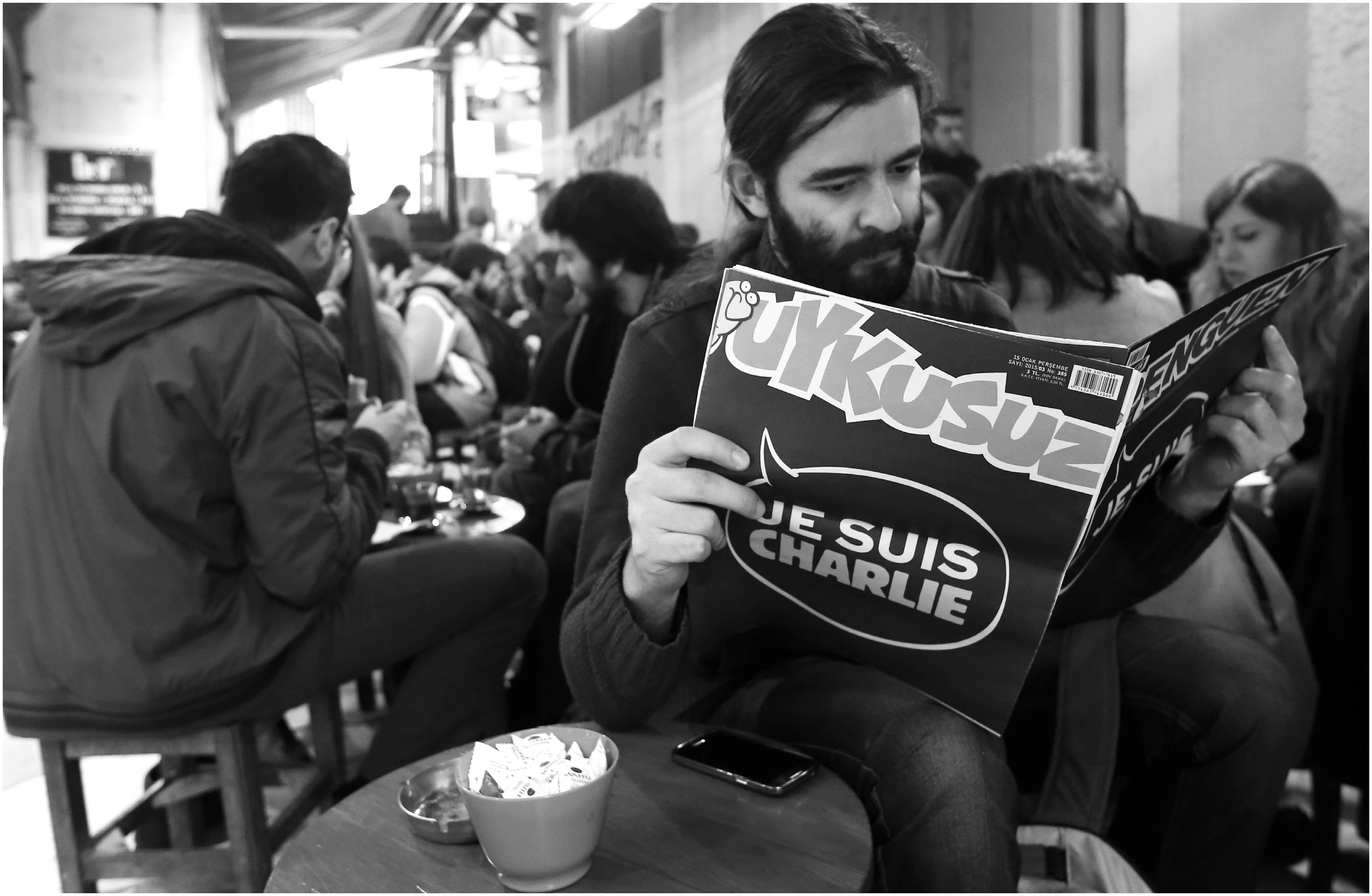
A new generation of Turkish satirical magazines are ruffling feathers.
“
The editorial in Püff’s inaugural issue (published in January 2015) mocked the current political atmosphere in Turkey, where it is becoming increasingly likely for critics of the government to get accused of partnering with Mossad, CIA and a Jewish-led conspiracy against Turkey. The Turkish word püff means the same as “puff” in English: the magazine’s logo features a firefighter struggling to puff out a fire.
Püff is one of a new generation of Turkish satirical publications with a conservative bent. For many years Turkey’s satire has been mainly found in secular, left-wing magazines. These have consistently ruffled establishment feathers, and every year numerous politicians and citizens successfully sue their staff (in March 2015, two cartoonists from Penguen magazine were sentenced to 11 months in prison for their work; their sentences were later commuted to fines). But now Islamists and right-wingers have started unsettling this picture. They are coming up with new publications offering a humorous look at Turkey’s current affairs from a perspective that’s at once satirical and distinctly conservative. Having long been used to dismissing all satire and mockery as “attacks of secularists and radicals against elected politicians,” right-wing politicians are beginning to realize how journalistic satire and mockery are part of public life, now that they are practiced by those in their own ranks.
Püff is published every Monday as a supplement inside the newspaper Zaman, the flagship publication of Hizmet, a faith-based movement headed by the cleric Fethullah Gülen who lives in exile in rural Pennsylvania. Once an ally of Turkey’s current government, the movement has become its fiercest critic. Nowadays its members are accused of “plotting to topple the elected government”, for which they are being subjected to terrorism charges in Turkey. These developments have created a fracture among conservatives; some have become pro-statist while others adopted an anti-statist discourse. Its association with the Hizmet movement sets the tone for Püff’s coverage: basically religious and right-wing, but with a strong subversive bent.
At Püff’s launch party in January, editor Abdullah Yavuz Altun condemned the murder of the cartoonists of the French satire magazine Charlie Hebdo. “When our plans were under way to launch a satire magazine, I was visiting Paris and one of the first things I did there was to get a copy of Charlie Hebdo,” he told his colleagues. “In Europe, criticism and satire are more aggressive than in Turkey. Nothing is holy there; morals are kind of a taboo. Charlie Hebdo’s cartoons about our prophet attracted a lot of negative reactions. There were similarly humiliating cartoons in the same magazine depicting Jesus and Moses … Without making excuses, we should stand by Charlie Hebdo and raise our voice against restriction of freedom of expression and the brutal massacre.”
The big bad wolf cover from Püff published after October’s Ankara bombings
Credit: (left hand page) Sedat Sunar/ EPA; (right hand page) Vedat Kemer

Püff’s stance on the Hebdo massacre stood in stark contrast to the reaction from another conservative satirical magazine, Cafcaf. “Arrogance has become a habit of the European culture. [Europeans] have placed themselves above others in a position where they are free and unquestionable,” read its statement about the events. In January, the magazine published a cover that depicted people from Gaza, Egypt, Afghanistan, China, Syria, Iraq and Chechnya, most of them wounded, many in bandages, in response to Hebdo’s “Tout est pardonné” (“All is forgiven”) cover after the attacks. “Non, rien n’est pardonné” (“No, nothing has been forgiven”) read the coverline.
Political differences notwithstanding, this new wave of magazines shares a highly irreverent sense of humour. In October, the week after bombings at a peace march in Ankara left more than a hundred people dead, Püff published a cover featuring Little Red Riding Hood and the Big Bad Wolf. She asks the wolf why he has such big teeth. “To be able to eat you better,” he answers, as expected. Little Red Riding Hood then indicates the judge standing just behind, and asks, “And why is this judge here?”. “So that he can announce a gag order about our case,” comes the answer, referring to the blackout forced on the media coverage of the aftermath of the bombings.
Historically, Islamic satirical magazines have rarely featured female figures on their pages. This makes Püff’s use of Red Riding Hood on its cover quite unorthodox. Printed in full colour and unafraid to subvert norms of conservative publishing, Püff is almost indistinguishable from left-wing satirical magazines like Penguen and Uykusuz, in its willingness to take on taboo subjects and in its production values.
Members of the team at Püff, including editor Yavuz Altun (second left)
Credit: Kürsat Bayhan/ Zaman
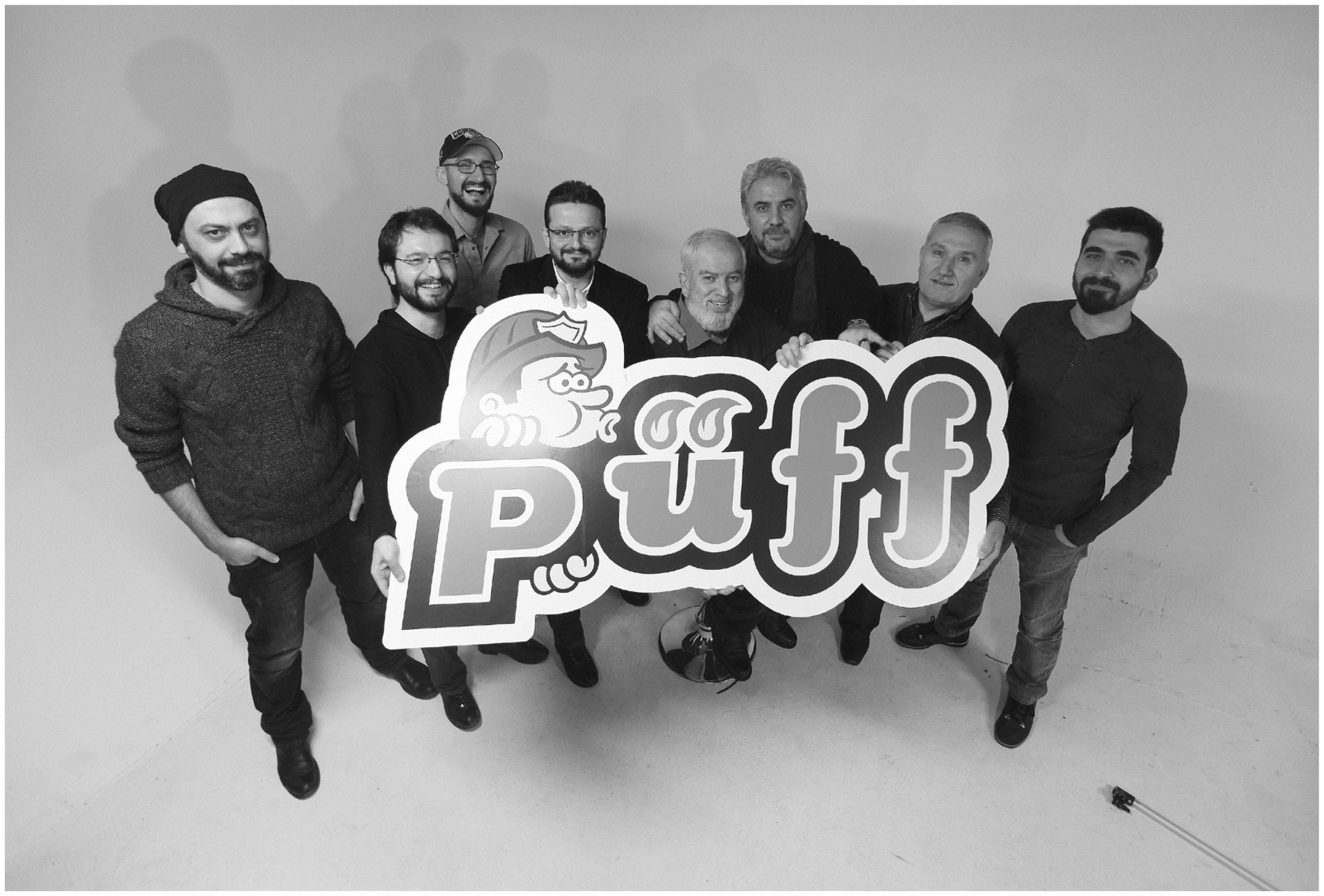
“We get different reactions with every new issue,” Altun told Index on Censorship. “Some people get mad just because we use the expression lan [a rude term for “buddy” in Turkish]. Others tell us the magazine won’t be successful unless we use jokes featuring sexuality and swear words.” And where do they draw the line, I asked Altun, what are their taboos? “Mocking people’s beliefs, obscenity and swear words are a bit taboo for us, naturally,” he said, referring to the magazine’s religious character. “Those elements have been a part of our satirical tradition since the Ottoman times. But we choose not to use them in our cartoons.”
Turkish scholars Levent Gönenç and Levent Cantek examined the rise of magazines such as Püff and Cafcaf in a paper in which they sketched a history of Islam’s relationship with satire. They pointed out that some schools in Islamic theology consider the production of jokes and images as strictly prohibited in Islam, while others disagree, carefully distinguishing mizah-ı mahmud from mizah-ı mezmum. The former, “praising humour”, refers to humour that advocates friendship and aims to make its audience “happy”. The latter, “scorning humour”, is discouraged in Islam because it is seen to feature lies and slander.
In Turkey the appetite for satirical magazines is huge. Despite the country’s 99% Muslim majority, Turkey’s satire has come a long way from the world of anti-religious journalism where bearded, religious-looking figures have often been demonised.
This has not always been the case. Throughout the 1940s Turkish republic was fearful of two “internal enemies”: communists and Islamists. The left-wing satire magazine Markopaşa and the conservative Borazan were seen as similarly dangerous for the wellbeing of Turkey, as they both scrutinised the single-party regime of nationalist republicans. Interestingly, Markopaşa and Borazan had a cartoonist in common, Mim Uykusuz. They also shared a publisher – one of the few that was brave enough to produce publications critical of the single-party regime.
The most interesting figure in the 1990s was Hasan Kaçan, a student of the legendary Turkish cartoonist Turhan Selçuk. After working with Selçuk in Gırgır, which at the time was one of Europe’s bestselling humour magazines, Kaçan started criticising his old magazine for his portrayal of Muslim characters. “In those caricatures Arabs are always the swindlers, the woman-crazy degenerate Muslims,” Kaçan told an interviewer in 1996. “They are depicted as those reactionary figures. In the past fifty years they have always been represented this way in cartoons, with their beavers, acne-covered noses, bad teeth, in a way little different from dragons.” He then wondered if those Muslim and Arab figures caricatured in those magazines were “really responsible for all the vice, the swindling, the corruption, the numerous political assassinations and deaths under police custody in Turkey?”
“There have been numerous attempts at conservative satirical magazines in the past, like Hasan Kaçan’s Ustura magazine,” Altun told Index. Püff’s readership consists of pious, conservative Muslims who receive copies of the satirical magazine every Monday inside a newspaper known for its socially conservative views; never before had a conservative satirical magazine reached such a large audience. Altun added that this approach, coming from the tradition of coffeehouse meddah (storytellers) mocking politicians, had a long history in Turkey. “But this is not particularly helpful when you put out a magazine in 2015,” said Altun. These observations led him to adopt a different approach; although technically European looking, their cartoons are carefully tailored for a Turkish audience.
And yet some of their work had been controversial. The cover of Püff’s 30th issue featured the coffin of a fallen soldier in the form of a ballot box and a short text: “The resolution process is over.” This was a reference to the suspension of the peace talks between the Turkish government and the militants of the pro-Kurdish PKK party, causing an escalation of violence that killed hundreds of Turkish soldiers throughout the summer of 2015. “Many of our readers showed little interest in the political story we were telling there,” Altun said. “They were offended by our choice to draw coffins of fallen soldiers in that way. In fact, the image of a coffin as a ballot box was something we also did not approve. But sometimes it is not possible to show things without producing such images.”
Altun described his staff as a young and amateur-spirited one. “We always discuss between ourselves: ‘Is this joke a bit too much? Are we really mocking a situation here or are we just trying to hurt the politicians?’ Some of our readers ask us whether it is not disgraceful to picture statesmen the way we do in our cartoons. Maybe it is a bit disgraceful, yes. But it is a necessary disgrace.”