




Abstract

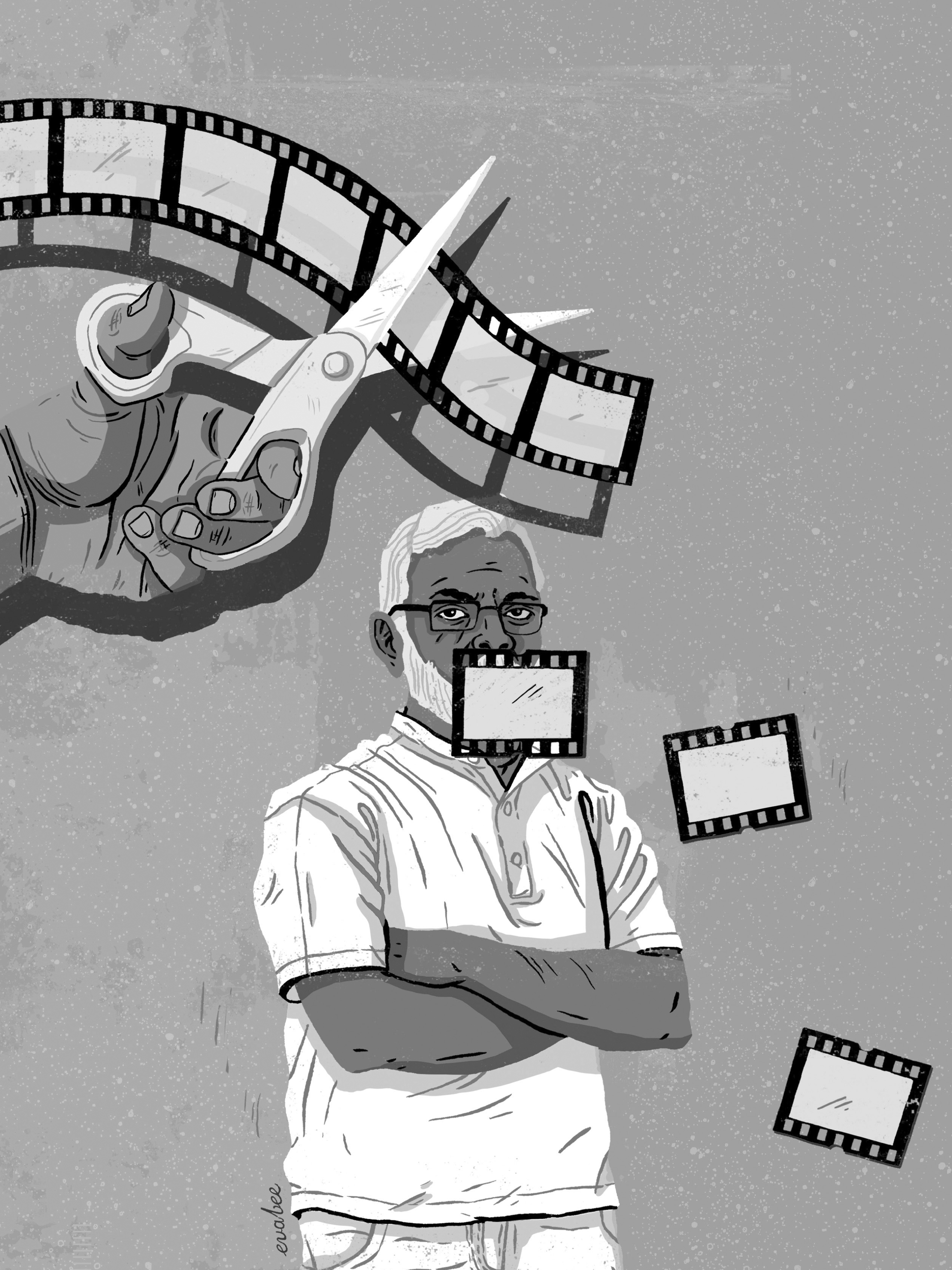
India’s film censors are only too happy to stop films they don’t like reaching audiences. Not much has changed since the 1950s, argues
Porkalathil Oru Poo portrays the life of Isaipriya, a Tamil journalist, who, according to footage first released by the British TV station Channel 4, was killed by the Sri Lankan army during the final days of the civil war that ravaged the country. According to Sattanathapuram Venkataraman Shekhar, one of the members of the board, Ganesan was unable to provide any evidence to the authorities on Isaipriya’s actual fate. “Apart from the fact that this could affect our relationship with Sri Lanka,” Shekar told Index, “the film also shows India in a bad light. The film seems to suggest that India didn’t help out during the civil war. How can we show this to the Indian public?”
The CBFC derives its authority from India’s Cinematograph Act of 1952. Its powers are enormous. Not only does it classify films based on the kind of audience that it believes may be permitted to view the picture, but it also enjoys the authority to ban a film altogether on certain specified grounds.
This approach, which gives broad authority to the state to determine which films should be available for broadcasting to the general public, is really symptomatic of the larger culture of censorship in India. In comparison to the role that the state might have played immediately post-independence in the 1950s, there’s little to suggest that anything has changed in its approach to censorship. If anything, restrictions on speech have only become more entrenched.
“Censorship is seen as forming an integral part of the state’s business,” the literary critic and novelist Nilanjana Roy said. “Very few Indians see prior restraint as being opposed to general democratic norms. Indian conservatives would argue that too much free speech is offensive, while Indian liberals would argue that too much free speech is dangerous.”
The courts, the supposed guardians of civil liberties, have rarely crushed legislation on the grounds that it violates one’s right to free expression. Gautam Bhatia, a lawyer and an expert on free speech legislation, said the last successful challenge against legislation made by parliament on such grounds, before 2015 when the Supreme Court invalidated a provision under India’s Information Technology Act, was in 1972. With the courts failing to fulfil their anti-majoritarian functions, the state has had a free reign to impose consistently paternalistic norms.
The present government, headed by the Bharatiya Janata Party’s Narendra Modi may go further in restricting speech than earlier regimes. “There is a large amount of cultural policing fundamental to the policies of the BJP government,” Nakul Sawhney, an independent filmmaker, said. “Censorship has been present under all regimes in India, but I think the current establishment has a greater tendency to suppress any form of dissent.”
Every time the government changes the composition of the CBFC is altered too. The present chairperson, Pahlaj Nihlani, has openly admitted to being a supporter of the government. “I am proud to say I am a BJP person. I believe in [the] BJP,” he said on television, after taking office. “Narendra Modi is the voice of the nation. He is my action hero.”
Much like the cinema, books too have often been on the receiving end of bans, occasionally expressly by the state, and, in other cases, suppressed by the long arm of the criminal law. In 1988, India became the first country to ban Salman Rushdie’s novel, The Satanic Verses. It achieved this by imposing a notification under the Customs Act, prohibiting the import of the book, purportedly on the grounds that it contained blasphemous content.
The Satanic Verses was by no means the only precursor to the more recent bans that the country has seen. There were a significant number of books barred in the years immediately after independence. These included, in 1959, The Heart of India, written by Time Magazine’s New Delhi correspondent, Alexander Campbell. The book, a fictional account of Indian bureaucratic life, was banned for its supposedly “repulsive” content.
More recently, works have been proscribed at the bidding of various communities and religions, sometimes at the mere suggestion that a book might contain objectionable content. In 2004, the western Indian state of Maharashtra issued a notification, under India’s Code of Criminal Procedure, banning James W. Laine’s book Shivaji: Hindu King in Islamic India. The government argued that the book disparaged Shivaji Bhonsle, a 17th-century Marathi leader, who had ousted the Mughals to form a separate state in west India, and, in so doing, had potentially threatened religious sentiments. Eventually, in 2010, the Supreme Court of India found that Laine’s book had been illegally banned, in contravention of the constitution’s guarantee of free speech and expression.
To approach the courts and to overcome censorship is perhaps the best, and only conceivable technique available for those whose works are thwarted. But, the process can be arduous and time-consuming. What’s more, the general record of the courts, both the various high courts and the Supreme Court of India, in preserving the right to free speech, has been poor.
Judges are too often prone to recognising censorship as a legitimate object of the state’s functions. In a decision rendered in 2007, the Supreme Court had upheld a notification banning a Kannada novel by PV Narayana on the grounds that certain portions of his book denigrated the character of the sister of an ancient Hindu saint. Even in the absence of any threat of violence, the court held that the burden to disprove the government’s objections lay with the novelist.
Article 19(1)(a) of India’s Constitution guarantees to its citizens a right to free speech and expression. But the following clause, Article 19(2), permits the state to make “reasonable restrictions” on the right in the interests, among other things, of public order, decency, morality, sovereignty and integrity of the state, friendly relations with foreign states, and so forth. It is this limiting clause, which is often used to justify not only bans on books, but also the operation of various penal provisions that serve to have a chilling effect on speech. “Ultimately, prior restraint as a concept has to be questioned,” Pankaj Butalia, a documentary filmmaker, told me. “For that we’ll need a movement of great proportions, demanding a change in our constitution.”
Both the CBFC and the Film Certification Appellate Tribunal have recently denied Butalia’s film, The Textures of Loss, a certificate for screening. One of their ostensible reasons for the decision was the use of the phrase “disproportionate violence” by the filmmaker to describe actions taken by security forces in Kashmir. Another was a statement by one of the interviewees who had recently lost his eight-year-old son because of attacks by Indian security personnel. The father apparently says in the film: “I beg Allah that this kind of an India be damned. That the whole of this India be damned and of our government here and all their families like they’ve ruined our whole family…”
In January this year, Butalia approached the Supreme Court, seeking to question the standards on which the decision denying him clearance had been made. To his surprise, the judges were more concerned about the broad content of the film than they were with the reasons they had given for censoring it. “Why is [the film] one-sided? Where is the alternate picture? We don’t know why it has become fashionable and a question of human rights to talk about one side of a story,” justices Vikramjit Sen and Chockalingam Nagappan told the filmmaker. “Rights are always conferred on two parties and not only on one of them… this is what is happening with activists.”
Fortunately for Butalia, the justices allowed him to approach the Delhi High Court with a fresh petition challenging the CBFC’s decision. On 25 May 2015, the Delhi High Court ruled in favour of the film. It directed the board to grant The Textures of Loss a “U” certificate. But, weeks later, Butalia continued to await permission from the board. He proposes to go to court again, seeking to have the CBFC held in contempt of the courts.
“The entire censorship regime in India is flawed,” Butalia told me. “We can’t be expected to rush to the courts each time we want to express ourselves. There’s absolutely no hope for an independent voice in our country today.” Ganesan, who, like Butalia, is fighting his battle against censorship in the courts, was even more contemptuous of the state of free expression in India. “It doesn’t matter which government is in power,” he said. “India is a democratic country only in name.”
© Suhrith Parthasarathy