Abstract

Twenty years ago, environmental activist Ken Saro-Wiwa was hanged, alongside eight other dissidents at the orders of Nigeria’s rulers, after campaigning against oil companies and for the rights of the Ogoni people.
Google tells me that the saying is from the Greek philosopher Heraclitus who observed “No man steps in the same river twice, for it’s not the same river and he is not the same man”.
I am not the same man who read those letters years ago but then neither was my father. Back then he was just my father, a myth in the making, very much alive but on his way to becoming Ken Saro-Wiwa.
I am struck now as I was then at the way the letter is clearly written for public consumption as much as for my benefit. I bristled back then at the realisation that I was being served up as a piece of agitprop but now I can smile at the memory.
I duly did my duty as instructed in the letter, getting the word out to the world’s media and defending my father right up to his execution and for some time after. In a way you could say it was the making of me as a man, a journalist and a writer – pretty much as he predicted in this letter.
His other prediction is what still concerns me and should concern all of us – “extricating the Ogoni people out of their predicament is going to be a much more gargantuan task”. A lifetime’s work, he predicted.
I took those words personally at the time and bristled at the notion he might be signing me up for a tour of duty. I think those words still whisper in my ear from time to time. This is part of the dilemma of being Ken Saro-Wiwa Junior, first son and namesake to an idea that is still very much alive a generation after my father died.
As I mellow into and past my mid-40s, a stone’s throw from the age when my father wrote those pregnant and prescient words to me, I have come to understand that those words were not directed at me, alone. They are meant for us, the world, to make good the ultimate sacrifices that he and many others made to make the world a safer place.
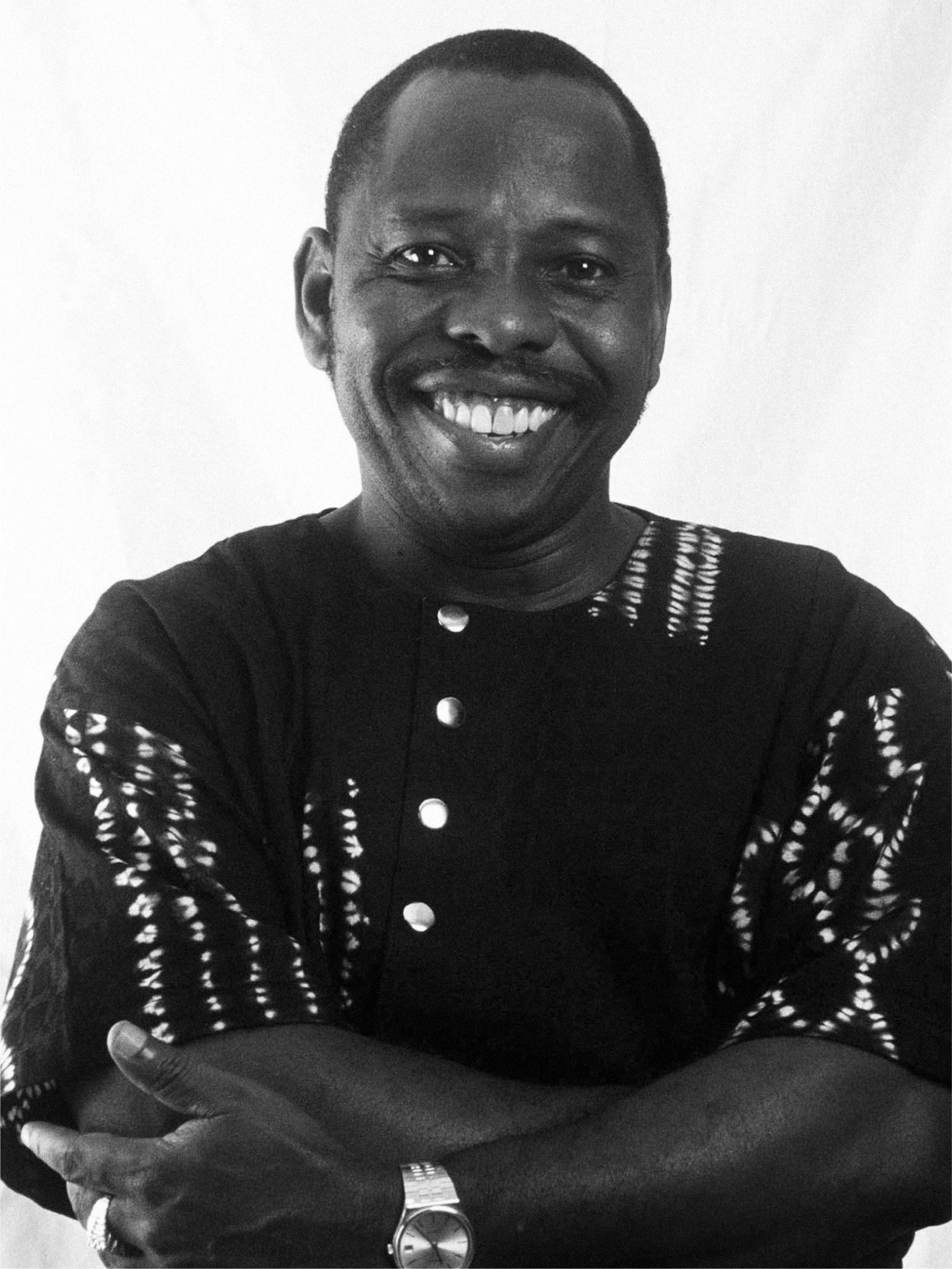
Nigerian environmental activist Ken Saro-Wiwa, who was killed 20 years ago
Credit: Newspapers Ltd / Rex Shutterstock
For me, the story of my father and the struggle of the Ogoni people is an everyman narrative about social justice and sustainability. From my vantage point, on my life’s journey, the Ogoni river has flowed through a long, drawn-out court case in New York, nine years as a presidential adviser, and here we are 20 years after he wrote those words and the Ogoni are no closer to anything that he or anyone of us could describe as justice. In fact the water may have become muddier and murkier, making it more difficult to clean up, as my father would have wanted.
Five things to know about Ken Saro-Wiwa
Ken Saro-Wiwa and eight others from the Movement for the Survival of the Ogoni People were hanged in the south Nigerian city of Port Harcourt in November 1995.
Nigeria was suspended from the Commonwealth for over three years as a direct result of the killings of the Ogoni Nine, who had campaigned against environmental damage and human rights abuses in the Niger Delta.
Oil company Royal Dutch Shell paid $15.5m in an out-of-court settlement in 2009, after being accused of being complicit in human rights abuses in Nigeria – a case led by relatives of the Ogoni Nine. Shell denied liability but said the payment was part of a “process of reconciliation”.
Saro-Wiwa wrote and produced the long-running satirical TV series Basi & Co, which was once said to be the most watched soap opera in Africa. He also wrote novels, poems, short stories and children’s books.
A memorial to Saro-Wiwa – a silver “battle bus”, decorated with oil cans – will be taken to Nigeria by arts campaign group Platform later in 2015 to mark the 20th anniversary of his death.
Still a United Nations Environmental Programme report on the Ogoni spent years gathering evidence to support my father’s claims that Shell had despoiled the Ogoni environment. Although the recommendations have not yet been implemented, the federal government has accepted the report and we live and continue to work in hope that Ken Saro-Wiwa’s life and death will one day be honoured.
© Ken Saro-Wiwa and Ken Saro-Wiwa Jr
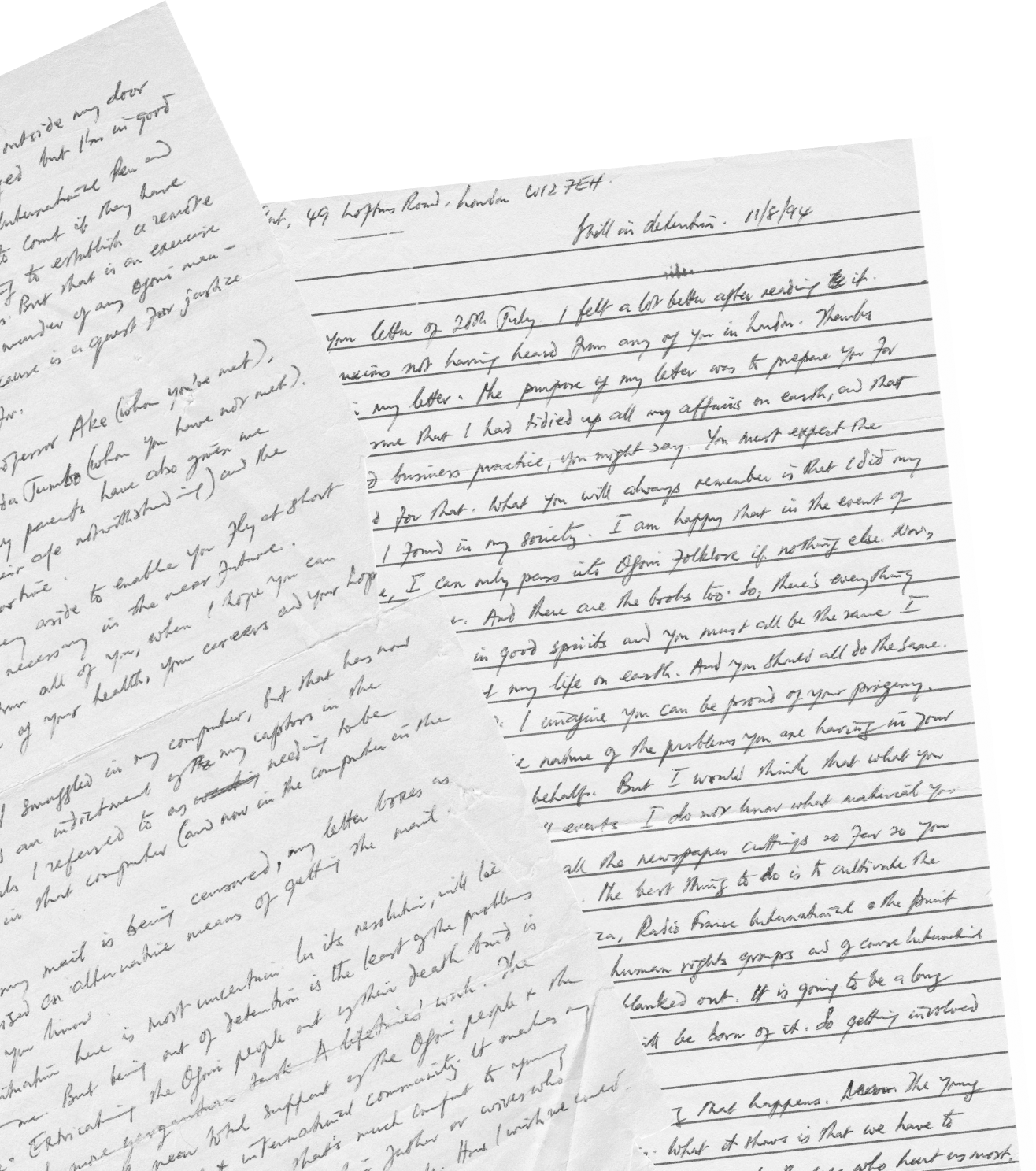
Still in detention 11/8/94
Dear Junior,
Thanks a lot for your letter of 20th July. I felt a lot better after reading it. I had become extremely anxious not having heard from any of you in London. Thanks for doing all I asked for in my letter. The purpose of my letter was to prepare you for any eventuality. And to ensure that I had tidied up all my affairs on earth, and that you know about it. A good business practice, you might say. You must expect the worst and prepare your mind for that. What you will always remember is that I did my best to fight the injustices I found in my society. I am happy that in the event of death, which will surely come, I can only pass into Ogoni folklore if nothing else. Now, I could not demand more than that. And there are the books too. So, there’s everything to be thankful to God for. I am in good spirits and you must all be the same. I am fighting to the last minute of my life on earth. And you should all do the same. Do not fear, and do not be distressed. I imagine you can be proud of your progeny.
You do not let me know the precise nature of the problems you are having in your encounters with the British public on my behalf. But I would think that what you need to do is to keep them informed of all events I do not know what material you have, but I’m asking Apollos [his business manager] to send you all the newspaper cuttings so far so you can keep abreast of the latest information. The best thing to do is to cultivate the media — BBC African Service, Voice of America, Radio France International and the print media in the UK. Also the environmental and human rights groups, and of course International Pen so that news of the Ogoni struggle is not blanked out. It is going to be a long struggle whether I am there or not and heroes will be born of it. So getting involved in it is not bad at all for anyone.
After Birabi I’m not now surprised at anything that happens. The young Orage’s reaction would have shocked me otherwise. What it shows is that we have to choose our friends carefully and that those closest to us may be the ones who hurt us most.
As of today, my situation has not changed much. I have not had access to a lawyer, I cannot challenge my detention properly in court. I need medical attention, but cannot get it. Where I am held is tolerable, but the food is atrocious and I do not have access to the family or anyone. I am denied access to radio, newspapers and books. Two armed guards are stationed outside my door 24 hours a day. My sense of justice is outraged but I’m in good spirits and in fighting mood. Express my gratitude to International Pen and Amnesty International. The state is yet to charge us to court if they have any evidence whatsoever. I gather they are now trying to establish a remote link between the leadership of Mosop [Movement for the Survival of the Ogoni People] and the murders. But that is an exercise in futility. There was nothing to gain by the murder of any Ogoni – all of us are victims of the State and Shell. The Ogoni cause is a quest for justice and not for power. So there is nothing to kill for.
I have had considerable support from Professor Ake (whom you’ve met), Apollos Onwuaosoaku, Iheme and a Miss Elfrida Jumbo (whom you have not met). You must express my thanks to them. My parents have also given me wonderful support and encouragement (their age nothwithstanding) and the Nigerian press have been very supportive.
You will have to keep some money aside to enable you fly at short notice to Nigeria should it become necessary in the near future.
I look forward to hearing from all of you, when I hope you can let me have intimate information of your health, your careers and your hopes for the future.
I am writing even here. I smuggled in my computer, but that has now been seized after I published an indictment of my captors in the dailies here. The materials I referred to as needing to be published in future are in that computer (and now in the computer in the PH [Port Harcourt] office).
I believe that my mail is being censored, my letter boxes as well, and I’ve not devised an alternative means of getting the mail. When I do, I’ll let you know.
What you will always remember is that I did my best to fight the injustices I found in my society
The political situation here is most uncertain. In its resolution, will be what happens to me. But being out of detention is the least of the problems I have to face. Extricating the Ogoni people out of their death bind is going to be a much more gargantuan task. A lifetime’s work. The exhilarating thing is the near total support of the Ogoni people and the support I find in the national and international community. It makes my suffering worthwhile. I doubt that that’s much comfort to young children who need the attention and care of their father or wives who require the same. But then, to everyone his fate. How I wish we could choose our parents!
Keep smiling. God bless you.
Jeje
© Ken Saro-Wiwa