




Abstract

The tradition of free discussion in UK universities is under threat from governments that want to suppress critical voices, writes lecturer
Academic freedom is typically enshrined in university statutes, a typical formulation being that “academic staff have freedom within the law to question and test received wisdom, and to put forward new ideas and controversial or unpopular opinions, without placing themselves in jeopardy of losing their jobs or privileges” – as the statutes of the University of Warwick have it. Yet academic freedom is now being fundamentally weakened and qualified by legislation, with which universities must comply.
British Prime Minister David Cameron, speaking in Munich on 5 February 2011, said: “We must stop these groups [terrorists] from reaching people in publicly funded institutions like universities.” This was followed by a UK government report on tackling extremism, released ahead of the recent election, which said: “Universities must take seriously their responsibility to deny extremist speakers a platform.” It was suggested that “Prevent co-ordinators” could “give universities access to the information they need to make informed decisions” about who they allowed to speak on campuses. Ahead of May’s UK election university events had already been changed or cancelled. And immediately after the election, the government signalled its intention to focus further on the extremism agenda. In endorsing this approach, university vice-chancellors have acquiesced in a too-intimate identification of the interests of the search for better argument with whatever is stated as government policy. The expectation is that academics will in turn give up the autonomy required to criticise that policy or those who now manage it on government’s behalf in our institutions.
Governments worldwide increasingly assert the legal power to curtail the free speech and freedom of assembly that is axiomatic to the existence of academic freedom. This endangers democracy itself, what John Stuart Mill called “governance by discussion”. The economist Amartya Sen, for example, has recently resigned from his position as chancellor of Nalanda University in India because of what he saw as “political interference in academic matters” whereby “academic governance in India remains … deeply vulnerable to the opinions of the ruling government”. (See our report from India, p28) This is notable because it is one extremely rare instance of a university leader taking a stand against government interference in the autonomous governance of universities, autonomy that is crucial to the exercise of speaking freely without jeopardy.
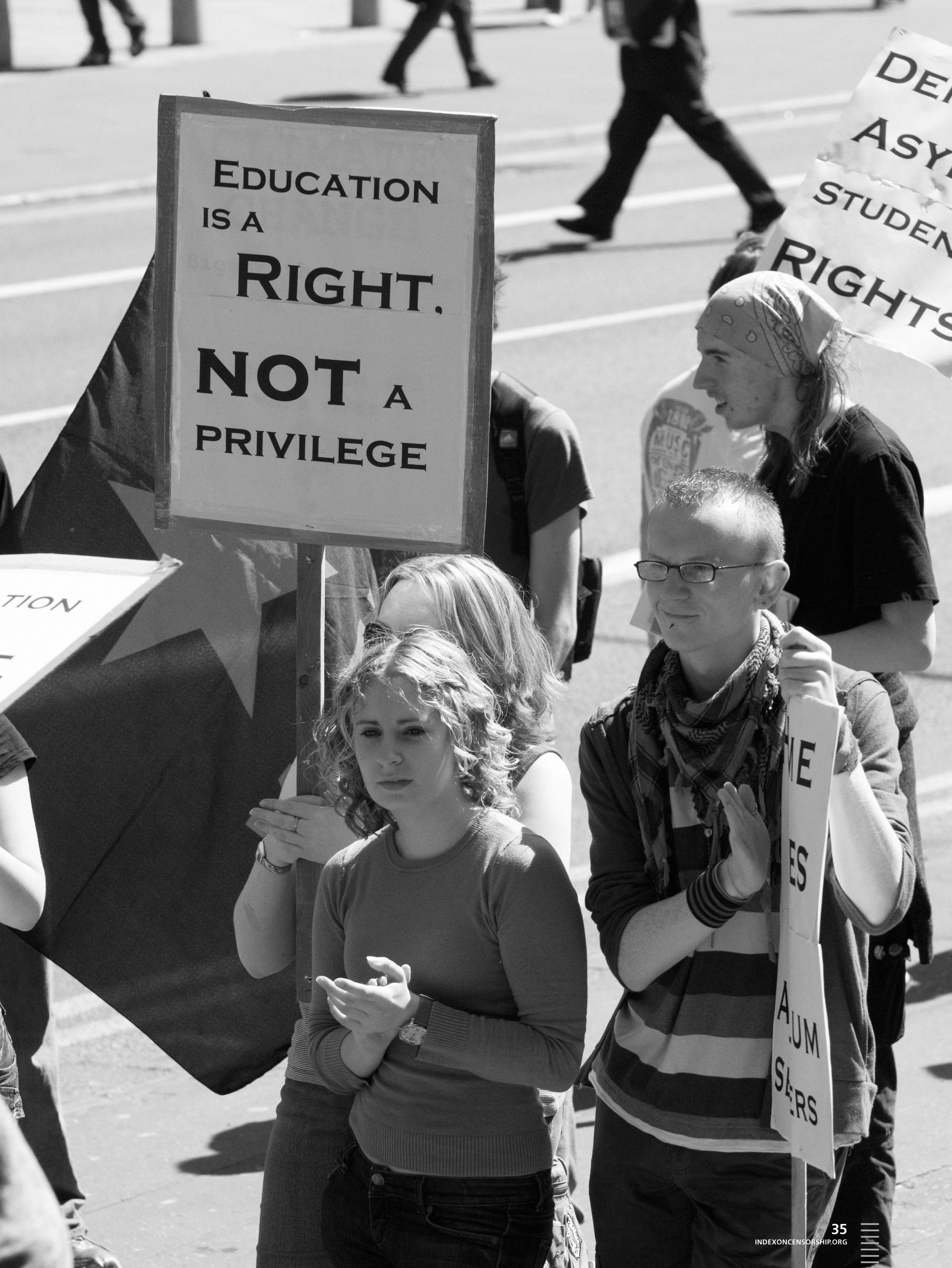
Students taking part in a protest in Manchester, UK
Credit: M Itani/Alamy
Opinion
Speaking out: a student’s view
When we supress free speech in universities, we threaten not only these institutions’ ability to develop the minds of their students, but also their ability to contribute to the public good. The lecture theatre exists at one step removed from the real world, where dangerous ideas have dangerous consequences. UK politician Theresa May holds that universities can be breeding ground for extremism. I disagree. Controversial ideas will not go away if we ignore them. They must come out somewhere, and universities offer a safe space to pay due attention to these ideas, and to give them the scrutiny they so desperately need.
The concern expressed by students who support the No Platform movement has two major causes. Firstly, there is the concern that giving a platform to speakers within an academic institution gives them undue legitimacy. Secondly, many hold universities to be safe spaces, in which students have a right to be protected from speakers whose views cause them distress.
An invitation to speak in a debate and be challenged in an academic setting does not confer legitimacy. If anything, it offers the opportunity for poorly considered, extreme views to be exposed for what they are. Abhorrent views will find a way out, and consequently society cannot afford to ignore them. Universities provide the perfect neutral environment for such views to be properly analysed.
The problem comes when one side of the debate shouts so loudly that the other can no longer be heard. When the Durham Union Society announced that they were holding a debate on multiculturalism to which two members of the BNP had been invited, two students were reported to have sent a letter to the society, demanding the cancellation of the event and threating a large protest. The letter is reported to have said “if any students are hurt in and around this event responsibility will lie with you”. This type of veiled threat has no place in legitimate debate.
It is easy to consistently offer platforms to highly privileged establishment figures with somewhat controversial views, and to hold this up as indicative of an intellectually varied and free environment. However, often the most challenging ideas will come from those who have a different perspective on society – one that has historically been underrepresented in academia, due to the speaker’s race, class or gender, or another such factor. More can always be done to increase the varied array of voices that is vital to a rigorous academic education.
Education means nothing if it does not offer the opportunity to be exposed to, challenged by, and yes, occasionally frightened by, new ideas. It is the job of those who run our universities to seek out those speakers best placed to put forward such ideas for their students’ education. We may claim that the universities in question have got it wrong – that the ideas that they give a platform to are not worth sharing – and we may make our voices heard on this matter. This type of debate is vital to the flourishing of proper education. But to shut down voices on either side of the debate is damaging both to universities’ academic goals, and to their duties to society.
© Charlotte Ivers
Academic freedom, and the possibilities it offers for democratic assembly in society at large, now operates under the sign of terror
Academic freedom, and the possibilities it offers for democratic assembly in society at large, now operates under the sign of terror. This has empowered governments to proscribe not just terrorist acts but also talk about terror; and governments have identified universities as a primary location for such talk. Clearly closing down a university would be a step too far; but just as effective is to inhibit its operation as the free assembly of dissenting voices. We have recently witnessed a tendency to quarantine individuals whose voices don’t comply with governance/government norms. Psychology professor Ian Parker was suspended by Manchester Metropolitan University and isolated from his students in 2012, charged with “serious misconduct” for sending an email that questioned management. In 2014, I myself was suspended by the University of Warwick, barred from having any contact with colleagues and students, barred from campus, prevented from attending and speaking at a conference on E P Thompson, and more. Why? I was accused of undermining a colleague and asking critical questions of my superiors, the answers to which threatened their supposedly unquestionable authority. None of these charges were later upheld at a university tribunal.
Free-speech controversies at UK universities
Southampton University withdrew permission in March for a three-day conference questioning Israel’s right to exist. Health and safety concerns were cited as the primary reason for the university pulling out of the event. The university had been petitioned by the Zionist Federation UK, which gathered over 6,700 signatures calling the conference a “kangaroo court” rather than an academic debate, and saying it would “legitimise the harmful message that Israel’s very existence is up for debate”. (They explain their reasoning on page 38.)
A counter-petition, signed by more than 900 academics urged Southampton University not to yield to pressure. The conference organisers, Professor Oren Ben-Dor and Professor Suleiman Sharkh, challenged the university’s decision by applying for a judicial review at the High Court. The bid was refused, with Judge Alice Robinson ruling that the university was right to cancel the conference after it had consulted police.
Queen’s University Belfast cancelled a Charlie Hebdo conference in April because of security fears, and then reversed the decision after an outcry from writers and academics. In a widely reported email to delegates, the university’s vice chancellor, Patrick Johnston, said he had decided to call the event off, citing concerns about security and the university’s reputation.
After some critical press coverage, a spokesperson later said the appropriate risk assessment had been completed and the symposium would go ahead in June.
“Union apologises for censoring atheist ‘spaghetti monster’ poster”, read a headline on Politics.co.uk. It came after London Southbank University staff removed the Atheist Society’s freshers’ fair poster to avoid “religious offence”. The poster incorporated a spoof of Michelangelo’s Creation of Adam, which replaces God with the Flying Spaghetti Monster and is often used as a parody of intelligent design. “Looking for logic? Pastafarianism is a real religion,” it read.
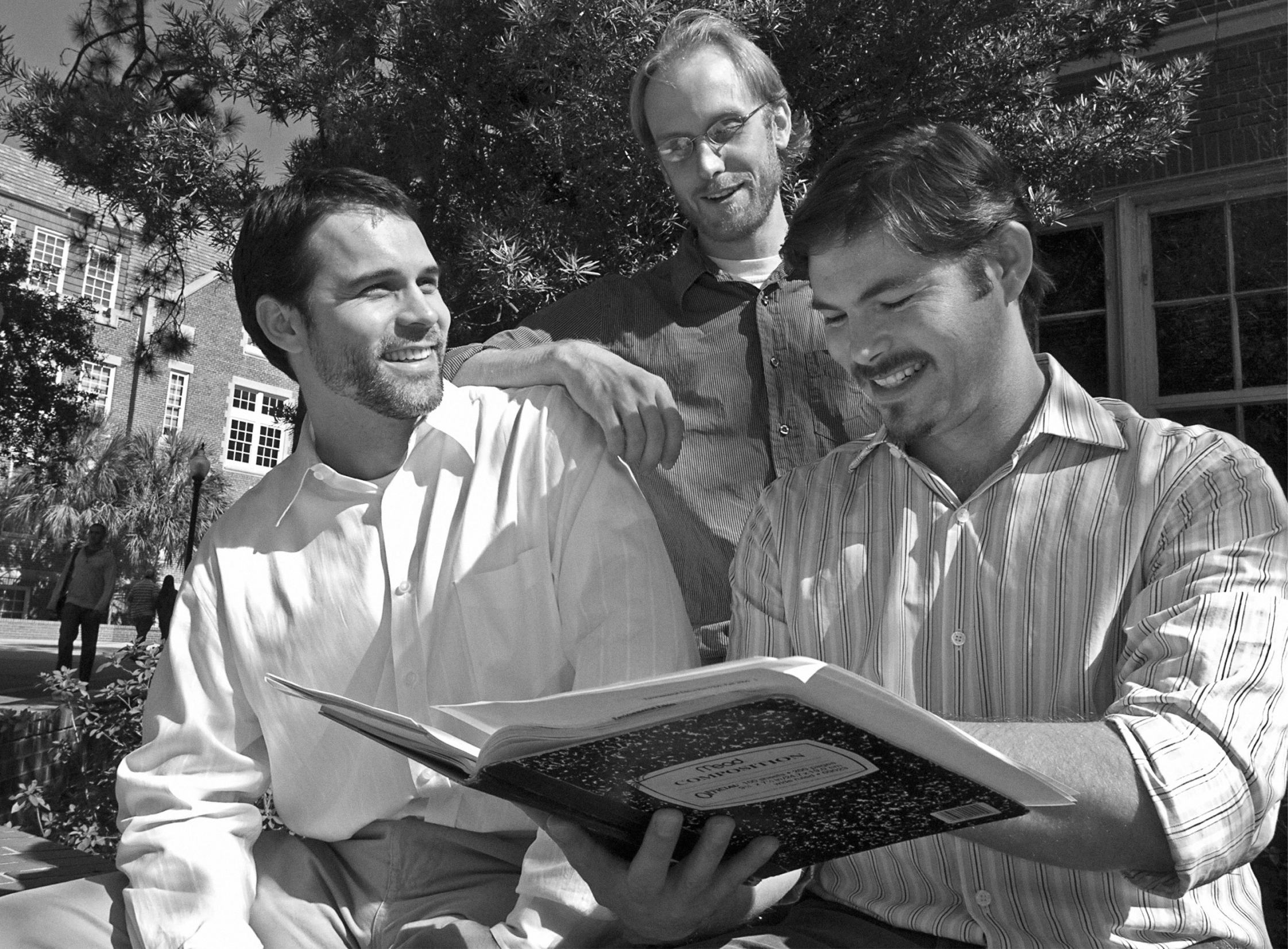
University of Florida students discuss Flying Spaghetti Monsterism ahead of a religious conference
Credit: Phil Sandlin/AP/Press Association Images
Counter Opinion
Why Southampton conference needed stopping
“Have you stopped beating your wife?” This is the classic example of the loaded question, the question you can’t answer without implicitly agreeing to the (unpleasant) premise, argues Paul Charney.
That, in essence, was the case with Southampton University’s recently cancelled conference, International Law and the State of Israel: Legitimacy, Responsibility and Exceptionalism. That cancellation has been mischaracterised as a quashing of freedom of speech, pitting those who wanted an open discussion of the Jewish state and her various misdemeanours against the bullying Zionist lobby.
The problem was that the starting assumption was that Israel’s creation and continued existence were immoral and illegal. If that’s your opinion, then fine. But the whole point of academic discussion – like freedom of speech – is to be open and honest, to get closer to the truth. Thinkers from across the political spectrum should have been welcome – not just one clique. Instead, this event would have been a show trial dressed up as an academic conference.
Freedom of speech does not mean you are obliged to hold all events in your venue. A prestigious scientific institute would be unlikely to host a gathering of the Flat Earth Association, for example. Universities also have a duty of care towards students – one reason why racist “academics” wouldn’t be able to host a conference on why former African colonies should be returned to their masters.
One of the keynote speakers was Richard Falk, a man who has been condemned by the UK and US officials, as well as former UN Secretary General Ban Ki-moon, for promoting anti-Jewish stereotypes and conspiracy theories.
We would welcome any real, open discussion on the subject of Israel’s legitimacy. But with rising anti-Semitism, this masquerade would have been of little genuine academic value, while contributing to the demonisation of the Jewish state.
©Paul Charney
More insidious is the recourse to “courtesy” as a means of preventing some speech from enjoying legitimacy and an audience. Several UK institutions have recently issued “tone of voice” guidelines governing publications. The University of Manchester, for example, says that “tone of voice is the way we express our brand personality in writing”; Plymouth University argues that “by putting the message in the hands of the communicator, it establishes a democracy of words, and opens up new creative possibilities”. These statements should be read in conjunction with the advice given by employment lawyer David Browne, of SGH Martineau (a UK law firm with many university clients). In a blogpost written in July 2014, he argued that high-performing academics with “outspoken opinions”, might damage their university’s brand and in it made comparisons between having strong opinions and the behaviour of footballer Luis Suárez in biting another player during the 2014 World Cup. The blog was later updated to add that its critique only applied to opinions that “fall outside the lawful exercise of academic freedom or freedom of speech more widely”, according to the THES (formerly the Times Higher Education Supplement). Conformity to the brand is now also conformity to a specific tone of voice; and the tone in question is one of supine compliance with ideological norms.
This is increasingly how controversial opinion is managed. If one speaks in a tone that stands out from the brand – if one is independent of government at all – then, by definition, one is in danger of bringing the branded university into disrepute. Worse, such criticism is treated as if it were akin to terrorism-by-voice.
Nothing is more important now than the reassertion of academic freedom as a celebration of diversity of tone, and the attendant possibility of giving offence; otherwise, we become bland magnolia wallpaper blending in with whatever the vested interests in our institutions and our governments call truth. This vested interest – especially that of the privileged or those in power – now parades as victim, hurt by criticism, which it calls offensive disloyalty. What is at issue, however, is not courtesy; rather what is required of us is courtship. As in feudal times, we are legitimised through the patronage of the obsequium that is owed to the overlords in traditional societies.
Silence the speaker; divide and rule the audience. When that seems extreme, attack not what is said but its potentially offensive tone
Academic freedom must reassert itself in the face of this. The real test is not whether we can all agree that some acts, like terrorism, are “barbaric” in their violence; rather, it is whether we can entertain and be hospitable to the voice of the foreigner, of she who thinks – and speaks – differently, and who, in that difference, offers the possibility of making a new audience, new knowledge and, indeed, a new and democratic society, governed by free discussion.
©Thomas Docherty