



Abstract

Earlier this year, an academic at Ankara University’s political sciences department spent an evening writing questions for an exam. He never for one minute suspected that one of those questions might lead to death threats.
As a historian of political movements during the time of the Ottoman Empire, Ünlü recently asked his students to analyse the 1978 Kurdistan manifesto written by Abdullah Öcalan, the imprisoned leader of Turkey’s Kurdistan Workers Party (PKK).
Öcalan who is serving a life sentence in the İmralı island off the coast of Marmara Sea, has, for the past few years, been conducting peace talks with the Turkish state and some politicians in Turkey’s ruling Justice and Development Party (AKP) have publicly applauded his new role as peacemaker.
But for the jingoistic newspaper, Vahdet, asking university students to analyse Öcalan’s early revolutionary manifesto amounted to nothing less than treachery.
“What kind of an university is this?” screamed a headline in Vahdet. “This academic, named Barış Ünlü, is asking his students questions about Abdullah Öcalan. He talks about him in his classes as if he was a ‘leader’. He presents the PKK to his pupils as ‘the Kurdish movement’.”
The article concluded that academics and journalists were following a similar strategy to support their “terrorist activities” : they were hiding “behind the cloak of freedom of expression.”
Because of these articles and a hate campaign on social media, Ünlü has received multiple death threats.
There cannot be many exams where the professor who sets the questions ends up being more terrified than his students. And although Ünlü was not subjected to any disciplinary proceedings by his university, he had to live in fear of his life for pursuing legitimate academic activities.
Ünlü’s case exemplifies the climate of fear surrounding academic freedoms in Turkey where one decision can destroy a meticulously built career.
“There is an identity crisis in Turkey’s education system,” Sarphan Uzunoğlu, a lecturer at Istanbul’s Kadir Has University, tells Index. “Most students who don’t have a Sunni Muslim background are not permitted to express their religious identities. Obligatory religious education is one of the leading problems of our education system. So being a Sunni Muslim with conservative values is ‘allowed’ whereas you are likely to experience oppression if you are a Kurd, Christian, Jew or an Alevi or Shia Muslim.”
Almost everyone knows structural causes behind Turkey’s academic freedom violations. The Council of Higher Education, better known here in Turkey by its acronym YÖK, is notorious among academics for its all-encompassing supervision of all activities in all Turkish universities. Established in 1981, a year after the 12 September military coup in 1980, YÖK’s job is to ensure that no academic institution in Turkey is independent and that all universities are run according to the principles of Turkey’s state apparatus. YÖK has a long history of interfering with the minutiae of academics’ lives including dictating whether they can grow beards or wear headscarves.
Its restrictions on the activities of academic personnel change according to the political climate, but its determination to control university life continues. Only last year YÖK announced new regulations that promised to change the lives of Turkey’s academics. The new rules banned academics from “giving information or expressing their opinions to the media, news agencies or radio and television channels, with the exception of scientific debates and statements”. This was a new way of telling Turkey’s academic community to shut up about public issues at a time when Turkey was undergoing an era of unprecedented social upheaval. Pressures on students also take place in the social media: an undergraduate student from Anadolu University who tweeted the link to the satirical website Zaytung (the Turkish equivalent of The Onion) got a suspended one year prison sentence in April this year.
The centralised control of educational life is a continuing problem that Turkey’s conservative government promised to fix when it came to power, but ended up strengthening. University administrations increasingly interfere in cultural activities and artistic events.
The annual documentary film festival at İzmir’s Ege University was abruptly cancelled in April. Students prepared a change.org petition to get permission for their festival which has a seven year long history to go ahead.
At Ankara’s Gazi University, two sculptures by the famous Austrian artist Heinrich Krippel were removed one night in 2013 simply because they were of nude figures. The year before, seven major universities, including Marmara, Atatürk, Gazi, Fatih, Turgut Özal, Akdeniz and Gümüşhane made filtered internet access mandatory for all students.
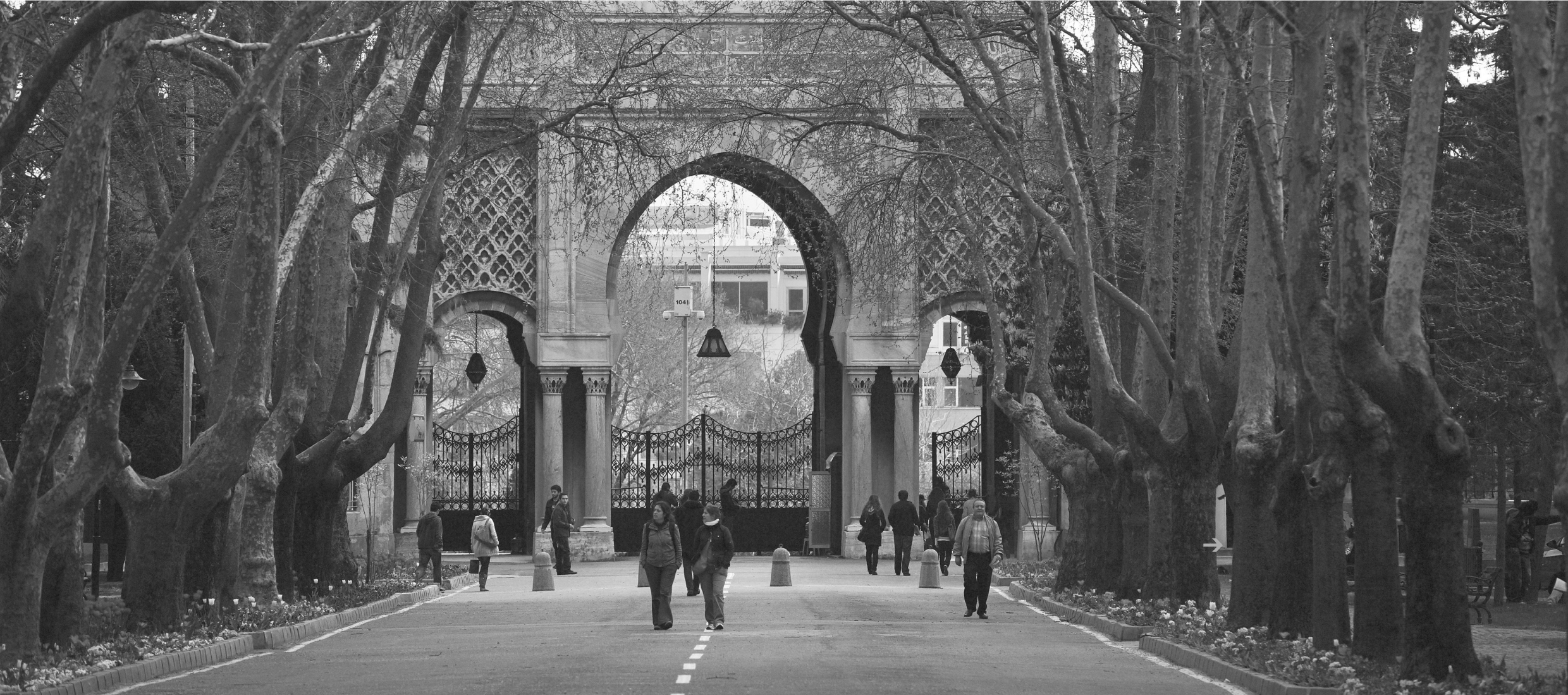
Students walk through the historic gate to Istanbul University
Credit: Agencja Fotograficzna Caro / Alamy
Case Study
Beware classic art
2015 was important for Istanbul University. Academics were scheduled to elect a new rector in March. Professor Raşit Tükel, the vice president of the Turkish Medical Association, won the election by a large majority. His election brought a sense of hope to the academic community but that sense was not to last.
It had been a tough few months in terms of academic freedom. Earlier in March Istanbul University’s art history club had decided to organise a panel called A History of Beauty Through the Lens of Art History and promoted it with a poster featuring Tiziano Vecellio’s classic painting, Amor sacro e Amor profano. The university administration told students that the image was “too explicit” and asked them to remove it from the poster. One student told Hürriyet newspaper how the faculty secretary told them to “censor the thing, do something about it”.
A few weeks before, students from the university’s communication faculty had planned to show a documentary film about the Dersim massacre, a military operation that resulted in the deaths of thousands of Kurds in 1930s. Turkey’s President Recep Tayyip Erdogan had personally apologised for the massacre in 2013, but this year the Istanbul University administration considered the showing of the film on their premises unacceptable.
In April, while attempts at censorship on campus continued, it was announced that Tükel was not going to be appointed as rector despite him topping the poll. YÖK, which is responsible for presenting the most popular candidate to the president for appointment, had recommended Tükel’s runner-up for the job instead.
“If you appoint the runner-up, why hold elections in the first place?” Tükel asked in a public statement. He has called the situation illegal and said this injustice had been perpetrated because of YÖK.
“You cannot be an independent rector when your appointment process is conducted through the government,” he said, pointing to the structural nature of the problem. “This is an attack on the will of the electorate”.
Other examples of censorship include Istanbul Technical University rector’s successful attempt this year to block access to a critical article published in the newspaper Radikal. He took out a court order against the paper because it criticised his failure to preserve academic freedoms on campus
The same month, an undergraduate complained about nude paintings hanging on the walls of Çukurova University’s library, claiming that they distracted students. When a newspaper reported on the issue, the library immediately removed the pictures, saying in a public statement that the paintings were removed because they were “too old”. YÖK’s new regulations and such seemingly random events are part of a shift in the Turkish education system and in what is allowed now at universities. Last year saw the 90th anniversary of the enactment of the Unification of Education Law in 1924. The law made it possible for the Turkish state to control every aspect of education by unifying all institutions under a ministry of education.
In 2013, Beytullah Emrah Önce, a board member of the religiously [CHECK] conservative organisation, the Association for Human Rights and Solidarity for the Oppressed (Mazlum-Der), expressed the need to abolish this law which he said would be “a start to the removal of the oppressive, repressive and denialist mindset of the government”.
Turkey’s education system seems set to remain anti-democratic as long as YÖK is in charge and university administrations take their cue from its regulations. In their manifesto for this June’s general elections the ruling AKP promised to reform YÖK, though what this means is that the institution will continue its existence but under different regulations.
“Universities simply do not have enough autonomy,” Sarphan Uzunoğlu said. “Security policies of university administrations are curbing free speech and making collective intellectual action impossible. Self-censorship is not an individual mechanism for us. There is an oppressive environment for both academic staff and students. As most of the bureaucratic mechanisms are controlled by laws and higher administrative staff, most intellectual activities are under surveillance.”
According to Uzunoğlu the curbing of academic freedoms goes hand in hand with an even more crucial shift from a state-driven education system to one based on neo-liberal principles.
“This second shift is economic in nature,” Uzunoğlu said. “State universities are weaker than ever, while the number of private colleges that have high tuition fees are rising every day. If you have enough money, accessing high quality education is ‘allowed’ for you, while for lower classes accessing qualified education is almost impossible.”
Nevertheless, Uzunoğlu emphasised that the relative freedom in private universities is also an illusion.
To have an understanding of Turkey’s academic freedom, compare the cases of two conferences about the killings of Ottoman Armenians. The first was held in 2005, and another one was scheduled to take place in April 2015.
The 2005 conference, planned to be held at Bosphorus University in Istanbul, featured a respected group of speakers, including the late renowned journalist and editor Hrant Dink and the novelist Elif Shafak. It was abruptly cancelled, after a nationalist lawyer applied for an injunction in a local court.
“I can’t approve of such a decision that cancels the organisation of an event where people would freely express their opinions,” said the then prime minister Recep Tayyip Erdoğan. So the conference was then held at Bilgi, a private university. Despite attempts by protesters to stop speakers from entering its premises, it was a success and a milestone for Turkey’s academic freedoms.
When academics from Turkish universities and University of California wanted to organise a similar conference in 2015, the centennial of the mass killings of Ottoman Armenians, at the same venue, Bilgi University refused, saying in a statement that they never received an application from them in the first place.
The organisers say the university had not only accepted their application but even announced the event before deleting it from its website. Such an occurrence, if proven, seems to point to a new, more sinister climate of censorship in Turkey’s academic life.
© Kaya Genç
In 2005, a conference at Bilgi University discussing Armenian Turkish deaths attracted protests, but went ahead
Credit: Faith Saribas/Reuters

