Abstract

Magnum photographer
Earlier in the year, the Hutu tribal majority had perpetrated genocide on the minority Tutsi people. Neighbour turned on neighbour, friend on friend, killing squads were organised, and over 100 days it is estimated that between half a million and one million people were murdered. The intervention of the rebel Tutsi army (RPF) turned the tables so that the Hutu, fearing retribution, started to flee.
From Uganda the journey to the refugee camp was fraught with problems. There was a 560km drive across difficult terrain. We had to confront drunken soldiers, pay out bribes and navigate poor roads.
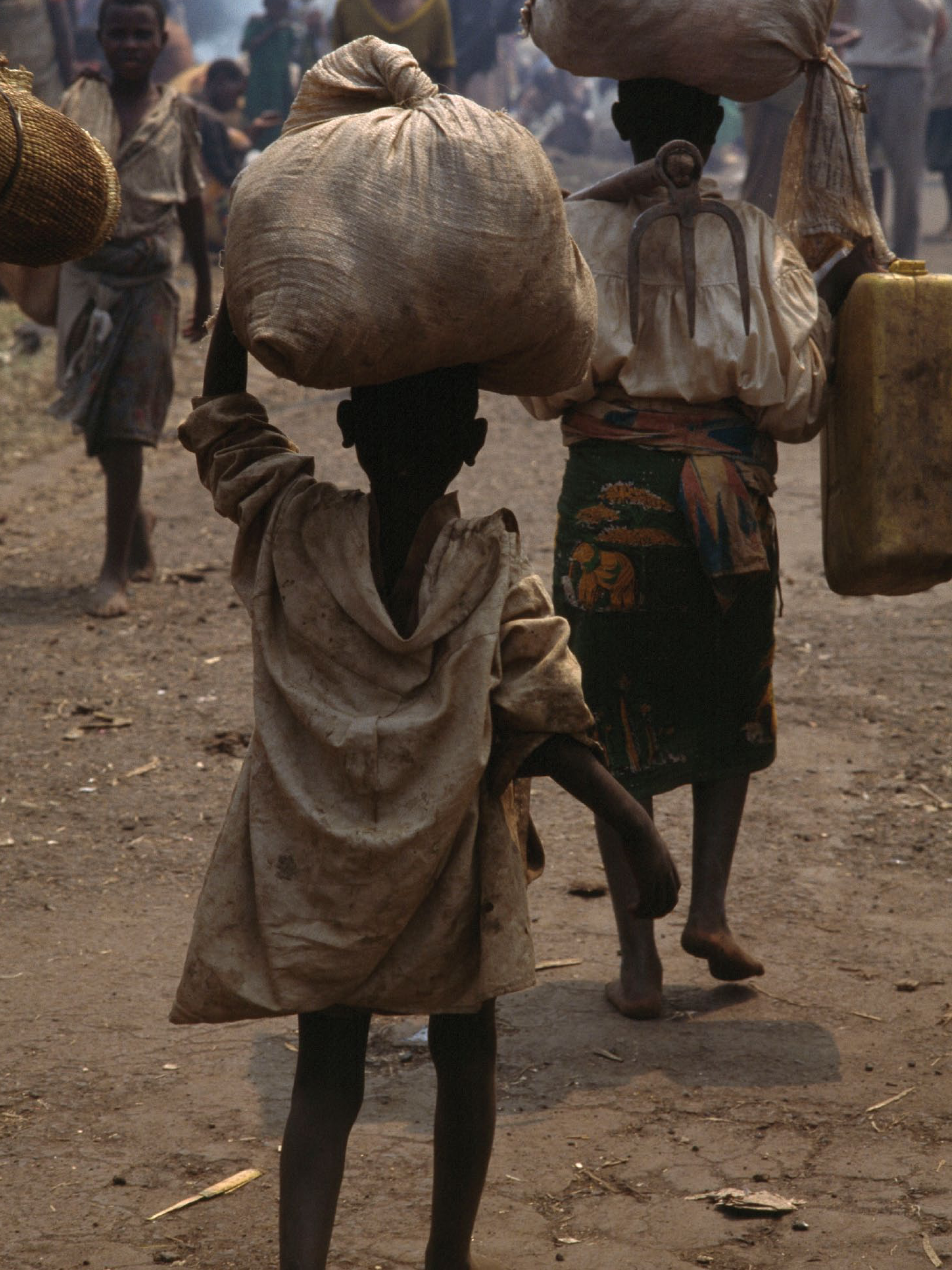
I thought when I covered the famine and civil war in Somalia in 1992 that I had seen the lower reaches of hell. I did not realise there were even lower depths. Goma was worse than Somalia and the scale was staggering. Once the border was opened people were funnelled over a narrow bridge into town, carrying whatever they could with them, including their children. They walked over a carpet of bodies of those that had died on the bridge. There was no other way in.
Once in town, much of which had been wrecked by previous fighting, people lay down wherever they could on the sharp skin-slicing volcanic pumice that dominated the landscape. NGO workers hunted through the people, distributing water, transferring the worst cases to make-shift clinics and feeding centres. Abandoned children, and those who had lost their parents, or whose parents had died, wandered around like ghosts. The smaller ones sat and cried.
Some who were stronger were encouraged to keep going a few kilometres beyond Goma to larger camps in the countryside, where they would get food rations and materials to construct a shelter.
The corpses literally piled up in the street. Some were bulldozed into mass graves. When local residents protested by making a roadblock of corpses, the Zairean army turned up and ordered them to be moved, and then went away again. Women filled water pots from the lake where bloated bodies floated yards away. Scavengers took clothes from stinking bodies. Children died in front of me. Some aid organisations were making heroic efforts to help the displaced people but the overriding sense was one of sleepwalking through madness. How to convey this nightmare? I think I failed.
Rwandan refugees in Goma, Zaire (now Democratic Republic of the Congo), in 1994
Credit: Chris Steele-Perkins/ Magnum
In those pre-digital days a major logistical issue was how to get my film out of the country. The Red Cross had a number of small planes bringing in staff and supplies from Nairobi. I arranged for a pilot to take some film from me, and for him to contact my agency, Magnum, so the film could be transported to Paris. However, the pilot forgot and put my unprocessed film in his locker room and went on holiday for a week. When the film got back to Europe it was two weeks late.
How easy it was to feel sorry for myself and lose perspective. The fragile journalist’s ego bruised while my subjects lay under a raging sun. I had lost 14 days of not being on the front pages. They were losing their children, their health, their homes, their sanity.
How beguiling the country could be too. Early in the morning, before the sun rose, and the stench invaded your pores, it was beautiful: pools of low mist, the glow of fires, smoke drifting, fluid abstract bodies balancing baskets and goods in silhouette against a waxing sky. This was the visual fodder of tourist brochures conjured from the landscape of suffering.
It is easy to be judgemental, far too easy. How often did I find myself thinking of the Hutu refugees: “Did you butcher your neighbours? Is that panga [machete] you’re carrying stained with human blood?” I even thought: “They deserve this after what they have done!” But not all are guilty. There are the children. They are the innocent. Justice, if there ever is justice, follows another course. That kind of thinking puts me on the level of the killers and I had to ask myself if I could ever do what some of them had done. The answer for us all is hard to accept, but we know that there are circumstances in which we could have.
Shortly after I got home from Zaire I became ill. I could hardly get out of bed or feed myself. I dragged myself to the Hospital for Tropical Diseases in London and had some tests. They found I was suffering from shock. I was sent home to lie down and rest. I had thought myself invulnerable but I had not been able to go through those experiences without being marked.
Almost two decades later I covered the Rohingya refugee situation in Burma. It was a totally different experience. The Rohingya, originally Bangladeshi Muslims, had never been given Burmese nationality and had been the target of violence by the local Arkanese population at various times. In 2013 the Rohingya had again been attacked in serious numbers and many driven from their homes. Some were now in makeshift camps, some in purpose-built camps and some were re-settled in areas with a high Rohingya population that had remained free of attacks.
Access to some of the camps was very easy, while others, the more inadequate ones, I was told, required government permission which I did not have time to get. So I flew to Sittwe where the nearest camps were close to town. Normally the United Nations and NGOs are happy to help visiting journalists, but the government control was such that they were paranoid about having their operations closed down if they were seen to be working with us.
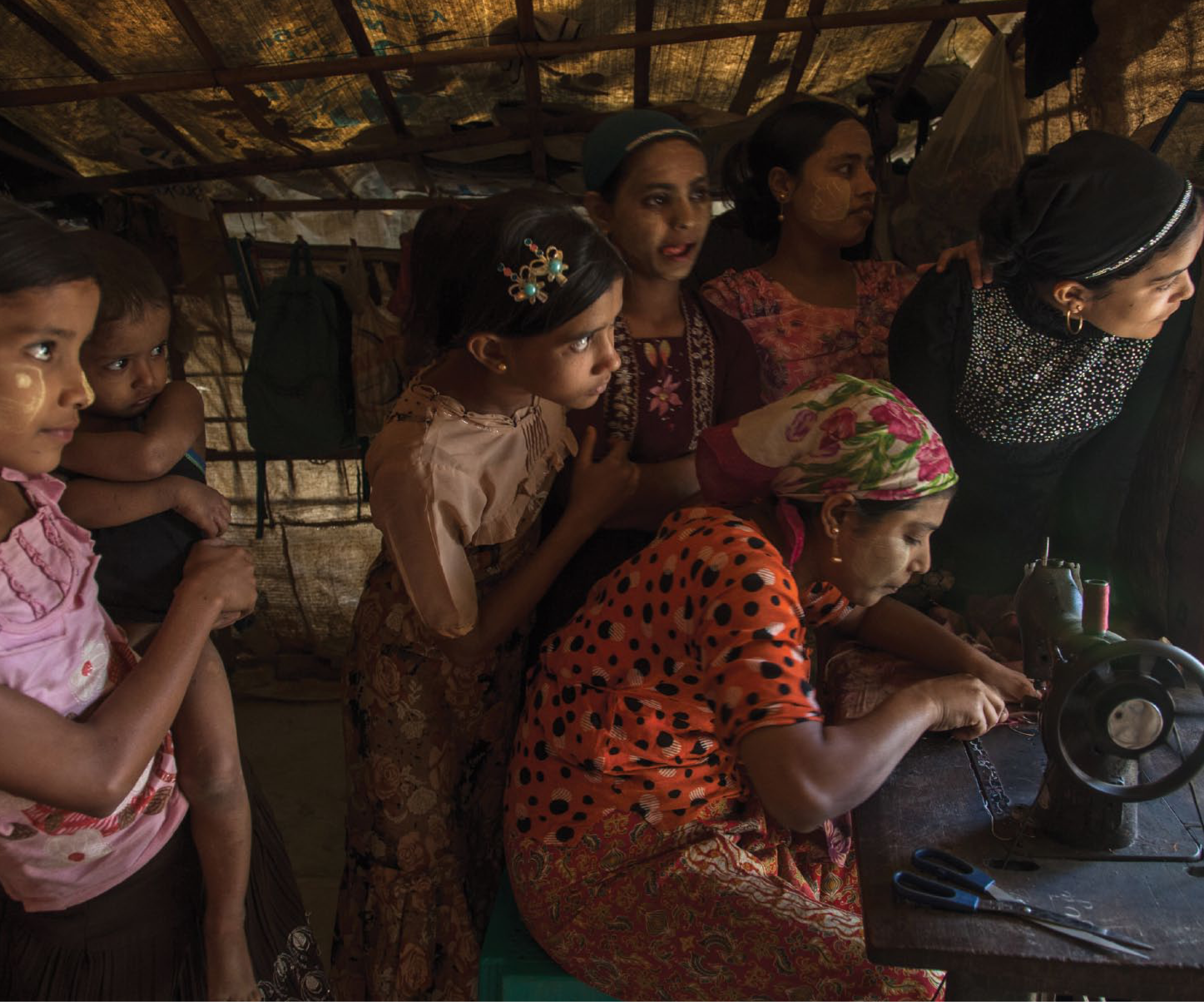
Fortunately I had been in touch with Aung Win before I left London, a fluent English speaker who had become somewhat of a press spokesman for the Rohingya. He and his family were displaced and he now lived in a house within a local Rohingya area, just outside Sittwe which had remained unscathed by violence. I took a taxi to the edge of the community, passed a laid-back police post, and was met by Aung Win and a 4×4 he had arranged for transport. The camps did not appear until we had driven about 30 minutes to Nazir district where we got to a metal bridge and looking down from the bridge to the right, the camp was pointed out to me. It had become an extension of the existing village. Some of the houses were constructed of tin and plastic. Others were just like village dwellings, small wood and straw houses with bits of polythene patching. The area was poor, but not exceptional. Some local women had started a sewing class to help provide a source of income. Neighbours stood and chatted, put washing out to dry on plants, and children climbed trees.
I remember being outraged in El Salvador by US crews pushing their cameras into grieving people’s faces. But, because I stood further back, did that make me superior?
Deeper inland were some purpose-built camps, such as Baw Du Pha, with regimented rows of rooms and a numbering system like a barracks. Nearby an enterprising farmer had hired some land and was running a successful melon farm. It was clear that the people here were not going back to their homes any time soon. This was now their home.
Aung Win explained the underlying neglect, and discrimination practised by the government. He explained how a hospital had been closed in Dapaing village, a Muslim enclave, as doctors no longer came and there was no medicine. A local nurse and a midwife from the camps kept watch at the hospital so they could at least provide advice to those patients who came expecting help. They did not want to be photographed for fear of reprisals.
The government had withdrawn funding to these areas, so in most places schools were run by volunteer teachers who were dedicated young people, mostly women. In the mosques, which were often just a tin-roofed platform, Quranic classes were held. In the village of Thea Chaung, where a number of refugees had gathered we saw a young imam trying to control lively kids, excited by the appearance of a strange photographer. There had been other photographers, film crews, journalists, and fact-finding missions before me, Aung Win said. He had taken about 150 journalists to visit the mosque, enquire, film and then move on.
How should we as journalists conduct ourselves in these situations? I remember being outraged in El Salvador by US television crews who were, as I saw it, pushing their cameras into people’s faces as they grieved. But, because I stood further back, did that make me superior? I was not invisible. I was still invading their grief and converting it to foreign currency, selling my work by recording their heartbreak. Nowadays I try to explain to people who I am, seek their agreement and try to communicate with them, if not in words, then by touch, gesture, a smile or movement of the head: the body language of empathy. And the photographer’s role is one of empathy. Without an emotional connection how can the photographer expect the audience to connect? But, at the same time, you’re a professional, you have to deliver, you cannot indulge in sentiment.
As in Goma, so in Sittwe, I try to do my best, but it all feels so inadequate in the balance of things when my home has not been destroyed, when my family has been killed, when I have not been rejected by the government of the county I live in. I can leave the confines of the refugee camps, drive past the laid-back police post, and take a plane to my comfortable home and consider if I want my chateaubriand steak medium or rare.
Women take a sewing class in a camp in the Nadir region, Burma, in 2014
Credit: Chris Steele-Perkins / Magnum