




Abstract
When a wave of attacks on African migrants ripped through South Africa seven years ago, a church became a sanctuary for people who feared opening their mouths in public because they would give away their origins. Now its days as a refuge are over, but, as
They were the last of the almost 35,000, mostly Zimbabwean, immigrants who sought refuge in the Central Methodist Church in South Africa’s city of gold. Seven years ago, it became a safe haven for people seeking protection from violent xenophobic attacks that were ripping through the country. South Africa is far more economically stable than its neighbours in the Southern African Development Community, and has long attracted hundreds of thousands of people seeking work and political security. Festering feelings that foreigners were stealing jobs, fuelling inequality and causing crime suddenly burst up and exploded. Riots broke out. Immigrants’ businesses were torched. Anyone with a foreign accent feared being attacked in the street. In the most horrific case, Ernesto Alfabeto Nhamuave, a 35-year-old from Mozambique who was working in Ramaphosa, a township in east Johannesburg, was set on fire in the street; the picture of him engulfed in flames, on his hands and knees as uniformed police officers looks on, went around the world.
In just two weeks, 62 people died and thousands were left homeless. It was particularly dangerous to be a foreigner moving around major cities like Johannesburg. Language, in particular the use of certain colloquialisms, made people targets. The Mail & Guardian newspaper reported that “as attacks on foreigners intensified and spread across Johannesburg, mobs began pulling people out of shopping queues and forcing them to take ‘tests’ to establish their nationality”.
While this was going on, George, a Malawian man who tended my parents’ garden every weekend took time off from his various jobs and returned to Malawi – because, he told me then, he was frightened to be stopped on public transport and ordered to speak isiXhosa, the most commonly spoken African language in the Western Cape province. He had heard of people (“people like me” he said), being thrown from moving trains because they could not identify body parts or use simple words in isiXhosa. Rather than risk his life, George stayed silent and spent a few months unemployed in Malawi before returning to resume his life in South Africa.
The Central Methodist Church, Johannesburg, was a safe haven for immigrants for seven years before its role as a shelter came to an end in December 2014. Pictured are some of the 35,000 people who have sought refuge in that time
Credit: Simphiwe Nkwali/Sunday Times
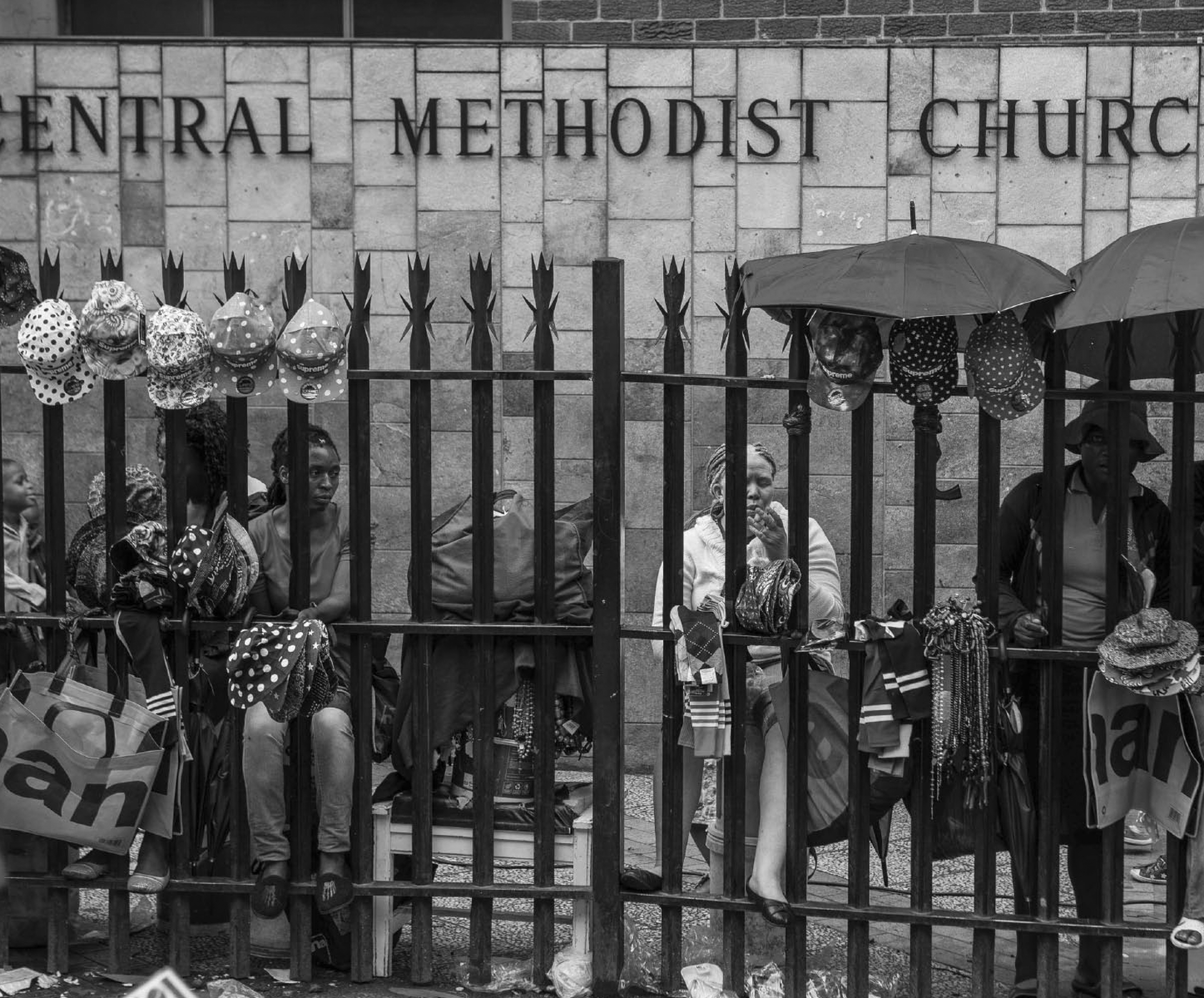
Many immigrants were not so lucky, and places like the Central Methodist Church offered at least some protection by opening its doors to terrified immigrants. But the building was never meant to be a long-term home. Like many buildings in Johannesburg’s city centre, which are overcrowded and ill-maintained, it degenerated into a slum as more and more people came. A reporter from the South African Sunday Times who visited the Central Methodist Church in December 2014, described filth, debris, broken lifts and people sleeping in stairwells.
By then, the church’s superintendent Bishop Paul Verryn, 62, was at the tail-end of a long battle that had seen him repeatedly butt heads with church leaders from South Africa’s Methodist church. In 2010, it suspended him, complaining he had taken decisions about the church building and its occupants without authority. The bishop’s suspension was quickly lifted, but for the next four years he fought to make the Central Methodist Church as good a temporary home as he could. By the end of 2014, though, it was clear that the church could no longer serve as a safe shelter. Verryn was moved to a new position and, on December 31, the remaining residents’ time ran out.
Verryn spoke to Index on Censorship on that last day, just after he had delivered his last sermon there. He said the church had been a shelter even before 2008, for those who were “quite seriously broken from the trauma of leaving their country and making the trip to South Africa”. They came from countries racked by decades of civil war, political and economic unrest: the Democratic Republic of the Congo, Somalia and Zimbabwe.
He had heard of people being thrown from moving trains because they could not use simple words in isiXhosa
Verryn said that “for the longest time there were about 50 people in the building”. But, in 2008, “there was an explosion of people moving into the building after the xenophobic attacks – about 1,500 moved in”. Some Verryn even accommodated at his own home in Soweto. Many of these people, he recalls, were suffering a double trauma: they had fled violence, or even war, in their own countries and, after building new lives for themselves, were thrown back into a kind of hell by the neighbours they’d trusted in South Africa. One man who lived with Verryn for a time was so severely distressed that when he slept any loud noise would trigger flashbacks and memories of torture.
During the church’s seven years as home and haven, Verryn preached to his congregation about the plight of those seeking shelter. In his sermons, he tried to educate South Africans about welcoming people from around the continent and world into their backyard, and many donated food and clothes to the foreigners living in the church.
By the end of 2014, even Verryn knew it was time to close the church’s doors. Central Methodist Church wasn’t meant to be a “destination”, he told Index on Censorship – rather, it was a stop on the journey that he hoped would see many people reintegrated into their South African neighbourhoods. “Though we provide a little bit of shelter from the street, this is not the ideal place, where people will be sleeping on the steps with no privacy for years.”
Attacks against foreigners remain uncomfortably common. The South African government insists that what victims and the media describe as xenophobia is actually just garden-variety crime. A cabinet statement from May 2013 read: “The cabinet is cautious not to label this violence as xenophobia because preliminary evidence indicates that these acts may be driven primarily by criminality.” But a trawl of South African newspapers reveals at least two or three reported attacks on foreign-owned shops each month, and as victims often complain that they are frightened of the police, it’s likely that the problem is vastly underreported.
South Africa holds its local government elections in 2016, and jobs, education and the provision of housing and sanitation will be top of people’s minds. Competition for jobs (South Africa’s unemployment rate was above 25 per cent in the third quarter of 2014) is fierce and foreigners are seen as “stealing” jobs from locals, whether by entering the formal labour market or setting up their own businesses. In 2013, the Gauteng Greater Business Forum denied that its members were actively organising xenophobic attacks on foreign-owned grocery shops – but went on to say that foreign-owned shops were bad for the economy and people from elsewhere in Africa and from Asian countries, such as Bangladesh and Pakistan, who most commonly run their own businesses, should be placed in refugee camps.
Central Methodist Church may have closed its doors, but feelings, nationwide, still run deep. Immigrants may not be stopped in the street and ordered to answer questions in Zulu or isiXhosa to prove that they ‘belong’, but judgements persist. “We are never not vulnerable, especially as a country that has been struggling with a propensity to be prejudiced all the time,” said Verryn. “You don’t come out of a history of centuries of oppression and think that all of us in this country are not susceptible to making irrational decisions based on tribe or gender. We have a long way to go, particularly in a nation where the disparity between haves and have-nots is this great.”
Footnotes
Additional reporting by Athandiwe Saba