




Abstract

As we approach the 70th anniversary of the end of World War II, Chinese cinema and TV drama are obsessed by the evils of Japanese invasion and occupation.
So why is Beijing encouraging these wartime movies with their anti-Japanese messages right now? Put simply nationalism has become the Communist Party’s closest ally. Antipathy to Japan is used as a way to nurture patriotic fervour and detract attention from the home front. The genre goes in and out of fashion. Films about the war have circulated for decades, but it was during a legitimacy crisis two decades ago surrounding Tiananmen Square that the Communist Party first initiated an aggressive anti-Japanese propaganda campaign to bolster support for the government.
As for the recent push, 2015’s China is not a secure place for the Communist Party. It has found itself embroiled in a series of corruption scandals and faces a population disillusioned by many aspects of contemporary Chinese society. A common enemy can promote unity and provide a useful political distraction. One user of microblogging site Weibo hits the nail on the head: “Other than the [Japanese] ‘devils’, who are we going to fight? Corrupt officials?”
China has a long tradition of producing war movies, mostly drawn from the brutal conflict with Japan between 1937 and 1945, known by the regime as the Japan War of Aggression. During the Cultural Revolution, the movie Tunnel Warfare (1965) was seen by millions in China. The film depicts resourceful Chinese insurgents outwitting Japanese soldiers through the establishment of a network of tunnels.
Tunnel Warfare is part of a well-stocked library. According to Reuters, some 100 films and 69 TV programmes were produced in 2012 alone about Japan’s war with China. After this bumper year, Xia Jun, a former China Central Television director, commented on the microblogging platform Weibo: “What’s up with China’s TV industry? Take a look around Hengdian [a major Chinese television studio] and you’ll see 40-50 casts and crews fighting [Japanese] ‘devils’.” It is estimated that the genre occupies as much as 70 per cent of the market, according to Reuters, and it’s a share that will increase in 2015 if government orders are obeyed – and in China, these orders usually are.
An image from the film City Of Life And Death, (also known as Nanking! Nanking!) released in 2009
Credit: Rex/National Geographic/Everett
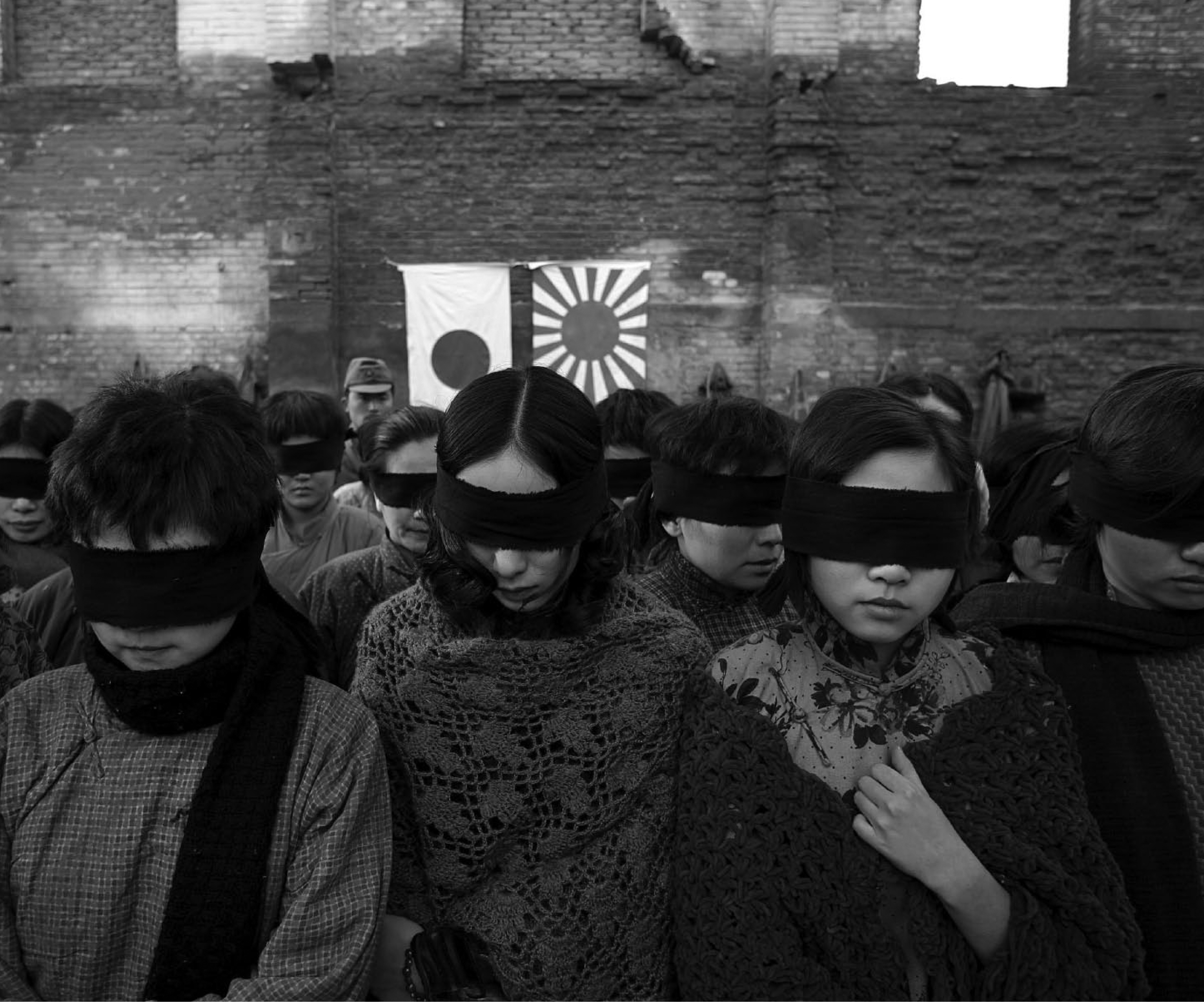
For most of the 20th century, China’s film and TV industry output was in the hands of the state, from inception through to completion. Under Chairman Mao (in power from 1949 to 1976), all movies had to serve a political purpose (The Party is great! Long live Chairman Mao!). Japan was lumped together with landlords, the former ruling Qing and other groups as “enemies”of the state, and these groups frequently appeared as the bad guys in films.
The state’s control of the industry started to relax under the market reforms of Deng Xiaoping from the 1980s. Film studios became autonomous and today can make their own content. That’s the theory at least. In practice they still have to get the approval of the Chinese censors if they want content to be aired domestically, either at the cinema or on TV. Having government approval is crucial. Government backing is even better – as shown in The Beginning of the Great Revival, a film about the founding of the Communist Party. When it opened in time for the party’s 90th birthday in 2011, state-owned firms and schools were ordered to attend, and critical reviews were censored. Success was guaranteed.
By contrast, Jiang Wen’s 2000 film Devils on the Doorstep was a flop. It tried to paint a more nuanced account of the war with Japan and was banned in China. The film, which won the Grand Prix at 2000 Cannes Film Festival, was accused of glorifying Japanese soldiers when it showed them exercising restraint towards Chinese villagers.
Mainland Chinese directors and producers are unwilling to spend time and money filming subjects the authorities might censor. It’s less about government-produced propaganda and more about for-profit propaganda.
China Film Group (CFG) knows how to play the game. Along with a smaller firm in which it holds a 12 per cent stake, CFG controls over half of all domestic film distribution. The firm produces tales of love, disaster and, of course, martial arts. But the easy money is in the war. In recent years, CFG has produced Nanking! Nanking! (also known as City of Life and Death) about China’s resistance against Japan, among other similar titles.
The genre has become synonymous with plots that rarely veer off a beaten track of good-versus-evil and acting that is derided as simultaneously wooden and over the top. Indeed, it has become something of a joke among Chinese viewers. Even Shuai, the Chinese actor quoted at the start of this article, is critical. “The plots are stupid and the characters I play are always the same,” he said, adding that he feels under-challenged by such roles.
But there’s more to the story. The Communist Party can use Japan as the prime enemy precisely because there are real grievances in China about the war. China’s war with Japan was, after all, the longest conflict during World War II, with Japan invading China two years before Germany invaded Poland. It was also among the bloodiest. Some 14 million Chinese lost their lives during the eight years of conflict. Seventy years on, these movies might employ similar motifs and often in silly ways, but that does not mean the subject matter is a joke. For this reason there is demand for them beyond government offices. Older people in particular want to watch these shows and films: for them, the war against Japan is not ancient history.
“What is often missed in the Western press is how deep the feelings are among Chinese people about the issue. People can stoke it up but obviously there has to be a fire there to start with,” Professor Chris Berry, a specialist in Chinese cinema, told Index. “It’s hard to say one is a propaganda film and one is a commercial film. There are many different players involved and they all have different wants.”
It is estimated that films about the war with Japan represents as much as 70 per cent of the market
Berry does believe these films are manipulated by the Chinese government for the purpose of propaganda, but he paints a more nuanced picture of what is going on behind the screens. He’s also keen to stress that not all of the Chinese war films are terrible.
“Some of the films about Nanjing in particular try to provide a more complex picture. They try to depict Japanese soldiers who are not necessarily just grinning devils, at least in the world of feature films – TV series are more stereotypical.”
Herein lies another problem with using the propaganda label too freely: Western commentators, in their haste to criticise China in this respect, are guilty of their own form of censorship. They effectively want to deny China the opportunity to talk about its wartime grievances.
It’s a point that Lu Yiyi, a journalist and expert on Chinese civil society, has noticed. In response to criticism of the 2011 Chinese film The Flowers of War, featuring Christian Bale, about the Japanese capture of Nanjing in 1937-38, Lu wrote in the Wall Street Journal:
“On the issue of China’s dispute with Japan over the presentation of second world war history, there is a clear tendency for many Western media reports to employ double standards, underplay the sufferings of the Chinese people during Japanese occupation and turn the coverage of the history dispute into attacks on the Chinese government.
Western commentators, in their haste to criticise China in this respect, are guilty of their own form of censorship
“Numerous Holocaust movies have been made that portray Nazis as evil incarnate, but one does not see Western media describing them as anti-German propaganda that ‘lacks subtlety’. Yet, when Chinese films on the Japanese occupation during second world war come out, western media reports are often quick to deplore their portrayal of Japanese soldiers as ‘one-dimensional savages’ and their ‘demonisation of the Japanese army’, despite acknowledging that the Japanese army had committed many atrocities, including during the Nanjing massacre.”
“It’s a mutual memory war,” said Berry, citing the example of school textbooks in Japan as comparison, which primarily show the Japanese as victims of the atomic bomb. That is a pertinent point: both historically and today under Japanese premier Shinzo Abe, the country’s war atrocities are downplayed and a heavy dose of lip-service is paid to Japan’s powerful nationalist lobby.
The end of 2014 saw Japanese nationalists call for Unbroken, an American movie about a prisoner-of-war directed by Angelina Jolie, to be banned. Chinese film director Li Ying’s 2007 tour de force Yasukuni was also banned by many Japanese cinemas. It examined the controversial war shrine in Tokyo from a number of different perspectives. In an interview with Index, Li, who currently lives in Japan, said that despite there being no official censorship body in Japan, certain topics are taboo. Criticising Japan’s emperor during World War II is one such topic.
“There are a lot of anti-war films in Japan, but none of them directly face the Japanese emperor,” he said. Undeterred by this past experience, Li has another film out this year, which again challenges popular convention about the war. Li wants to make people “rethink the tragedy of war” so that history is not repeated. At the same time he is acutely aware that he might receive unwanted animosity in Japan and admits that his producer is worried.
Viewers are right to be sceptical when watching “another China war movie”. What it does show though is that controversies surrounding how the war is remembered transcend borders. Manipulation is not a one-way street. Some of the content that is airing in China this year is certainly propaganda; other content is part of a cathartic coming to terms with the past. It will largely be up to the viewer to decide which is which.