



Abstract

Lebanese playwright
His 2013 play Will It Pass or Not? was banned by Lebanon’s censorship bureau, yet this new take, which includes scenes from the original, has been approved after some minor changes. It has already been performed in Beirut.
Bourjeily said this could be because of a change in personnel at the bureau, or more likely from the global attention, which came when the first play was banned. During his fight with the censors he was nominated for the 2014 Index Arts Award, and he also made international headlines when the authorities confiscated his passport last May.
Bourjeily’s passport was taken when he tried to renew it before a trip to London’s Lift festival. Initially he was told it could be six weeks before it was returned to him, but there was a sudden change. “People spread it all over the news. It went viral, everybody was talking about it, even internationally,” he said. “They gave me back my passport and now they gave me permission to do the [new] play … it’s a total reversal.”
However, other cases of censorship in the country highlight that the bigger issues are far from resolved. Bourjeily mentions the case of Kareem Hawwa, who shared an article relating to the interior minister on Facebook, and was then arrested on allegations of slander and defamation. Bourjeily says: “The article isn’t even written by this guy and then he got detained for four days and now he has a trial.” It is unclear whether or not Hawwa also posted comments on the article, which may have provoked his arrest.
Bourjeily believes Hawwa was released on bail as a result of media exposure, and that the actions of the Lebanese authorities are greatly affected by how the outside world perceives them. “I think there’s a schizophrenia with the Lebanese government,” said Bourjeily. “They want to be the free government who accepts everybody, who doesn’t oppress anybody, but at the same time they easily get offended. They easily get to abuse their powers. They don’t accept criticism from activists and then they actually pursue them through the justice system.”
Other cases of censorship highlight that the bigger issues are far from resolved
Bourjeily says that in having For Your Eyes Only, Sir approved, activists have won a small tactical battle, but they have yet to win the war.
Scenes from a live performance of For Your Eyes Only, Sir at the American University in Beruit
Credit: Richard Sammour
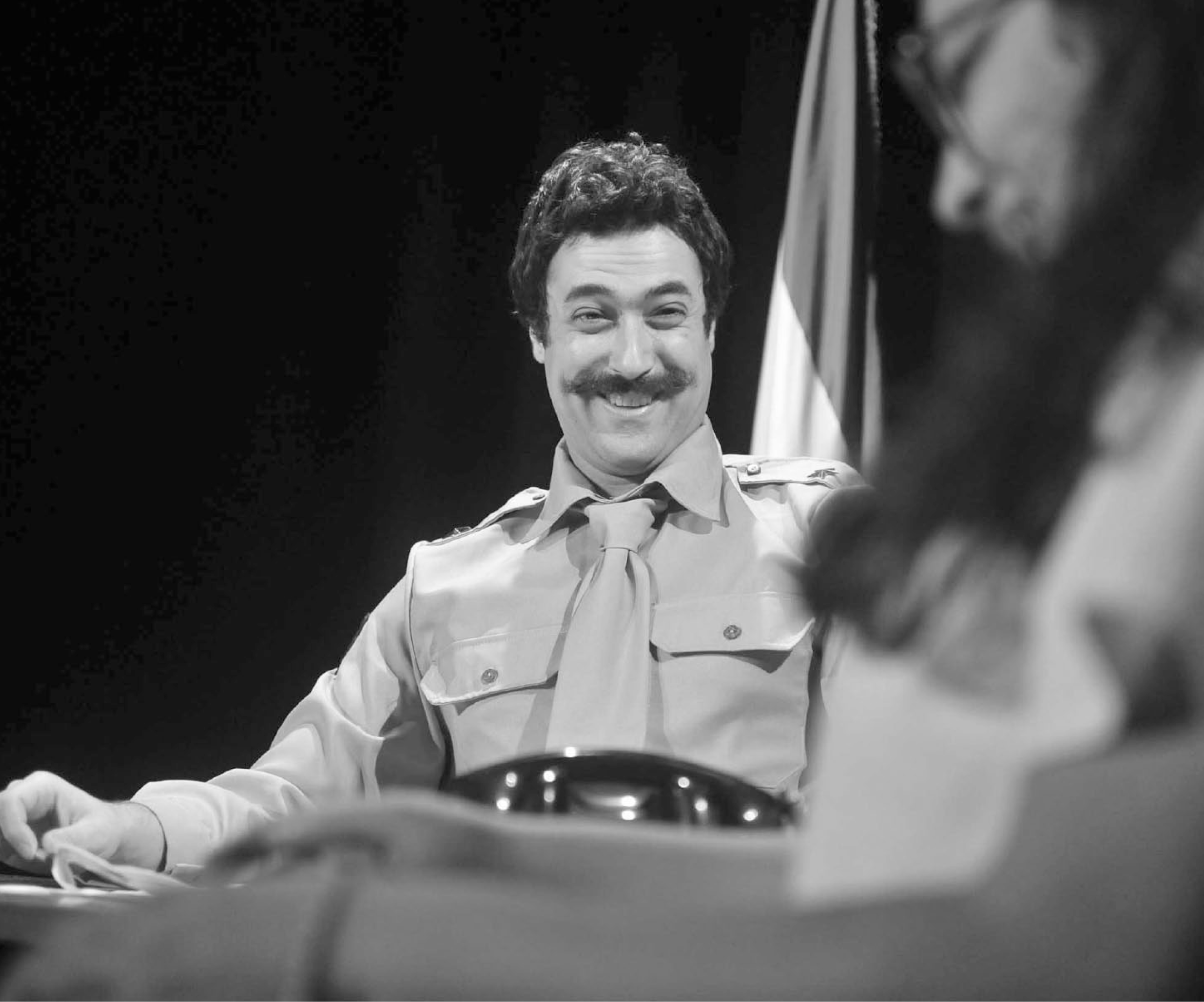
For Your Eyes Only, Sir
In the censorship bureau of the general security directorate. Kareem (33), a director, is sitting on a chair.
Sergeant Da’ja enters the room. Kareem raises his hand.
Why are you still here?
The captain got a phone call. I’m waiting for him to finish, then I’ll go in and see him again.
Fine.
Jeanne D’Arc enters.
Bourjeily (right) plays Kareem/Writer in a live performance of For Your Eyes Only, Sir
Credit: Richard Sammour.

Bonjour, I’ve come straight from the theatre. Do you recognise me? Jeanne D’Arc, the French-Lebanese actor. Perhaps you don’t know me by that name… what about Umaima Alaywan?
No, I don’t recognise you.
From Chick Lit?
No.
Waiting for a Brainwave?
What are all these?
The Smoked Cat?
The smoked what?!
They’re just a few of the most recent dramatic works I’ve starred in.
And what are you here for?
A month ago you gave me the all clear.
What all clear?
The all clear… You know – the all clear.
Do you mean a licence to perform?
A licence to perform, exactly. But today one of your men came and told me my play was an offence to public decency!
Ah, okay, I’m with you now.
I’ve come to find out what’s going on.
Okay, okay, you can go in to see Captain Shadid and he’ll explain.
They both enter the office of Captain Shadid.
Sir, this is Mademoiselle Jeanne D’Arc.
Please, come in.
Mr Captain, sir, I don’t understand. Which part of my play precisely offends public decency?
Mademoiselle Jeanne D’Arc, I haven’t seen your play but I have been reliably informed that there’s a scene where you take your clothes off on stage.
Who said that art had to be true to life? What is this play supposed to be – a documentary?
But I’m wearing flesh-coloured clothes. I’m not actually naked!
Ah yes, but the problem is that under the stage lighting it looks like you have actually taken your clothes off …
But I don’t take my clothes off! Are you saying that if I wear a beige camisole in summer it’s the same as being naked?
That’s not what I said. What you wear or don’t wear in summer or at any other time of year – that would come under the remit of the vice squad. But the main thing is that this play is not fit for the stage.
Excuse me, sir. I’m Jeanne D’Arc. I’m celebrated worldwide for my support for the cause of Arab women. My aim is not merely to portray fallen women. I’ll summarise the concept for you … Basically, the play deals with a woman who is imprisoned by a man and the underwear represents the way he sees her – i.e. sexually – so at the end of the play she flings off her clothes to show that she is throwing off the concept of the masculine society, liberating herself from the idea that a woman is a sexual object.
Playwright Lucien Bourjeily
Credit: Lucien Bourjeily

Absolutely, you’re quite right. I don’t doubt it for a minute, but as far as we’re concerned this amounts to nudity.
Captain, sir, I’d be very happy to act out the scene and show you that it’s not sexual, and you can see and judge for yourself.
Here?
Yes, here. I have everything here with me. It will only take a couple of minutes of your time.
Here? At the directorate? Well, it would be the first time we’ve had anything like this … But, well, okay, please go ahead.
Thank you, captain … But, sorry, would anyone from the office be able to come and help me? Because I’ll need someone to act alongside me in this scene.
Er, of course, no problem. Sergeant Da’ja will assist you. (He calls Sergeant Da’ja in.) Sergeant Da’ja, would you kindly join us for a moment?
Sergeant Da’ja enters the room.
Sergeant Da’ja, I’ll need you to assist Mademoiselle Jeanne d’Arc in performing a scene from her play.
Me, captain?
Yes, don’t worry, it’ll only take a moment.
Sergeant Da’ja is flustered. Jeanne D’Arc moves his shoulders, adjusting his posture.
I want you to just relax. Don’t tense up. Relax your body and work with me. I want you to feel it.
Er… sir, should I feel it?
Hmm, yes, why not? Feel it a little.
Jeanne D’Arc puts on a bra and knickers over her clothes, and sits down with a darbuka drum. She taps out a fast rhythm, with a beat between each word of the following monologue.
You enslaved me, you locked me up… You robbed me of my soul… my destiny… my body…But no more! I’ve changed, I’ve set myself free!
Jeanne D’Arc stands up, pulls off her bra, launches herself at Sergeant Da’ja, grabs his suit and leans towards him with both passion and disdain.
Sergeant Da’ja leans back, moving with her. We sense that he melts in her hands more than expected.
Straighten up, show some respect Da’ja!
Sergeant Da’ja straightens up and salutes.
Yes sir, at your command.
But captain, if possible could he go with the flow for just a bit longer?
But mademoiselle, we’re … Well, he is … Well, okay, why not? Go with the flow a little bit longer, Sergeant Da’ja.
Jeanne D’Arc shrinks down, while Sergeant Da’ja looms over her.
My destiny … my body … But no more! I’ve changed, I’ve set myself free! I’m a free woman … in a free society …
Jeanne D’Arc pushes Sergeant Da’ja away from her, turning away dramatically.
Lovely, lovely … I mean you’ve quite reassured the directorate. (He gives her a round of applause and Sergeant Da’ja does the same.) To be quite honest there is a sexual element to it, but if I were feeling inclined to look sympathetically on your case, and if this is how you’re dressed, well, then I wouldn’t see a problem with it … But you should wear clothes that aren’t flesh-coloured, otherwise we won’t be able to let the play continue.
But the whole point is that I’ve stripped myself of this sexual image … that I’ve flung it off and gone back to nature … the image of a woman’s bare breasts … it’s an image of life and freedom … a symbol of revolution, like the French revolution … I want her body to return to nature …
What I could do is I could come back tomorrow or even this afternoon and perform it for you in the proper costume, the flesh-coloured one? Then you can see for yourself, captain, that it’s no different … I assure you…
Okay, fine … Why not?
Oh, thank you, captain. I’m sorry for taking up your time.
Jeanne D’Arc leaves the captain’s office.
Thank you Servant Da’ja.
Sergeant.
Sergeant Da’ja, sorry. Anyway, you were great. Have you ever thought of taking up acting?
Er, no.
You should really consider it.
Jeanne D’Arc leaves.
You! Why are you still here?
I’m waiting for Captain Shadid. He had a call.
Kareem says “freeze” and everyone freezes. He stands up and takes off the hat he was wearing.
Welcome! What you’ve just seen is an excerpt from Will It Pass or Not? – a play that was censored by the General Security Directorate’s Censorship Bureau … and I’m the playwright who wrote that play.
What you’re going to see today is the play For Your Eyes Only, Sir – the sequel. It’s about what happened to me and the producers when we submitted the script of Will It Pass or Not? to the censors.
Usually with films or plays, they make a sequel because the first one was a resounding success and the whole world saw it and loved it, and the producers want to cash in on its success with another film about the same thing … Now I can’t claim that Will It Pass or Not? – the first part – was a resounding success or that the whole world saw it, because in fact it was banned from the stage after just five performances. But it succeeded in one very important way: it proved that censorship is still alive and kicking in Lebanon and that the censor – God bless him – is still as vigilant as ever, tirelessly watching over the values and morals of the Lebanese people, because apparently our play threatened every one of them. So I’d like to take this opportunity to thank the censor, as he will be reading these words of this script, too, as of course this new play will also be subject to censorship before it makes it onto the stage.
So please close your eyes for a moment, dear audience, and imagine the civil servant in the General Security Directorate as he reads these words that I’m saying now, every word that I speak. Whatever comes out of my mouth is what he’ll be reading. How do you think he’ll feel when he realises that I’m a character in a play addressing him directly? (He looks up)
Hello sergeant! How are you? Or general or colonel or lieutenant colonel, or whatever…
- Yes, you … I’m talking to you.
That’s strange – why am I looking up as though I were talking to God?
Anyway, keep your eyes closed. Now imagine the office with the chair that he sits on, the picture on the wall above his head, the files piled up around him, the pot of coffee, his mug, the suit he’s wearing… Do you think he has a moustache? Grey hair? Anyway…
To whom it may concern, he who has censored us…
(The writer points up at the sky.)
We told you that the play was a satire and that it bore no relation to reality, but now it turns out that the actions of the censor have proven the opposite to be the case.
Yes, Mr Censor, we would like to take a moment to respond to you. Please take a deep breath before you finish reading. After all, we wouldn’t want you to get confused between what is real and what is imaginary …
As you’ll recall, Will It Pass or Not? was a play with five characters:
(The characters enter the stage as the writer talks about them.)
Sergeant Da’ja, Kareem the film director, Captain Shadid, Naha Shadid, a journalist and the captain’s wife, and Jeanne D’Arc, who is also known as Umaima Alaywan.
In For Your Eyes Only, Sir there are also five characters, the counterparts of those in the previous play:
(The captain moves to the other side of the stage.)
The colonel without a name.
(Sergeant Da’ja moves to the other side of the stage.)
The sergeant without a name.
(Naha Shadid moves to the other side of the stage.)
A journalist without a name.
(Kareem moves to the other side of the stage.)
And I play the writer …
(The spotlight goes out on Jeanne D’Arc who is left on her own on the right hand side of the stage.)
Wait a minute, what’s my part in the sequel? Wasn’t I the lead role in the first play? No one’s said anything about my part being discontinued – I protest!
Your objection is quite justified, Jeanne D’Arc. I’m really sorry. I absolutely loved what you did in the last play, but what can I do? They banned us from performing it, because the play wasn’t “realistic”, and, well, I’m afraid there’s nothing like you in real life.
Nothing? No thing? Excuse me, Monsieur le Directeur, I’m a renowned artiste and I won’t accept anyone scrapping my part just like that. I want to speak to whoever is responsible. Who said that art had to be true to life? What is this play supposed to be – a documentary?
Please, you must tell him exactly what you’ve just said. We’ll make sure he hears it.
What do you mean? Where is he? Where’s he hiding? Is he here in this room?
No, no, he isn’t here right now, or he might have stopped the play. But I assure you everything you say will be in the script and we’ll submit it to the censor, to get his okay before we perform it. He can read it and if he doesn’t agree with me, he can edit out your part or change your words.
What?! Are you trying to scare me? Are you saying there’s someone who has the power to control me? And silence me if he wants to? Or make me say what he wants me to say? Who would even do that? What, are we in some kind of dictatorship? Who is this – Hitler? No, no, no! This is Lebanon, the land of freedom, of free women … Well, I’ll show you! I can say whatever I want! Ha! I’ll prove it to you – I’ll go and tell him right now!
Jeanne D’Arc moves her lips but we don’t hear a sound.
Ah, you see, he’s edited you out. So, I guess you won’t be onstage undermining the esteemed officer’s moral values, and meanwhile he is fulfilling his moral duty to the nation by curbing writers and creative people like yourself.
You’re kidding – what is this?! C’est impossible! Okay, fine – what am I supposed to do? Tell him…
Jeanne D’Arc moves her lips but we don’t hear a sound.
That’s it – I’ve had it! I quit! I cannot continue with my art in such conditions! I don’t know how you’re still here. I’m going to take the lot of you to court!
(She moves her lips but we don’t hear a sound.)
So let’s emancipate ourselves from this censorship of art!
Wow. That is perhaps the most moving revolutionary manifesto I didn’t hear! But never mind – the important thing is that he heard it before he deleted it … Don’t worry, I’ll find a part for you in For Your Eyes Only, Sir.
Jeanne D’Arc and all the other actors disappear.
(On the left side of the stage)
So, what have you got?
A script for a play.
Who’s the playwright?
Me.
And the producer?
March Ngo.
Do you have all the necessary paperwork in place?
Letter and registered declaration of the organisation’s intent
Municipality authorisation
Power of attorney on behalf of the director of said organisation
Identity card or passport and photo
Authenticated photocopies of all of the above
Okay, Okay.
The writer exits.
Two days later.
Letter and registered declaration, municipality authorisation, power of attorney, identity card, all the necessary stamps, okay, and the script – yes. Where do you want to perform it?
Bonjour, I’m Jeanne D’Arc, You asked for me?
Jeanne D’Arc, what are you doing? Please, not now… I told you, I haven’t got a part for you yet… I’m trying to think of something.
But God, this is so dull – you’re both just going on and on … and nothing’s happening. What’s going on with this play? Where’s the suspense? Are you the writer or what? Surely we don’t have to teach you how to do it?
Okay, hold your horses, the suspense is coming… Can you please let me get on with it?
Okay, but just don’t forget about me … I’m going to go and finish playing Candy Crush backstage.
Jeanne D’Arc exits.
And where do you wish to perform?
Al-Madina theatre.
When?
Mid-March.
Okay. And what is the play about?
A moment’s silence.
What’s it about? It’s a social satire.
A social satire (He’s writing all this down). And where is it set?
It’s set in the censorship bureau of the General Security Directorate.
A moment’s silence.
Sorry – where?
The censorship bureau of the General Security Directorate.
What do you mean?
It’s set here – in an office like this. And there are characters like me and you.
A moment’s silence.
And what happens in this play? Give me a brief summary…
