




Abstract

Novelist
Given the misery such limbo inflicts, it would be good to report that it is a relatively rare occurrence. Sadly it isn’t. The UN reckons there are around 15.5 million refugees in the world today – and by some estimates around two-thirds of them are in protracted refugee situations. The largest current refugee crisis – the displacement of more than three million Syrians into Jordan, Lebanon, Turkey and Iraq – has not been going on long enough to count as a PRS, though many experts think it is only a matter of time.
It is the immediate refugee crises like that in Syria or, closer to home, people trying to get across the Mediterranean in overloaded boats that tend to dominate the headlines. But the bigger, though less told, story is of refugees languishing in refugee camps, normally just over the border from their home country, for years and years and years.
It’s difficult to be precise about which is the world’s oldest refugee camp. As time passes, temporary camps can take on a permanence that makes them almost indistinguishable from other towns or from city suburbs. However, one of the oldest camps is surely Cooper’s Camp in West Bengal, India. It dates from the time of partition in 1947 when a large number of Hindus living in mainly Muslim East Bengal (now Bangladesh) fled across the border. Nearly 70 years on, Cooper’s Camp is still home to some 7,000 people.
It no longer resembles a camp. There is no boundary fence, and there are no guards or refugee agency buildings. In fact, Cooper’s Camp looks like a typical Indian village. Its many problems – inadequate housing, lack of infrastructure, general poverty, high unemployment, low educational attainment and poor physical and mental health – are common enough. What marks it out from all the other miserable towns and villages in the sub-continent is the status of its residents. Around 20 per cent of them, including some survivors from the 1947 exodus, still have not been given papers conferring Indian citizenship. This means they lack deeds to their land and don’t have voting or other rights. Leaving the camp puts them at risk of deportation as illegal immigrants. They are effectively trapped in the camp, which, though remote in some ways, is only 100 miles from the city of Kolkata.
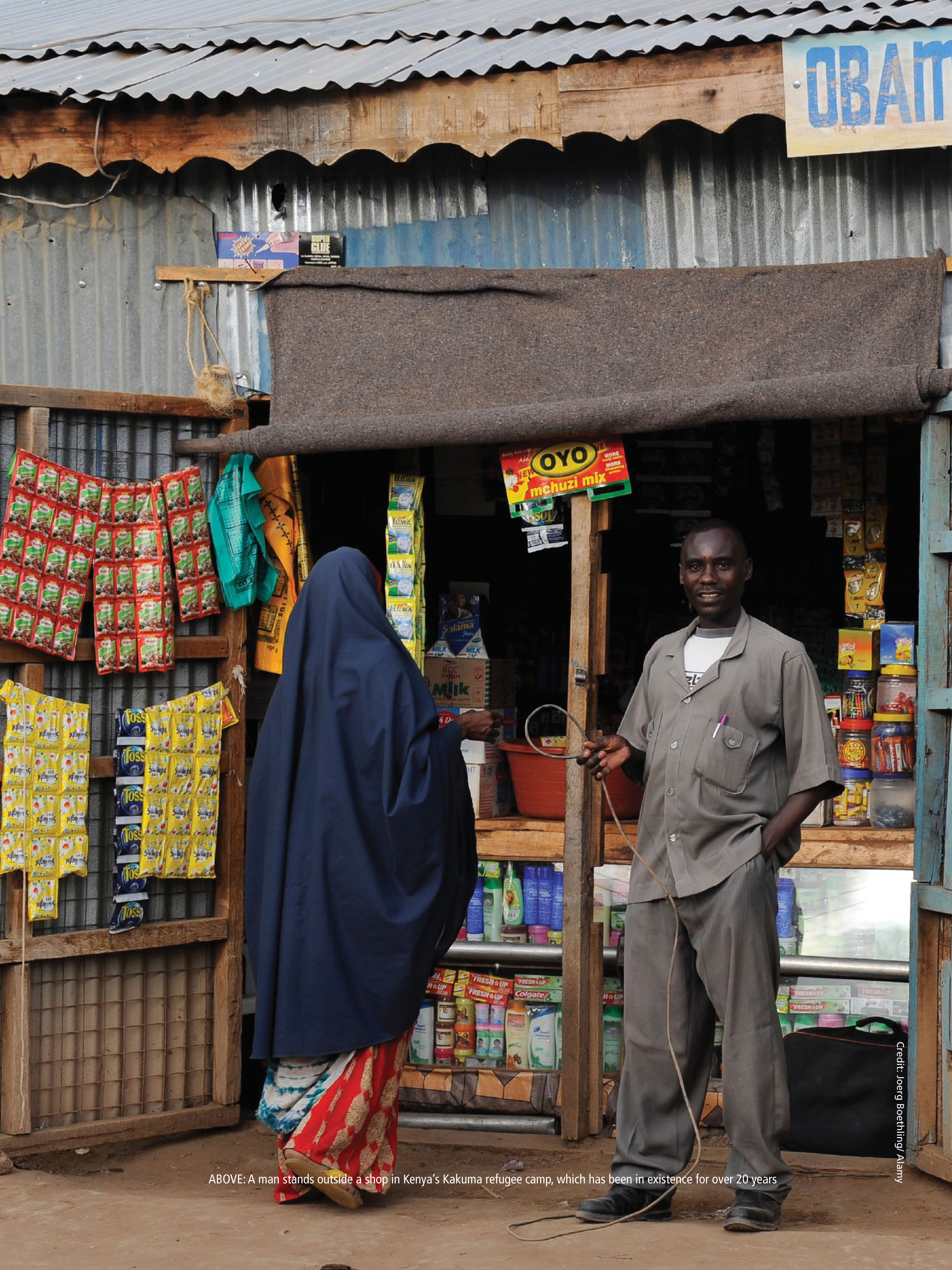
A man stands outside a shop in Kenya’s Kakuma refugee camp, which has been in existence for over 20 years
Credit: Joerg Boethling/ Alamy
Other refugees from partition who made it to Kolkata itself have fared better. Although they’ve had to go through legalisation processes which have sometimes stretched over decades, refugees living in areas of the city set aside for resettlement by the ministry of rehabilitation in 1947 have rebuilt their lives and transformed those areas. They are now considered to be normal residents of well-to-do, middle-class neighbourhoods.
However, being housed close to urban areas doesn’t always result in refugees effectively being absorbed into the local population. Palestinian refugees on the West Bank have also been living in camps since the late 1940s. There are 750,000 of them registered by UNWRA – the specialist agency for Palestinian refugees – and they are scattered across 19 camps and other settlements. One camp – Shu’fat – actually lies within the municipal boundaries of Jerusalem. The refugees who live there are officially residents of the city and have access to some of Israel’s social services, including healthcare. Their homes are also linked to the mains water and electricity supply.
But Shu’fat is by no means a suburb of Jerusalem. Access in and out is through military checkpoints and Shu’fat is hemmed in by Jewish settlements, an army base and Israel’s notorious security wall. There are children living in Shu’fat who, like their parents and grandparents before them, have known no other life than this severely constricted existence – living inside the boundaries of the city and yet cut off from it, part of a relatively prosperous conurbation yet still reliant on the UN for many of the basics of life.
In contrast to many of the Palestinian camps, the world’s largest concentration of refugee camps, in the Dadaab area of eastern Kenya, does conform to the popular stereotype. Tens of thousands of tents and other basic shelters are laid out in grids in a desolate landscape of red earth and dry scrub, miles from major urban centres. This complex of camps has been in existence for more than 20 years and at its peak housed around 500,000 refugees, mainly from Somalia. There are signs that Dadaab might not follow the example of Cooper’s Camp and Shu’fat and become, in effect, a permanent settlement. A tripartite agreement between the UN, Kenya and Somalia signed in 2013 has helped to facilitate the return and reintegration of up to 100,000 long-term inhabitants. On the other hand, the Kakuma camp complex in north-west Kenya, which has also been in existence for more than 20 years, has seen more refugees, mainly from South Sudan, arrive in recent years.
We cannot speak out and we have to be patient and passive. If we speak out too much, the chains tighten
Kakuma is perhaps best known in the West because it was the home for many years of Valentino Achak Deng, one of Sudan’s “Lost Boys” whose real-life story was turned into a novel – What is the What – by the US writer Dave Eggers. Before Valentino, who is writing for this magazine on how refugees are often not heard (See Lost boy found, Volume 44, 1/2015), got to Kakuma we learn in the novel of his experiences in a refugee camp in Ethiopia and how it was used as a recruiting ground for child soldiers by the SPLA rebel movement. Although international bodies are nominally in charge of most of the larger and longer-running refugee camps the real power inside the camps often lies with unofficial groups, sometimes of a terrorist or criminal nature. Once the camps become established, trading begins and small shops and service industries are set up. But because of the precarious governance and security in many camps, these enterprises are often subject to the extraction of extortionate rents by protection rackets. Drug-running, brothels and even paedophile rings are common, as are rapes. After dark, refugee camps can be as dangerous as any deprived inner city area, with the added disadvantage that it is not clear who “the authorities” are that should be providing protection. Sometimes the supposed “guards” are themselves complicit or active in violence – particularly against refugee women.
A major survey carried out in Dadaab found that many refugees felt their lives were hampered by a lack of information and by poor communication from administering agencies. While freedom of expression is generally not actively suppressed in refugee camps – Kakuma, for instance, has its own independent news magazine, Kanere – refugees usually lack a voice in the way the camps are run, and speaking out against official or unofficial corruption and violence is risky. Another protracted refugee situation persists along the Thai/Burmese border where some 120,000 Burmese refugees languish in a string of camps. Conditions are poor, and abuses by the Thai army and police are common. Yet residents fear to complain. A Human Rights Watch report in 2012 quoted a resident as saying: “We are on Thai land so we have to be submissive. We cannot speak out and we have to be patient and passive. If we speak out too much, the chains tighten.”
Around 20 per cent of them, including some survivors from the 1947 exodus, still have not been given papers conferring Indian citizenship
On the other hand, as Valentino Achak Deng’s story showed, life in the camps can take on a semblance of normality over time. In the book, life in Kakuma after initial hardship becomes more comfortable: Deng goes to school, takes part in youth projects, plays in basketball teams and hangs out with his girlfriend. All the same, Deng’s goal always remained to escape from the camps and start a new life in the world outside. In the end Deng was resettled in the United States. For most refugees, however, such a prospect is vanishingly small. UNHCR estimates that nearly one million refugees globally are in need of resettlement (including Syrians). But the number of places provided by the world’s governments is only around 80,000 a year. So for most of the men, women and children living in PRS, their life in limbo is likely to stretch well into the future.
As yet the Kilis camp in Turkey has only been in existence for a couple of years and its excellent facilities have earned it the sobriquet: the “five-star refugee camp”. But for all the well-equipped mobile homes, with their televisions and solar panels, for all the Western-style supermarkets and public “plazas”, for all the gleaming and efficient schools and medical centres, none of the residents sees a long-term future in this soulless, artificial settlement. As one man told The New York Times when one reporter visited Kilis in early 2014: “It’s hard for us. Inside we’re unhappy. In my heart, it’s temporary, not permanent.” He says that and we feel his anguish. But in 10 or even 20 years time, it is highly possible that he’ll still be there: trapped, like so many other millions, in a PRS.
