




Abstract

Author
And yet, for the vast majority of men and women living in England at the time, the Magna Carta was supremely irrelevant, and would remain so for at least four, and arguably six, of the eight centuries that have elapsed since King John signed it. A clue to the reason lies in the content. Yes, it mentions “rights”; but most of it is concerned with less elevated issues: bridge-building, corn, carts and horses, “merchandise”, wood, land, castles – and “money [borrowed] from Jews”.
The prosaic truth is that the Magna Carta was, at its heart, a financial deal that was forced on the king. He was running out of money to fight the French; and the barons decided to impose seriously tough conditions in return for giving him some more. Running through the Magna Carta is their demand that the king should stop pushing them around and confiscating their assets. They wanted him to obey some basic rules. If there was a dispute, they wanted these to be resolved by an independent judicial process, not the king’s cronies. Don’t be fooled by the reference to “free men”. The barons meant rich people like them, not the ordinary folk that they oppressed rather more completely than the king oppressed his landowning critics.
So what happened to transform the Magna Carta from a fix, protecting the wealth of the rich, to the defining event in our journey towards democracy? The answer is essentially simple. The term “free men” was gradually expanded to include all adults, poor as well as rich, male as well as female. Rights that were originally designed for very few people came eventually to apply to everybody.
In other words, in as far as the Magna Carta came eventually to symbolise our basic freedoms, it did so as a by-product of a struggle about something completely different. Normally, we talk about “the law of unintended consequences” to mean something designed to do good that ends up having bad side-effects. The story of British liberty supplies us with examples of the opposite: often self-serving and sometimes grubby arrangements leading to an expansion of liberty.
Consider the career of Sir Edward Coke. He was no bleeding-heart liberal. As chief justice he prosecuted Sir Walter Raleigh for treason and presided over the trial of Guy Fawkes following the Gunpowder Plot. It was Coke who designed Fawkes’ punishment: “He is to be cut down alive, and to have his Privy Parts cut off and burnt before his face”. Coke ended up as one of Britain’s wealthiest men; few have accused him of a generous spirit or a commitment to financial integrity.
History shows the Magna Carta is one of the influences on extending liberty including suffrage for women. Here, performers from the 2012 Olympics form part of a protest for women’s rights
Credit: Nick Savage/Alamy
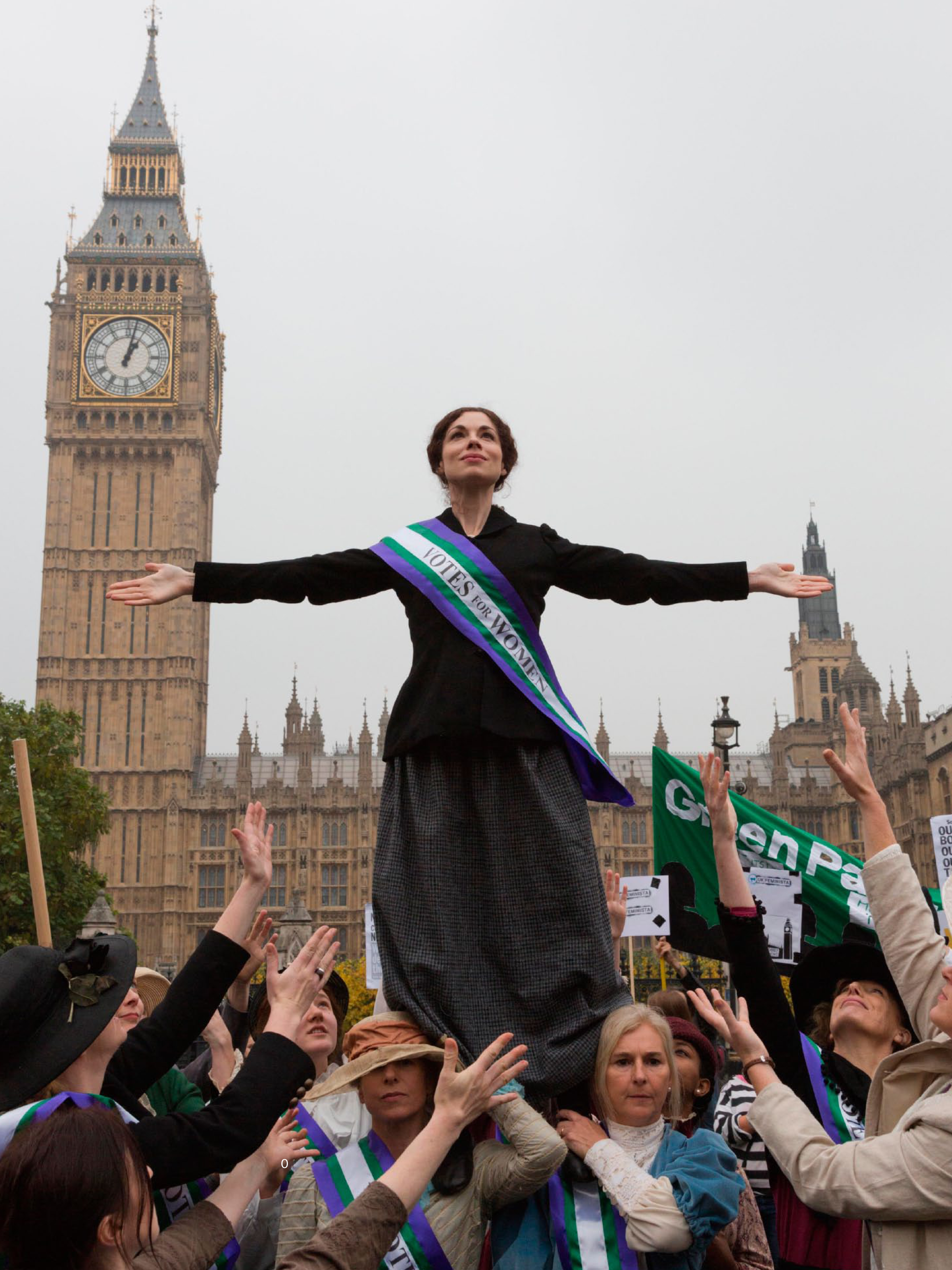
Yet, in the power struggles of the early decades of the 17th century, it was Coke who killed off the divine right of kings by telling James I that the law should apply to monarchs as much as anyone else – and some years later, persuaded parliament to adopt the Petition of Right, which made more universal the Magna Carta principles that people should not be taxed or imprisoned except by due process of law and according to Acts of Parliament. Had Coke decided that it was in his best interest to side with James I and Charles I, instead of opposing them, these reforms might not have taken place. Or, at least, Coke would not now be the man remembered for securing them.
Then there is the way censorship ended in 1695. Until then, any publication had to be approved by the Stationers’ Company. The original intention, more than a century earlier, had been to ensure that the advent of printing did not lead to an avalanche of seditious literature. But by the final decade of the 17th century, the company was accused of using the Licencing Act to make excessive monopoly profits. It came into conflict with publishers, printers and booksellers who felt the company was inhibiting their trade. Had the Stationers been less greedy and more far-sighted, it might have headed off such conflicts. Instead, parliament responded to these commercial battles by repealing the Licencing Act.
Within 10 years, a range of newspapers started publication across the country. Books and pamphlets containing literature, dissent and satire flourished, subject only to the laws of sedition (though these could sometimes be applied harshly). The open contest of ideas transformed Britain. It helped to propel the Age of Enlightenment and the Industrial Revolution. More than 100 years later, the great historian, Thomas Macaulay, described that parliament’s decision to repeal the Licencing Act as “a vote which has done more than liberty and for civilisation than the Magna Carta or the Bill of Rights”.
These episodes support what has been called the Whig view of history: that, slowly and with interruptions, but inevitably, the story of human history is one of eventual social progress. Our freedoms have been a long time in coming, and forward lurches have sometimes been by-products of other battles, but in the end they could not be stopped.
One of our more dramatic contests between progress and caution was the struggle for votes for women. Until the second half of the 19th century, the campaigns to extend the franchise were almost exclusively about extending it towards more men. True, Mary Wollstonecraft had put the case for gender equality as early as 1792, in A Vindication of the Rights of Women; but for some decades, most progressive men in a position to make a difference either ignored or opposed her arguments. Here is what John Bright, one of the most reform-minded Liberal MPs of his time, wrote in 1882: I act from a belief that to introduce women into the strife of political life would be a great evil to them, and that to our sex no possible good could arrive … As civilisation founded upon Christian principle advances, women will gain all that is right for them, although they are not seen contending in the strife of political parties. In my experience I have observed evil results to many women who have entered hotly into political conflict and discussion. I would save them from it. If all the men in a nation do not and cannot adequately express its will and defend its interests, to add all the women will not better the result, and the representative system is a mistake. Books and pamphlets containing literature, dissent and satire flourished, transforming Britain
Fortunately his views did not prevail – although it took another 46 years before women enjoyed the vote on the same terms as men. Even then, women were excluded from the House of Lords. This did not change until 1958 when life peerages were introduced and women could then be appointed to the Lords. But even then the idea of gender equality met resistance. One hereditary peer, Earl Ferrers, said this in one of the Lords debates on the bill: I hope very strongly that this provision will not become law because, in my humble opinion, I think it would be an unmitigated disaster to have women in this House … Frankly, I find women in politics highly distasteful. In general, they are organising, they are pushing and they are commanding. Some of them do not even know where their loyalty to their country lies … It is generally accepted, for better or worse, that a man’s judgment is generally more logical and less tempestuous than that of a woman. Why then should we encourage women to eat their way, like acid into metal, into positions of trust and responsibility which previously men have held? It’s worth remembering that Britain took 713 years to progress from Magna Carta to universal suffrage for all adult men and women
The ludicrous thoughts of an old man brought up in the Victorian era? Not a bit of it. Ferrers was only 28 when he made that speech – he had inherited his title when he was 25 – and he died as recently as 2012. In due course he changed his mind; or at least we should assume so, for in the 1980s he was happy to serve as a junior minister under Margaret Thatcher.
Taking the long view, it’s worth remembering that Britain took 713 years to progress from Magna Carta to universal suffrage for all adult men and women. Rightly we support far faster progress towards freedom, equality and the rule of law in countries with more recent experience of tyrannies. But when we seek to accelerate their journey, we should recall with some humility how slow ours has been – and how fragile and imperfect our liberties continue to be.
On the other hand, we can take pride in the way Britain blazed a trail for other countries. The Habeas Corpus Act was passed in 1679, and has since been adopted by much of the world. And the United States Bill of Rights, approved by Congress in 1789, lifts much of its language from the British version exactly 100 years earlier – for example, the ban on “cruel and unusual punishment”.
Perhaps the US would have done better to have copied our Bill of Rights on another contentious matter. Our Bill of Rights allowed people to bear arms “suitable to their conditions and as allowed by law”. That vital qualification, which would allow for sensible gun control laws, was omitted in the American version.
Nevertheless, the larger truth remains. The struggle to secure freedom in Britain was long; the struggle to defend freedom everywhere, including in our own country, will never end.