




Abstract
Persecution of Chinese Christians has included demolition of churches, removing crosses and driving services underground. As Christmas approaches,
Local government officials claimed the demolitions were part of a campaign to target illegal structures in the province. But their statement was contradicted by leaked party documents, which singled out churches and folk religious sites in a “three rectifications and one demolition” campaign.
Elsewhere in China, a Chinese pastor at a church in Henan province will celebrate Christmas from a prison cell. Zhang Shaojie, who led the Nanle County Christian Church, was found guilty of fraud and of “gathering crowds to disturb public order” in July and jailed for 12 years. His daughter, her husband and their son fled to the US immediately afterwards.
Then, on the border with North Korea, hundreds of missionaries and foreign workers in Christian charity groups were forced to leave the country. Some who remain have spoken of an atmosphere of fear, according to a report by Voice of America.
These incidents come as a recent government pledge to nationalise Christianity is believed to be a trick to bring underground churches to the surface in order to better control them. In August, Wang Zuoan, director of the State Administration for Religious Affairs, officially announced at a Shanghai conference on Christianity: “The construction of Chinese Christian theology should adapt to China’s national condition and integrate with Chinese culture.” The greatest fear, beyond the immediate, is that both these moves are forerunners for a wider campaign against Christianity.
Bob Fu, founder and president of China Aid, which provides legal aid to Christians in China, has called the recent persecution of Christians under Xi Jinping’s leadership the worst since the Cultural Revolution. Fu is not someone to mince his words. The US-based pastor converted to Christianity at the end of the 1980s. He then went on to start a campus church at Renmin University in Beijing and a secret bible school in Fangshan District, Beijing. In 1996, he and his wife were detained for illegal evangelising. Released unharmed, they soon sought sanctuary in the US.
Speaking to Index, Clay Finley at China Aid described the persecution as “significantly worse under Xi Jinping than it was under his predecessor”. But, he said: “The reasons for that change of policy are not entirely clear.”
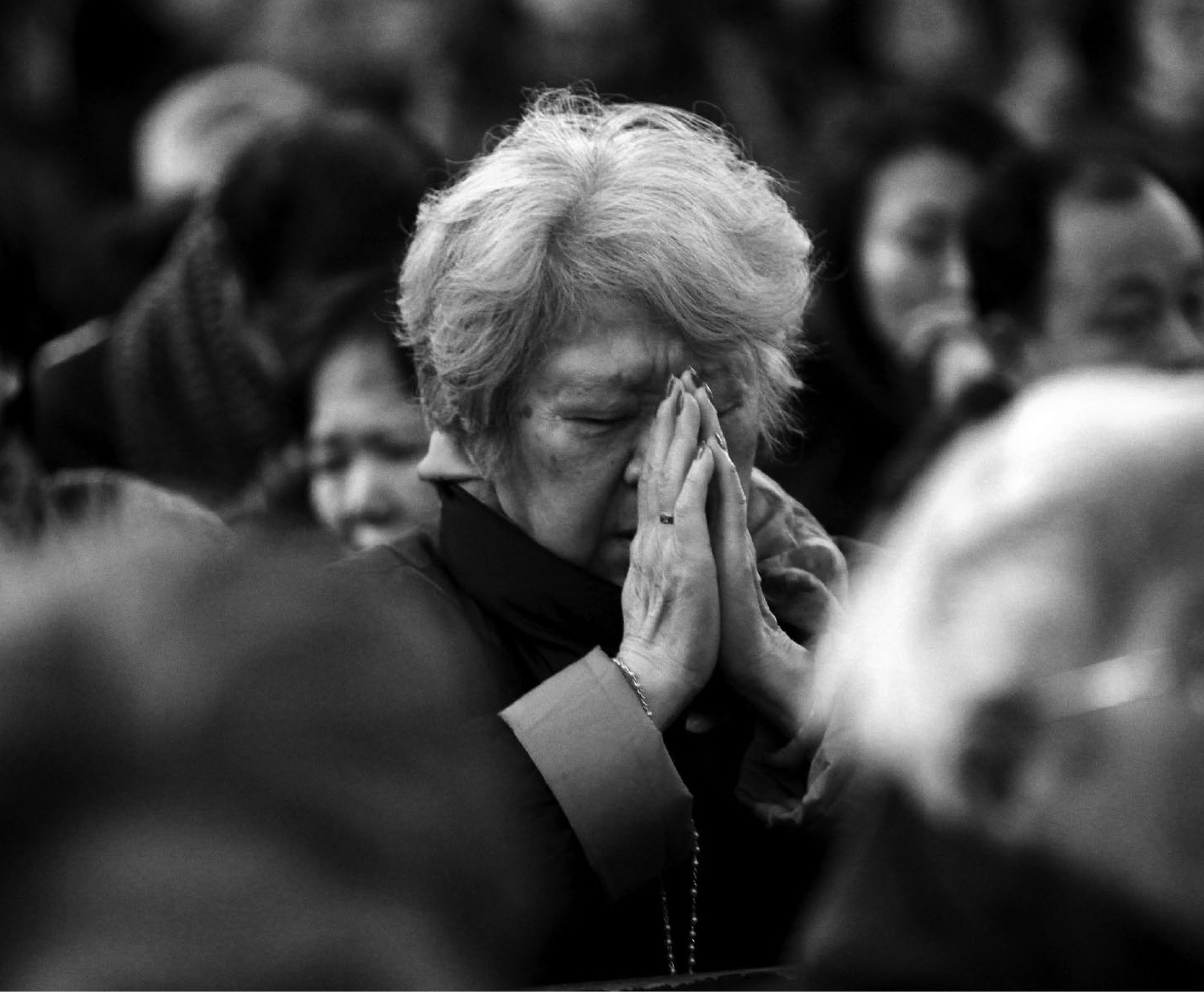
Chinese Catholics pray during a Christmas mass at the Xishiku Cathedral Catholic church on Christmas Day in Beijing, 2011
Credit: How Hwee Young/EPA
One suggestion is that Christianity is becoming a victim of its own success. A remarkable trend in China in recent years is the explosive growth of Christianity. The number of Christians is now estimated at between 100 million and 130 million, more than the membership of the communist party. The church has the potential to act as a unifying force for political opposition to the government’s authority: it cuts across regional and class divides.
Christianity arrived in China during the Tang dynasty (618-907), establishing itself from the 19th century under the influence of Western powers. The 20th century dealt the faith a series of blows. Most significantly, when Mao came to power in 1949, religion was deemed an enemy and described as “poison”. During the Cultural Revolution (1966-76), the eradication of religious life became a top priority. Christians went underground.
The number of Christians is now estimated at between 100 million and 130 million, more than the membership of the communist party
Since the death of Mao in 1976, Christians have been able to create more space for themselves and are tolerated to a degree. There have even been encouraging sounds from the communist party. China’s last president, Hu Jintao, described elements of Christianity as compatible with his vision of China as a “harmonious society”.
But the government has continued to preach atheism and places restrictions on faith. All churches are required to register with the government. The printing of bibles is banned; Catholics cannot recognise the authority of the Vatican; and proselytising is an offence. Christians face jail for distributing religious materials, founding unlicensed house churches and other perceived transgressions.
Christians face jail for distributing religious materials, founding unlicensed house churches and other perceived transgressions
Finally, membership of a church and of the communist party are mutually exclusive (though it’s rumoured plenty of communist party members attend churches in secret). Given the benefits open to communist party members, this is a serious deterrent. Chen Xiaomi, who has just started university in Sichuan province, tells Index about how her grandparents converted to Christianity a few years back. Following suit is not an option for her at this stage, as she would like to join the communist party.
“Carrying on the work of the church is not easy,” says Brent Fulton, president of China Source, which tracks Christian life in China.
“There is a huge grey area in terms of what is or is not allowed. I admire the ability of today’s young urban Christians to walk carefully in this grey area, being willing to explore new opportunities as they arise and not giving up when they run up against obstacles. By doing so they have greatly expanded the social space which Christianity in China occupies.”
Wang Meimei, a 32-year-old practicing Christian in Beijing, speaks of the hostility she experiences on a daily basis. “People mock me when I say I am Christian,” she tells Index.
At university, Meimei was actively discouraged by her teacher from practising her faith. She would never attempt to convert people and would not post about her faith on social media platforms.
It’s a similar story for Diane (not her real name), a young woman who attends a local church in Hebei province, near Beijing. She is not comfortable asking for 25 December off work and instead will celebrate Christmas on 27 December.
But not everyone or every part of the country appears to have had the same experience. “No, I’ve not noticed any increase in repression in 2014,” says Meimei. Though neither Meimei nor Diane have heard of the recent crackdowns going on elsewhere in their country, a testament to how tightly controlled information is in China, and one questions to what extent their sense of security is premised on false information.
Fulton picks up on this point. He says that if the events of 2014 are part of a crackdown, it is not widespread at present. Should we be worried? “Not from the standpoint of government repression,” he says.
“Christians in China do face significant restrictions and (as in the case of Wenzhou) sometimes outright hostility from officials. However, most Christians I talk to are more concerned about the future of church leadership, the effects of materialism upon the church, and whether or not the church will be able to meaningfully engage with China’s urban society.”
Fulton does concede some cause for concern. While China’s current president Xi has not come out as either for or against Christianity, Fulton says, “he is emphasising some themes that could have repercussion for Christians”. Nationalism is one such example. Christianity is often portrayed as foreign, so campaigns to increase nationalist sentiment could be married to campaigns against Christianity.
Fulton also explains how the regime is getting tougher on dissident voices (see Index’s previous report on the crackdown on human rights lawyers, Guarding the Guards, Volume 43, 3/2014) and the effects could spill over into the church. This has happened during previous anti-crime and anti-dissident campaigns.
As Christmas trees go up in shopping hubs across the country (with many missing the religious significance and leaving them up way into the new year), Christians wait with bated breath to see what the future will bring.
A Christian in Hong Kong
Journalist
Being a Christian in Hong Kong comes at the ease you would expect in any open society. Perhaps the difficult task would be finding a church that suits your needs. Even among the expat community, there are plenty of options.
In Hong Kong, a friend introduced me to Alpha (a beginner’s guide to Christianity), and the sessions are open to all English speakers living in Hong Kong. I found the mix of locals and expats a welcome and stark contrast from China. In the mainland, locals and foreigners are not allowed to gather together for purposes of worship, unless the service is state-approved ahead of time.
But now Christians from Hong Kong are grappling with a new feeling: a fear that one day, the landscape could resemble what’s across the sea in the mainland, the other half in the “one country two systems”.
That may be one of the reasons that some Christians are key players in the pro-democracy protests, including self-identified Christian Josh Wong, who at only 17 years old has become the face of the movement.
The Occupy Central campaign may have started as a protest for greater democracy in Hong Kong, but it’s now encompassing issues such as religious freedom.
In Beijing, a foreigner can enjoy the privilege of choosing a church, but this requires bringing something else to a place from worship aside from curiosity: a foreign passport.
That is what deterred me from finding a church during my four years living in Beijing, a city where churches often function as decorative backdrops for wedding photos. Having grown up in a Christian family in the United States, I considered re-exploring my faith. The notion, however, that only those with a foreign identity could benefit from religious freedom discouraged me.
This isn’t to say that access to Christianity is unattainable. For example, Beijing International Christian Fellowship is one of the main churches for foreigners, with over 3,000 members.
The website comes with this disclaimer though: “As an international church in the People’s Republic of China, the local authorities have given us permission to meet together for worship each Sunday, however, our religious activities are limited to foreign photo ID holders … We encourage Beijing International Christian Fellowship members to actively seek friendships within the local Chinese communities and pray for opportunities to invite them to a local Chinese church.”
In the Alpha group I currently attend in Hong Kong, of the dozen or so participants, around half hail from Hong Kong. The other half is a mixture of Americans, British Taiwanese, and everyone in between. Grace Fan, head of one of the Alpha groups at Soloman’s Porch, is from Hong Kong but spent a year in Beijing.
“I had just started going back to church again when I was based in China, I went to several churches and underground churches while I was there. The passport-for-entry type churches did feel really segregated and classist, but that’s really the only way that China can control ‘outside’ thinking,” she said.
Not all Christians support the protest and some churches have been divided over the issue. Reverend Tin Yau Yuen of the Methodist Congregations of Hong Kong issued an open letter, A Church at Crossroads, which explained he was opening the church as a refuge to people who were hurt in the demonstrations, and why he felt he should.
For now, what is at stake is the future for Hong Kong schools and churches? Is the fight for democracy so intricately intertwined with Christianity that churches should feel obliged to take a stand? For schools that are religiously affiliated, do they have an obligation to protect students? Or, is the cause so muddled that churches should just maintain their silence? Either way, the religion and the pro-democracy movement are both grappling with the Communist Party of China’s limitations on their currently enjoyed freedoms.
© Hannah Leung
