




Abstract

Two of South America’s leading cartoonists –
Rayma (aka Rayma Suprani)
Cartoons are a thermometer for a country’s freedoms. When a cartoonist is persecuted because of their work, it is a sign of a failed democracy. Cartoons are like mirrors in which governments can see themselves, and that’s why authoritarian regimes don’t like them.
I lost my job at the Caracas-based El Universal newspaper in September for a cartoon that criticised Venezuela’s health system. I had worked for the paper for 19 years, but it had been recently taken over by a little-known Spanish company, which some suspect to be a front for pro-government investments. Their aim has been to silence voices like mine.

My offending cartoon (pictured bottom left) showed a normal heart-rate monitor and another, based on the signature of the late president Hugo Chavez, flat-lining to show how the politicisation of hospitals had become a disease.
I have never self-censored my work. My role is to highlight and criticise Venezuela’s most acute problems – corruption, economics, power, health and insecurity. This is why up to the point where I lost my job, I received death threats, anonymous insults and government pressure. In August, the newspaper tweeted that I had apologised for a cartoon I drew of Colombia’s president Juan Manuel Santos, with a pig’s head. I hadn’t.
In Venezuela there is hardly any independent media left. The government started by buying radio stations, then failed to renew the licences of those that were about to expire. Next, the government moved on to television stations, and finally it bought newspapers and other publications, which are now being choked by the country’s inability to buy newsprint. [See Paper Chase: Overcoming Venezuela’s Newsprint Shortage, Index 43, 3/2014.]
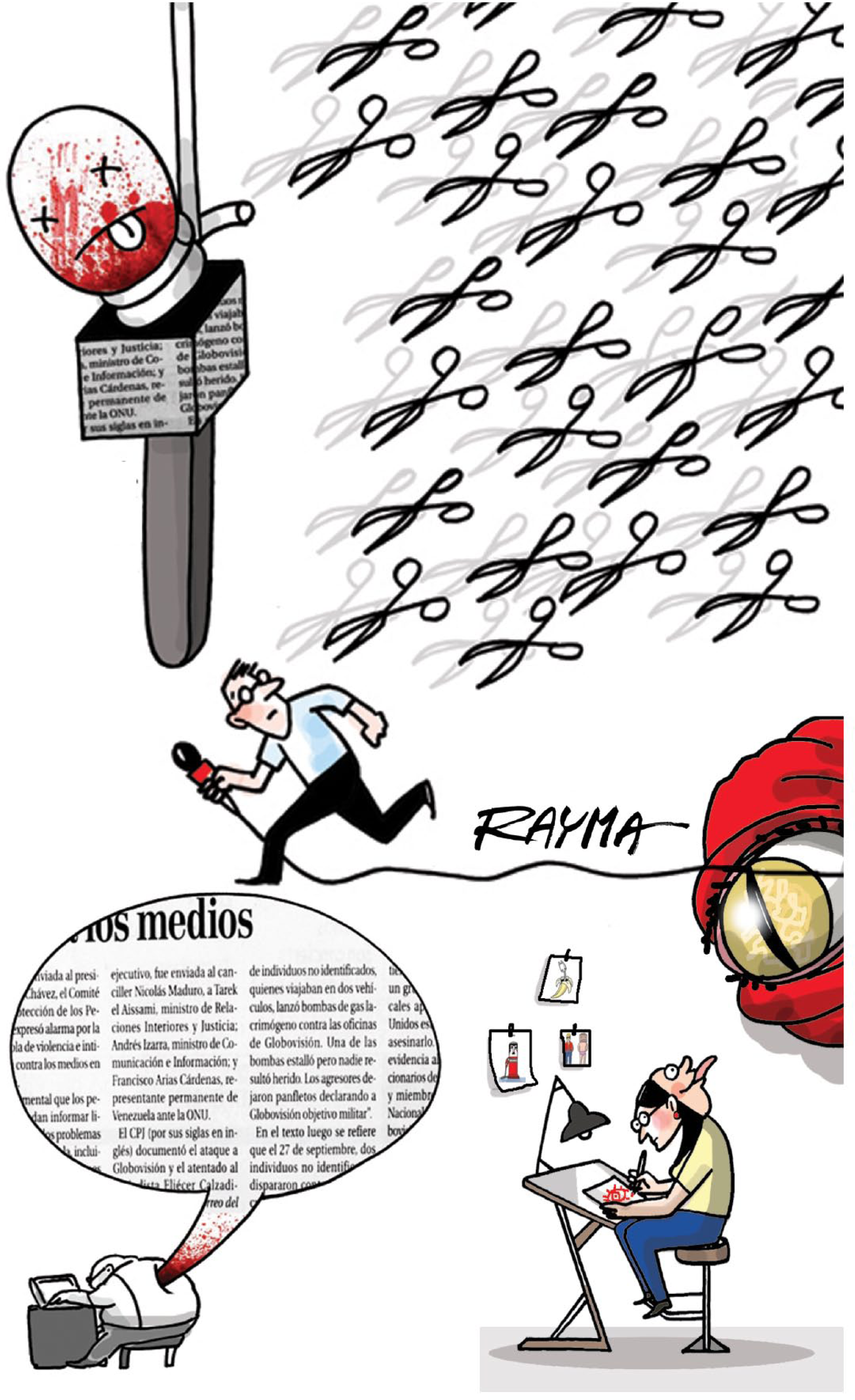

This all creates a terrible situation for free expression in Venezuela and I have been left with nowhere in the mainstream media that will publish my work. It’s hugely important that the foreign media and NGOs write about my case, because we feel we can’t. The political situation here is very delicate. Hopefully, it will turn around at some point so we will see more tolerance and freedom, but, for the moment, that seems like it is a long way off.
Bonil (aka Xavier Bonilla)
I believe that humour is the best antidote to fear and the best defence against abuses of power. I have been drawing for 30 years and I am not going to back down, even though things are hard in Ecuador, especially with the new criminal code. The Communication Law, introduced in 2013, now allows a government body to fine and prosecute the media.
One of my cartoons, for the newspaper El Universo, became one of the biggest examples of the reach of the new law and showed its attempts to censor critical voices. It related to a raid in late 2013, by the police and the public prosecutor on the home of Fernando Villavicencio, a journalist and parliamentary adviser for the opposition. They did it without warning, and in response to calls from President Rafael Correa, who accused Villavicencio of hacking presidential emails.
My work showed the officers using heavy-handed tactics when they entered the journalist’s house. The president saw the cartoon, insulted me personally, and ordered the communications superintendent to open a case against me. They concluded that I should “rectify” my cartoon, because it was inciting social unrest. They also fined El Universo $92,000 for having published it, saying the newspaper had violated article 25 of the law, prohibiting the media from taking an “institutional position” over the guilt or innocence of people involved in investigations. I maintain that my cartoon remained neutral on Villavicencio’s guilt or innocence.
The newspaper paid the fine and also published my “correction”, which, with its ironic tone, irritated the president even more. It included an overly polite exchange between Villavicencio and the authorities. “Nice to meet you, Mr Villavicencio. We have come to confiscate your computers and tablets. Why don’t you call your lawyer?” “No, no need. I trust you. You’re the legitimate authorities. Take everything you need.”
Correa said at the time: “The problem is not the cartoon, it is that they are lying and that’s very serious.” The president’s abuse of power brought me great support and the solidarity of many colleagues in Latin America and around the world. Rayma’s firing was another case of intolerance and sectarianism in the region, and it is something totally unacceptable, against which we all have to unite.