



Abstract

South Korean artist Lee Ha talks to
Lee is a pioneer of political satire in South Korea. While political art was an important part of the country’s democratisation movement in the late 1980s, the images then tended to be no-nonsense calls for freedom and civil rights. In his work, Lee has taken an irreverent approach, using cartoonish styles and wild colours.
His latest antics come at a time of particular public sensitivity as South Korea is still reeling from its worst-ever peacetime disaster. In April, the Sewol ferry sunk, killing more than 300 people, most of them school children. The government was criticised for failing to regulate the shipping industry properly, for allowing an unsafe vessel to leave port dangerously overloaded and for reacting too late when disaster struck.
Lee responded to the national grieving with an image of President Park Geun-hye, clad in traditional Korean attire, smiling as the Sewol sank behind her, surrounded by seven dogs, one representing each member of her cabinet. In Korea, describing a person or thing as “doglike” is a harsh insult.
In his other infamous image, he depicted President Park as a kind of geriatric Snow White with a bulbous, oversized head, holding an apple, which has a portrait of her father, the late President Park Chung-hee, set in a heart-shaped window.
South Korea is generally ruled by Confucian norms, where it’s taboo for someone to openly criticise someone older than themselves, and it is especially rare for personal attacks to be made in public. Many, therefore, find Lee’s images offensive. But beyond gasping in shock, there is not much the authorities can do to stop him, besides regularly dragging him into court and hoping he gets fed up and quits of his own accord.
Lee says he’s never been convicted of anything, but he has been charged 30 times, indicted three times and brought in for questioning by police countless times. His first indictment came in 2012 when he was charged with illegal advertising after he posted an unflattering image of the former South Korean president Chun Doo-hwan, a military strongman who ruled from 1980-88, holding a cheque for a little less than $300. At the time, Chun was a subject of controversy for claiming that he was unable to repay the millions he stole from state coffers as president, saying he had only a few hundred dollars to his name.
Part of what has got Lee into trouble is his insistence on displaying his work outdoors. Instead of keeping his images inside galleries in well-to-do neighbourhoods, Lee prefers to put them up in public, on walls and at bus stops in busy urban areas. By making his work visible to more people, he hopes to spur a conversation on aspects of Korean society he thinks should be addressed.
ABOVE: Lee Ha’s caricatures of the 2012 presidential candidates resulted in arrest, but not conviction
Credit: Lee Ha
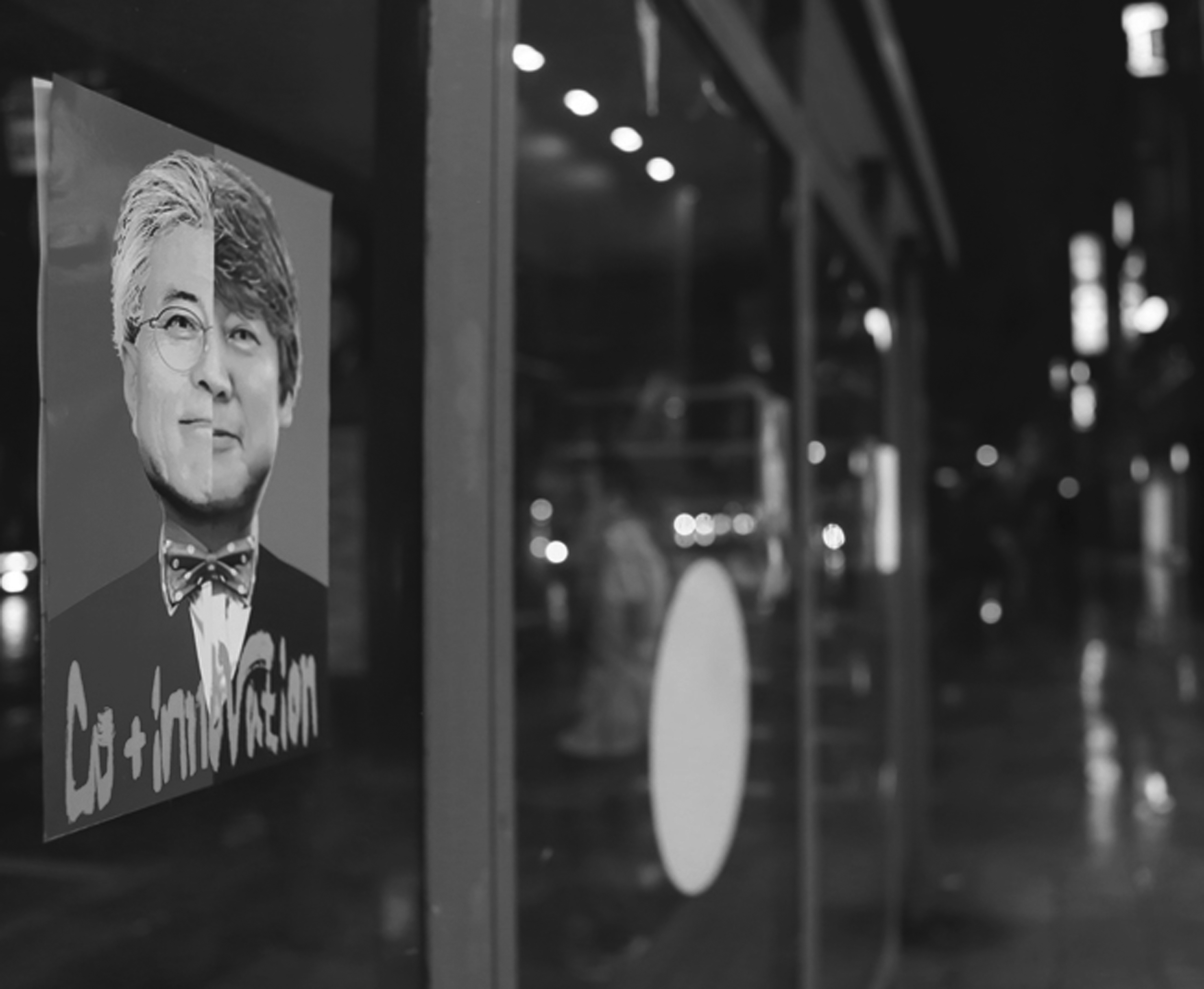
“Nowadays we have a lot of serious social problems, like corruption and inequality. We need to reflect on the unpleasant reality,” Lee says.
Lee was acquitted after his legal representatives argued that the poster could not be considered advertising because there were no products or services mentioned in the image.
In late 2012 Lee was charged with violating the special election law after putting up posters that showed caricatures of the opposition candidates running against Park for the presidency. The law prohibits the dissemination of materials in support or detraction of a candidate 180 days before the vote, but Lee was not convicted because the Supreme Court considered his works contained no clear political message.
He depicted President Park as a kind of geriatric Snow White with a bulbous, oversized head
The third indictment was for the image of President Park as Snow White, for which Lee was acquitted in June.
ABOVE: Lee Ha’s portrait of South Korea’s president, Park Geun-hye, with the Sewol ferry sinking behind her and seven dogs representing her cabinet members
Credit: Lee Ha

Lee’s arrests have taken place against a backdrop of declining freedom of expression in South Korea. In 2011, South Korea’s Freedom House press freedom ranking fell from “free” to “partly free” and has remained there ever since. In knocking South Korea down a notch, the Washington-based watchdog pointed to “increasing official censorship, particularly of online content, as well as the government’s attempt to influence media outlets’ news and information content”.
Similar criticisms were made by the United Nations’ special rapporteur for human rights defenders, Margaret Sekaggya, when she visited Seoul in June 2013.
The country is admired overseas for its lightning-fast internet connections, but South Koreans do not enjoy unfettered access to the web. Freedom House put South Korea 20th out of the 60 countries in its report on internet freedom. It was described as “partly free”, the same category as Nigeria, Brazil and Angola.
Though Lee is still not much known outside Korea, an exhibition in the US has raised his international profile. In the spring of 2011 Lee’s depictions of world leaders were exhibited in New York under the title Pretty Dictators versus Pretty Leaders. The exhibition included an image of US President Barack Obama as a smiling Rambo figure with an assault rifle and a portrait of Osama Bin Laden cradling a fluorescent green lamb.
His experiences in and out of court over the past few years have Lee convinced that the nation’s authorities are simply harassing him with the hope that he will eventually shut up.
Lee thinks he is being made an example of for other artists, a sign of the struggles that follow any overt criticism of those in power.
“My case isn’t just about me – it’s important for all artists and creative people in Korea,” Lee said. “By trying to intimidate me, the government is trying to keep everyone quiet and scared. They’re trying to send the message that one can’t be outwardly critical and keep one’s freedoms.”
