




Abstract
UK defamation law was reformed early this year, but what does it mean for the media? Journalism lecturer
Journalists want to publish interesting and important stories. To do this, they often have to include information that individuals or companies dislike because it casts them in a bad light. The threat of a defamation action has often been used to stifle unwanted publicity even when the information is true. Accuracy and facts are essential. Journalists need to know how to present information. Are they detailing a fact or expressing an opinion? If a story is published that turns out to be incorrect, is the story in the public interest? Knowledge of all this is required in order to avoid a defamation action.
Even if you are prepared to fight your corner and believe that your story is true, the cost of defending it can be high. When Simon Singh was sued by the British Chiropractic Association (BCA) he spent more than £200,000 before the Court of Appeal ruled that he could use the old common law defence of fair comment and the action was dropped. Singh had criticised the BCA about the way in which certain treatments were publicised or promoted by them. He expressed his views in The Guardian, but the BCA decided to sue Singh personally. Newspapers have insurance to meet claims but individuals do not, and so one good way of squashing a story is to sue the writer. The longer a case takes, the higher the costs. If the law is complex cases will take a while to resolve. Journalists need to know all this. But, as solicitor Tamsin Allen explains in the following article, there is a new defence available in the 2013 Defamation Act for academics who publish in journals.
Journalists in the UK must now swot up on the new Defamation Act, which came into force on the 1 January 2014. They also have to consider the old law in order to discern how the new legislation may make a difference in practice. Many of the commentaries on the new legislation agree that the old law will still be taken into account when courts consider new claims, at least for a while. It’s not easy. The old law was made up of two Defamation Acts (1952 and 1996), plus an enormous amount of case law.
One of the main concerns was that defamation law, as it stood, favoured the protection of reputation over freedom of expression. Claimants had to do very little to succeed. They needed to show that material was published to a third party and that it was defamatory. They did not need to show any loss or harm. The burden fell on defendants to show why they should not be liable. This could be done using one of several defences – including justification, fair comment and privilege.
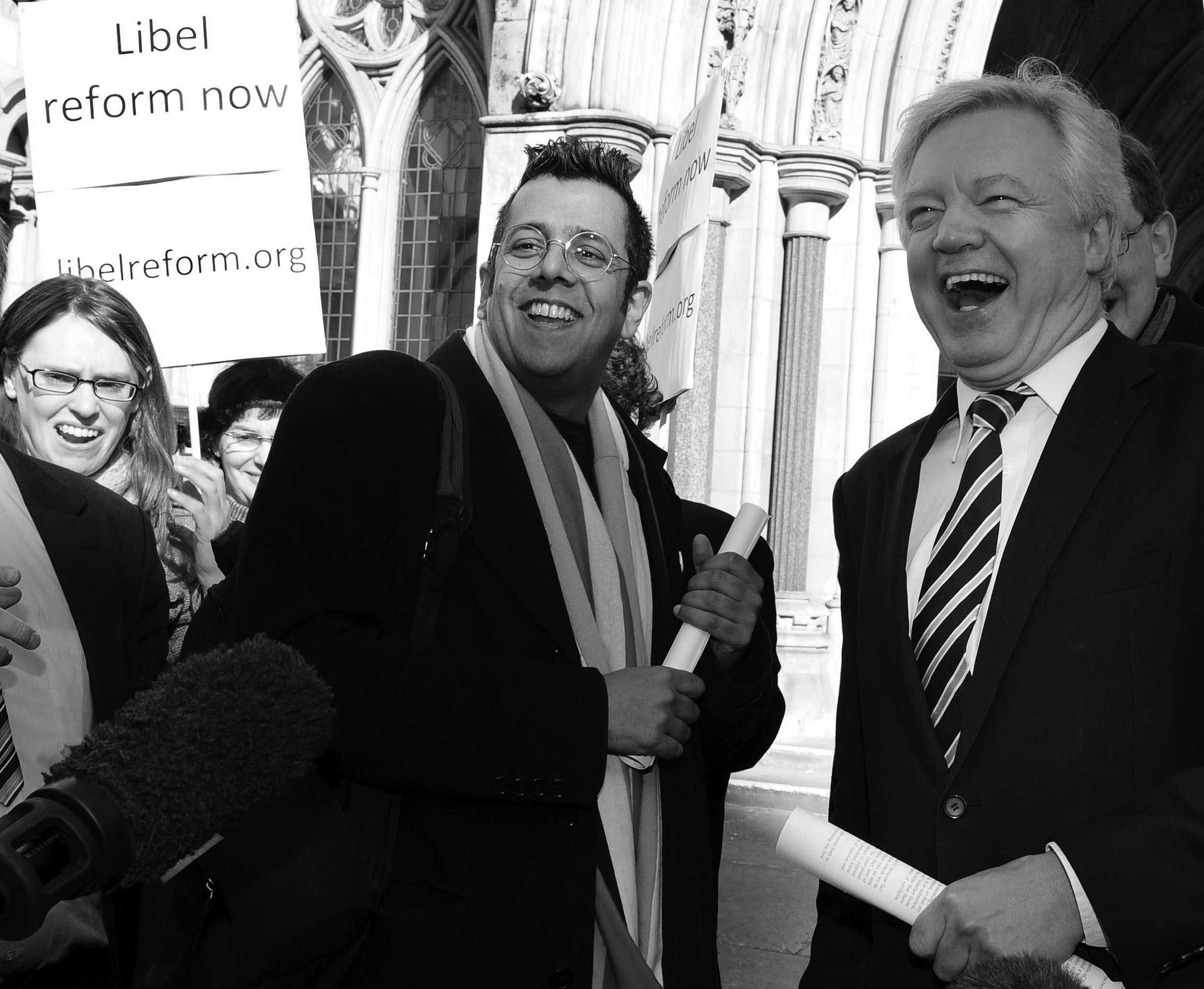
ABOVE: Science writer Simon Singh, left, with supporter David Davis MP, outside the High Court in London, after Singh won his Court of Appeal battle for the right to rely on the defence of fair comment in a libel action
Credit: Fiona Hanson/PA Archive/Press Association Images
So what will be the consequences of the new act? How much difference will it make to journalists? Claimants will now have to do more than before. Section 1 of the act states that a claimant must now show that the material either has caused, or is likely to cause, serious harm to his or her or its reputation. Where the claimant is an organisation that trades for profit, it will have to show serious financial harm. This section was designed to prevent frivolous claims. But courts had already devised a method of dealing with such claims. In the McLibel trial, McDonald’s would have found it difficult to negotiate Section 1 when suing Helen Steel and Dave Morris for defamation. Steel and Morris were activists who handed out leaflets highly critical of the McDonald’s operations outside a McDonald’s burger restaurant. McDonald’s sued for defamation even though it is hard to know how much harm the leaflets would cause to its business. McDonald’s was successful insofar as the defendants could not prove the truth of the statements on the leaflets (although the pair later took the case to the European Court of Human Rights, which deemed they had been denied a fair trial under article 10). But under the 2013 act, McDonald’s would have had to show that the material caused serious financial harm before being allowed to pursue the claim. Although Section 1 and other aspects of the act have been criticised as “cosmetic” by lawyer and academic Claire de Than, there may be a benefit in having this test set out in legislation as it is more accessible as law and may deter claimants more than a decision of the court.
However, many claims will easily surmount this hurdle. There have been several cases in which claims that would have met the test have been successful, only for the material complained of to be exposed later as entirely true – the case of the cyclist Lance Armstrong, for example. Armstrong vehemently denied taking any form of performance-enhancing drugs and successfully sued The Times. However, some years later Armstrong admitted the claims were true. Where claimants lie or persuade others to lie on their behalf, no amount of legislation or improved defences will help – possibly not even the public interest defence. My journalism students are well aware that they must keep notebooks and other evidence, but sometimes they need to be convinced that other factors come into play when deciding whether to publish a story or defend a claim. The Lord McAlpine case was very useful on this point. In 2012 the BBC Newsnight programme broadcast an item that claimed to know the identity of a well-known figure involved in the abuse of residents of a children’s home in north Wales. Although the programme did not actually name anyone, users on social-networking sites inferred that McAlpine – former deputy chairman of the Conservative party – was the accused. This was quickly shown to be entirely untrue, and McAlpine was successful in legal claims against the BBC, the comedian Alan Davies and Sally Bercow.
Defamation law, as it stood, favoured the protection of reputation over freedom of expression
Trying to crystal-gaze how the courts will interpret the new statutory defences in the 2013 act is hard. In the past it was argued by many that the law never protected reputation or free speech. When the new legislation was finally given royal assent, Lord McNally claimed it would strike the correct balance between the two. It was hailed in the statement as an improvement, bringing an antiquated law into the 21st century.
Not everyone agrees. De Than says the act is merely codifying what courts have done already and achieves little else. Alastair Mullis and Andrew Scott in a recent article in the Modern Law Review also argue that the act has not addressed the right to reply or indeed the issue of what actually amounts to defamation. They say that because the courts will still have to use the old law to interpret the new, cases will not necessarily be shorter. Costs will not go down and there will not be a better balance between free speech and protection of reputation.
McDonald’s would have to show that material caused serious financial harm before being allowed to pursue a claim
In trying to address the balance between freedom of speech and reputation, the legislation has gone some way towards redressing imbalance but fails to tackle effectively the issues of costs and remedies.
A hard act to follow
Britain’s libel laws have had a makeover following an intense media campaign, but the changes might not be as profound as supporters hoped, argues lawyer
Any law that adjudicates between the media and citizens is bound to be controversial. The Defamation Act 2013 came into force at the start of this year. It was the product of a remarkably intense political and media campaign. The Libel Reform Campaign hailed the act as “a fairer libel law, which would allow us to criticise and hold to account the rich and the powerful”. According to the government, its aim is “to ensure that a fair balance is struck between the right to freedom of expression and the protection of reputation”.
The most controversial elements of libel law are in the territory of newer relationships – between science bloggers and drug companies; individuals subjected to hate campaigns on social media or comment threads; large companies using reputation management professionals to silence their NGO critics. Will the act succeed in rebalancing the law to ensure fairness to both publishers and those on the receiving end of criticism? We need to wait for cases to be heard to see how the changes work in practice, but there is plenty to consider even now.
The act introduces a “serious harm” threshold. This is a statutory version of an existing common law convention that a libel should be sufficiently serious to warrant the issue of proceedings. Having it in black and white may help to discourage trivial claims, but this is not a substantive change. However, there is a change in the serious harm threshold for companies. The act states that “harm to the reputation of a body that trades for profit is not ‘serious harm’ unless it has caused or is likely to cause the body serious financial loss”. What is serious – whether it includes damage to goodwill – has yet to be decided, but this is a significant and welcome development (except perhaps for very small companies, which will have an additional expensive hurdle to leap before being able to sue over damaging false allegations).
There are some other significant changes in the act. Section 8 introduces a single publication rule. It replaces the rule that every publication of defamatory material gives rise to a fresh cause of action that is subject to its own one-year limitation period. The old rule allowed claimants to sue archived website publications many years after first publication online, as every download constituted a “new” publication. Now claimants will be barred from suing more than a year after first publication (unless publication is in a substantially different medium). The court still has discretion not to apply the one-year limitation if it is just to do so – for example, where a claimant did not know that a version of a defamatory article had been archived and was still accessible – but the onus will be on the claimant to persuade the court.
The new defences in the act will require many years of judicial interpretation before they can be used as a simple tool by writers and publishers without lawyers. The new defence of “honest opinion” replaces the old “fair comment” defence, and is very similar; the defence of “truth” replaces the virtually identical common-law defence of justification. The “public interest” defence is based on an existing defence of “responsible journalism” but is different in some important ways. A publisher will be able to defend a statement that is on a matter of public interest and the publisher reasonably believed to be in the public interest. The concept of public interest itself is fluid. The act says that the court will look at all the circumstances of the case in deciding whether or not the defendant’s belief that the statement was in the public interest was reasonable. It seems certain that the courts will look to the existing body of learning and the common law to help in interpretation, despite the abolition of the old defences. But how is the author of a community blog supposed to find out whether their remarks about the church hall funds are in the public interest? Should the author examine the accounts rather than relying on back copies of the parish magazine?
Section 12 is an attempt to provide an effective remedy for those who have been defamed, by giving the court the power to order publication of a summary of its judgment. This may be valuable for claimants and could help to reduce damages by helping to vindicate the claimant’s reputation. Such summaries are likely to become standard in the majority of successful defamation actions.
In Section 6 there is also a new defence to protect scientists and academics publishing in peer-reviewed journals. The publication of a statement in such a journal is privileged, as long as certain conditions are met. This development is helpful and relatively uncontroversial – although most such publications would have been privileged under the old common law qualified privilege defences.
Although claims brought by foreign claimants have hit the headlines, they are very small in number
Section 9 of the act is intended to address the issue of libel tourism by introducing a new test for acceptance of jurisdiction in defamation cases by courts in England and Wales. It applies when a defamation action is brought against a person who is not domiciled in the UK, an EU member state or a state which is a party to the Lugano Convention. In such circumstances, the court must be satisfied that the UK is “clearly the most appropriate place in which to bring an action in respect of the statement”. This section demonstrates parliament’s intention to deal with the UK’s reputation as libel capital of the world, and may have an impact on judges deciding on such claims. However, the civil courts had already developed guidance on choosing the most appropriate jurisdiction in numerous areas of law, so there were already rules to govern decision-making. Claims brought by people living in jurisdictions with corrupt or poorly functioning legal systems, or systems which do not comply with the European Convention on Human Rights, can still be heard in the UK, even if the claimant’s connections with the UK are peripheral (providing the claimant has a reputation to be protected here and there was publication here). Although some claims brought by foreign claimants have hit the headlines, they are very small in number. The changes in this section are more to do with perception than reality.
Section 5 of the act creates a new defence for operators of websites who can show that they did not post the statement complained of (so it applies to comments posted by readers). But it is subject to a number of conditions and gives protection only to website operators who respond to a “notice of complaint”, which must include details of the person posting the statement in question. The problem with this section is that it does not provide claimants with an effective route to deal with defamatory allegations made online, nor does it provide complete protection for website operators. It is inconsistent in some important ways with the E-Commerce Directive adopted in 2000 and it relies on regulations that can be changed, thus undermining the stated intention for clarity and foreseeability. The law on website operators, hosts and search engines remains an impenetrable mess.
The laws on website operators, hosts and search engines remains an impenetrable mess
As well as the previous defamation acts, a mass of existing case law will remain relevant, and there will be new case law defining the provisions in the 2013 act. Does it rebalance freedom of expression with the protection of reputation? It makes life easier for those writing in the public interest and for scientists, and more difficult for companies to use the libel laws to protect their reputations. But the new defences show how effectively our courts had already developed this balance. Of course, that development took many years and much expense before cases got to the Court of Appeal or Supreme Court. But the risk of codifying such defences is that future development becomes more difficult, not less.
© Tamsin Allen