




Abstract
Belarus Free Theatre is preparing for its 10th birthday and the Belarusian elections. The company’s co-founder and artistic director, Natalia Kaliada, talks to
“The day after the election, the electoral committee will make an announcement that Aleksandr Lukashenko has received 84 per cent of the vote. Many political activists will be jailed. Europe and the USA will not recognise the result of the election, but neither will they put any pressure on Lukashenko to change it.”
The only wild card is the role Russia will play, she argues. “If Russia decides to invade Belarus then that would be a totally new development,” she said. “Otherwise there will be no surprises from Lukashenko.” Her cynicism is not surprising given not one of the elections held in Belarus since 1994 has been recognised by the OSCE as free and fair.
Right now, the BFT is preparing a series of dramatic actions to draw attention to the lack of freedom, and the upcoming elections, in the authoritarian state. These will include “solidarity parties” around Europe, working particularly with young people to expand knowledge about Belarus, and to illustrate what restrictions exist in the country. They are looking at staging events inside and around telephone boxes, which are similar in size to prison cells people are held in by Lukashenko.
Kaliada has done everything in her power to campaign for democracy in her country. This tireless commitment to raising awareness of human rights and political abuses has taken her and the company’s co-founder, her husband Nikolai Khalezin, around the world speaking at the highest level to politicians in the UK, USA and across the EU.
Asked how different the upcoming election was to 2010, when Lukashenko returned to power for a fourth term with 80 per cent of the vote, she said: “The difference was that five years ago there was hope. Now, there is no hope. The opposition leaders are either political prisoners or ex-political prisoners, living in exile with no political rights in Belarus.”
Lukashenko’s destruction of the opposition started the day after the last election in 2010, when 30,000 people came into the main square in Minsk to protest the result. Hundreds of demonstrators, including six out of the nine opposition leaders, were arrested, and many of them brutally beaten. Natalia was also arrested. Nikolai went into hiding. The KGB were searching for supporters of the opposition. Kaliada worries that “next year it won’t be a special division of police who will crack down on peaceful demonstration, but tanks”.
Kaliadia describes how she was held for 20 hours in horrendous conditions with no access to toilet facilities and no water. Guards threatened to rape her with a chair leg. As soon as she was released, she and her family were smuggled by friends in a car to Moscow before flying to the USA. They didn’t know then that they would not be able to return. In April 2011, they flew to London where they claimed asylum. All this time they were campaigning for the release of political prisoners.
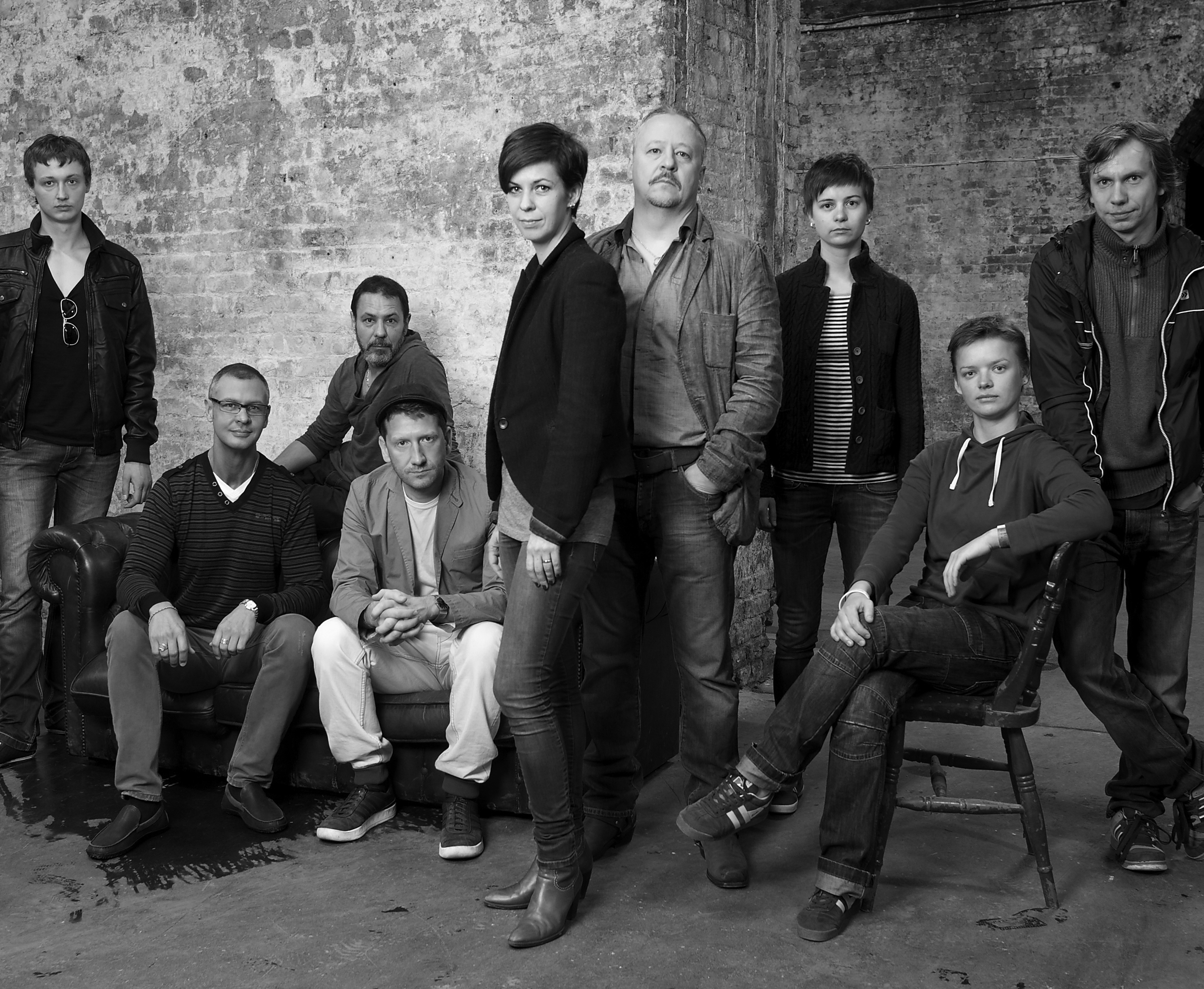
ABOVE: Members of the Belarus Free Theatre, including co-founders Natalia Kaliada and her husband Nikolai Khalezin (centre), who fled Belarus after being held as political prisoners
Credit: Michiel van Nieuwkerk
Later that year, Index arranged a meeting between them and the UK’s deputy prime minister, Nick Clegg. “The next day our parents’ apartments were raided by the KGB and our relatives were horribly beaten. My father-in-law died of a heart attack after one of these raids. This was the saddest moment of our exile,” said Kaliada.
Since then Kaliada and her family and two other company members, including fellow artistic director Vladimir Shcherban, have made their home in London, and the theatre has become an associate company at the Young Vic. The majority of the company, 29 actors and students, remain in Belarus, where the company has always been underground. They perform where they can, in friends’ apartments, in nightclubs before they open, in works’ canteens after they close, in the forest, in small villages. She said: “We are just one company with two completely different realities – one part of the company in exile, and the other underground.”
But, as the election year approaches Kaliada is in no doubt that the situation is getting worse. “The arrests, the interrogations have intensified,” she said. “They have normalised. They used to happen two or three times a year, now it is every month. Last year we lost our venue, a small private house in the suburbs where we had rehearsed and performed for six years. The authorities threatened that they would knock the house down, so the owner had no choice but to ask us to leave.
In Belarus, the audience risks arrest by attending the event, just as much as the company by performing
“Now they threaten people who offer us alternative spaces to rehearse or perform – threaten to take away their business licence, or threaten their children. So they cannot let us use it for long and we have to move on. This is a huge burden, also financially.”
Next year, Belarus Free Theatre will celebrate its 10th birthday. When they started out, they never anticipated that the company would have this dual identity. They have continued to adapt, while remaining as connected as possible to their roots, rehearsing every day on Skype, teaching their students, coming up with new ideas. Each new show in London is live-streamed to their audiences in Belarus, including after-show discussions. Their company members travel to the UK to perform and tour, and to run workshops around the UK and internationally.
Meanwhile, their experience of producing and marketing shows in the UK has led to very different restrictions. Kaliada explained that it was now economics that dictated what she and the company could say and do.
She said: “When I was teaching our students underground in Belarus, I told them that if you go to a free society, you will get money from specific trusts and foundations only if you fit into their marketing strategy.”
In Belarus, there is no right to freedom of assembly or freedom of expression. In Belarus, the audience risks arrest by attending the event, just as much as the company by performing. Just getting to see the show is a challenge – a text message directs them to a clandestine destination. Sometimes a wedding party is used as a front so they can perform their shows.
Belarus Free Theatre’s core audience around the world is young – people aged 20 to 30, who find out about the shows on Facebook, Twitter and through word of mouth. Last year, they ran a campaign called Give a Body Back, alongside their show Trash Cuisine. The campaign was about capital punishment, based on stories members of the company had collected from all over the world. It centred on the call for the bodies of executed prisoners to be returned to their families in Belarus. They invited their audience to join their actors at three different places in London – Parliament Square, Trafalgar Square and Piccadilly Circus. They then asked people to get into body bags and stay still for one hour in protest.
“The entire staff of Oberon Books joined us,” said Kaladia. “They closed the office for the day. It is really beautiful to develop such relations with an audience when it’s clear that there is no need for us to be divided into the audience and the company, but we are just all together.”
In spite of a deep-seated fatigue with realpolitik (conveyed in the title of their ongoing series of political actions to spotlight injustice, Fuck Real Politik), Natalia sees their campaigning in the political arena as crucial. She anticipates that next year will bring urgent challenges on this front.
“Of course there will be arrests around the election,” she said. “The EU will not react to arrests, we know that. It is horrible knowing that no-one does anything when people are arrested. But maybe we can lobby EU politicians to stop political prisoners from being tortured.”
Would she ever consider being a politician herself if the political system changed in Belarus? “No, no, no! We need to have the right to criticise politicians always,” she said. “Because there will always be things to criticise even if democracy comes to Belarus.”