




Abstract

Long-time Moscow resident
That communist-era joke about a watermelon seller, with only one watermelon to sell – “Well, there’s only one Brezhnev but we elect him, don’t we?” – is still apt today, when Russians fully expect that Putin will be president for life. They may not be thrilled at the prospect but most will give no more than a fatalistic shrug of the shoulders.
What outsiders must understand is that most Russians, on balance, prefer Putin. The turbulent 1990s were too scary for them. They have traded freedom for shopping, gradually improving living standards and stability. As in Soviet times, those who disagree and crave oxygen are a minority. Only a few will stand up and be counted.
If consumerism stops being a powerful enough new opium for the masses, Putin has shown that he will try imperial adventures and the people are ready to swallow that too. In the parliamentary “debate” on the annexation of Crimea, only one deputy, Ilya Ponomaryov, risked being called a “fifth columnist” and “traitor” and voted against.
In Putin’s Russia, what matters is loyalty, not talent. If you don’t conform but think in a different way, you are isolated. If, like my friend L, you happen not only to question the government’s policies but also to be gay, you are very isolated indeed.
The deal that Putin long ago made with society is “make money, travel, do what you like but don’t rock the political boat”. If you don’t like it, you can always emigrate.” Those who have challenged Putin have found themselves in jail. Anna Politkovskaya is only the most famous of two dozen journalists killed in Russia since 2000 for trying to expose abuses.
The rule of law simply doesn’t extend to Russia; expect anything from the justice system, except justice. Non-governmental organisations are regarded with suspicion and squeezed. Independent media have all but been wiped out.
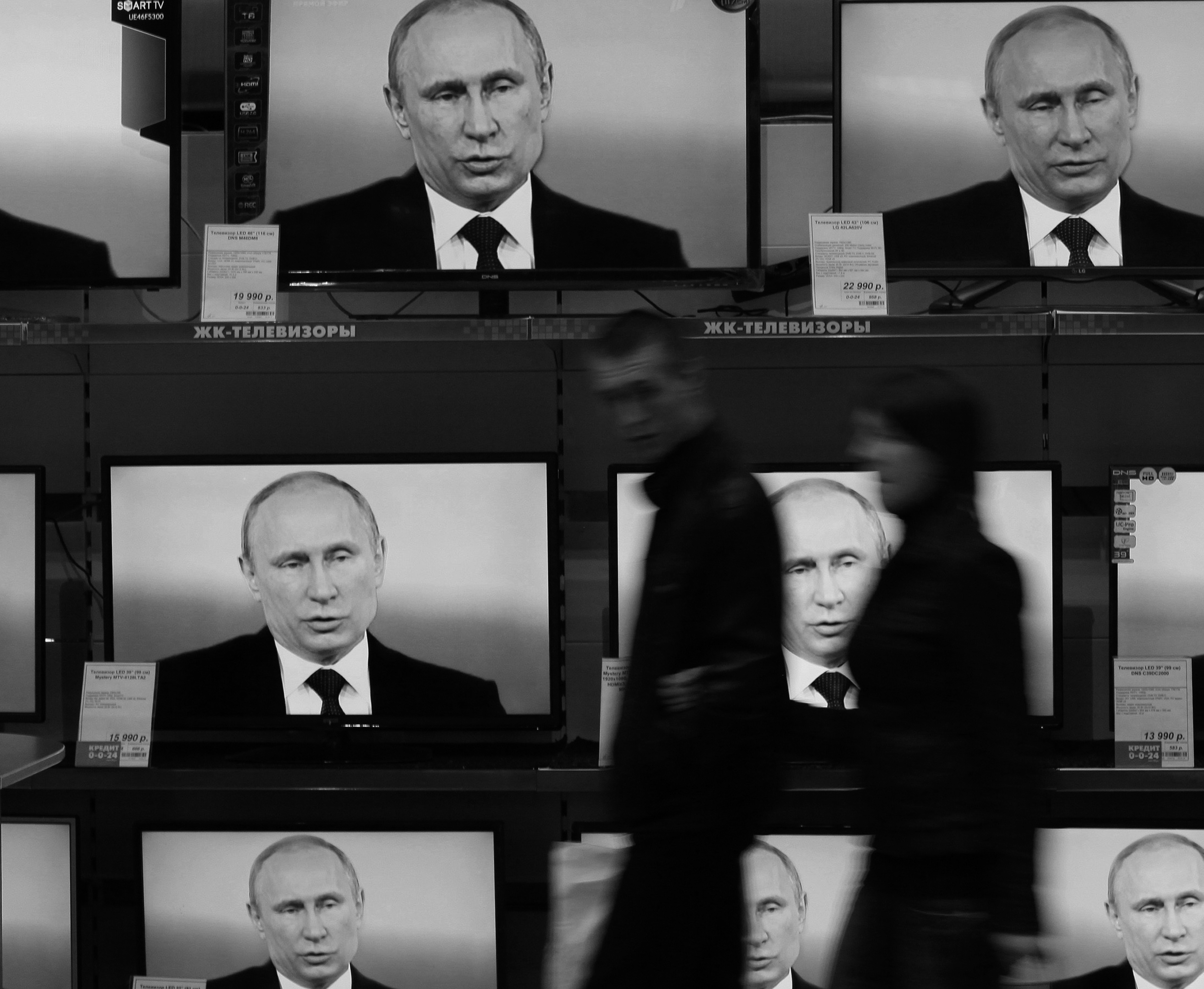
Thinking Russians in big cities can hear a variety of voices by surfing the internet or listening to Echo of Moscow radio, which the authorities allow so the intelligentsia can let off steam. But most Russians get their news and views from Channel One television and that is enough for them.
Unlike the Germans, who confronted their past, the Russians haven’t begun to consider their history. Stalin made a few “mistakes” but he won the war, didn’t he? Few Russians are aware of how other countries were affected from 1939 to 1945; that Stalin and Hitler had a pact before they fell out. And with the single history book that Putin has ordered for schools, they are not about to be enlightened any time soon.
Above: People walk past television sets in a shop window during Russian president Vladimir Putin’s live nationwide phone-in. Putin said Russia would not seek to cut itself off from the outside world with a Soviet-style Iron Curtain
Credit: Ilya Naymushin/Reuters
“We’re back to the old ways of teaching our children to lie,” said my friend T, a cautious Putin critic, who at home will tell her children one thing while making sure they don’t repeat it at school.
What has happened to the Russian soul? The mass of ordinary Russians have sold it. They know this and deep down they feel ashamed. But what can they do? Change is so difficult. “Democracy is not for us,” they say, a little wistfully. “We need a strong hand.”
Corruption is everywhere, from the top to the bottom of the system. A poorly paid state sector worker will take his boss a small bottle of Cognac in the hope of being included in the payout of New Year bonuses. There’s a price for everything, from getting off a criminal charge to saving your son from army conscription or receiving decent medical treatment.
Corruption persists because, nasty as it is, it basically suits everybody. Citizens break the law, knowing that most of the time they will get away with it, while the powers-that-be always have a hook to catch you, if they want to.
In this climate, small businesses struggle. Prime Minister Dmitry Medvedev recently lamented that too many Russian students were choosing careers in the well-padded bureaucracy rather than in the risky world of business. Is it any wonder? The Russian economy remains dependent, as it was in Soviet times, on the export of oil and gas.
So has travel, which supposedly broadens the mind, changed nothing? Not entirely.
It is refreshing to see Russians travelling – travelling anywhere, just the shortest, cheapest foreign trip will do – and coming to the conclusion that their country is neither better nor worse than other countries but simply part of the planet. These people often bring back self-respect and a whiff of freedom, along with the souvenirs in their suitcases.
But others, despite, or perhaps because of, travelling, come back with their inferiority-superiority complexes reinforced. They go to the West and miss the point. They return, saying that Russia has a “special way”, as if there is any other way but the way of common humanity. They perceive slights and go so far as to say that Western people hate them.
Often the problem is that Russians are not fluent in English or any other foreign language. Andropov was no fool. A retired KGB officer who told me of Andropov’s idea to save the USSR said he knew most Russians would come home because of their need to speak their own language.
Twenty five years after the fall of the Berlin Wall, Germany and the countries of the former Warsaw Pact have clearly benefitted. But Russia is retreating behind a mental wall of its own making. For someone like me, who devoted a whole career to promoting East-West understanding, the new Cold War that seems to be approaching is a matter for deep sadness.
Unlike the Germans, who confronted their past, the Russians haven’t begun to consider their history