Abstract
This month thousands of Chinese students find out the results of the most important exam of their lives. But when those results come through, girls have to achieve higher scores than boys to be accepted on the same university courses.
“The first four girls who did it had TV stations filming them. We’re in Beijing and it’s risky to shave our heads in public. So we did it in our office and posted pictures to Weibo,” Xiong tells Index. Xiong works at Gender Watch, a Chinese NGO tackling the issue of gender discrimination. The company’s page on Weibo, the Chinese equivalent of Twitter, is the most prominent platform in the country fighting for women’s rights. Prior to shaving their heads, Xiong and her co-workers tried to find out from the Chinese ministry of education why there were unfair quotas. The response was unsatisfactory. The government said that it was based on “national interest” but did not elaborate on what that meant.
“We were furious about this,” she says. After uploading the photos of herself and her co-workers, 20 others shaved their heads in solidarity, all posting their pictures online. Thousands more expressed their support.
Two years on from the event, Xiong’s hair has grown back. Gender discrimination, on the other hand, remains in place in the university sector. As Chinese students sit the national college entrance exam this June, known in China as the gaokao, there’s still work to be done on gender equality.
University admission in China is based solely on the gaokao. Approximately nine million students take it over three days each June and find out in the summer whether they’ve been admitted to the university and degree course of their choice. No additional material is expected of applicants, making the process transparent in theory. The reality is different.
Reports first started to circulate in 2005 of restrictive practices against women, according to Chinese news outlets. Girls were being banned from studying a variety of subjects across the country, from engineering to navigation. At the same time, they were expected to score higher than boys to get into the same universities for the same courses.
Different reasons were given. For example, police or military-affiliated academies claimed their courses were too dangerous for women. Women not being able to carry heavy equipment and not being able to escape a mine as quickly as men in an emergency were reasons cited for lower admissions on mining courses.
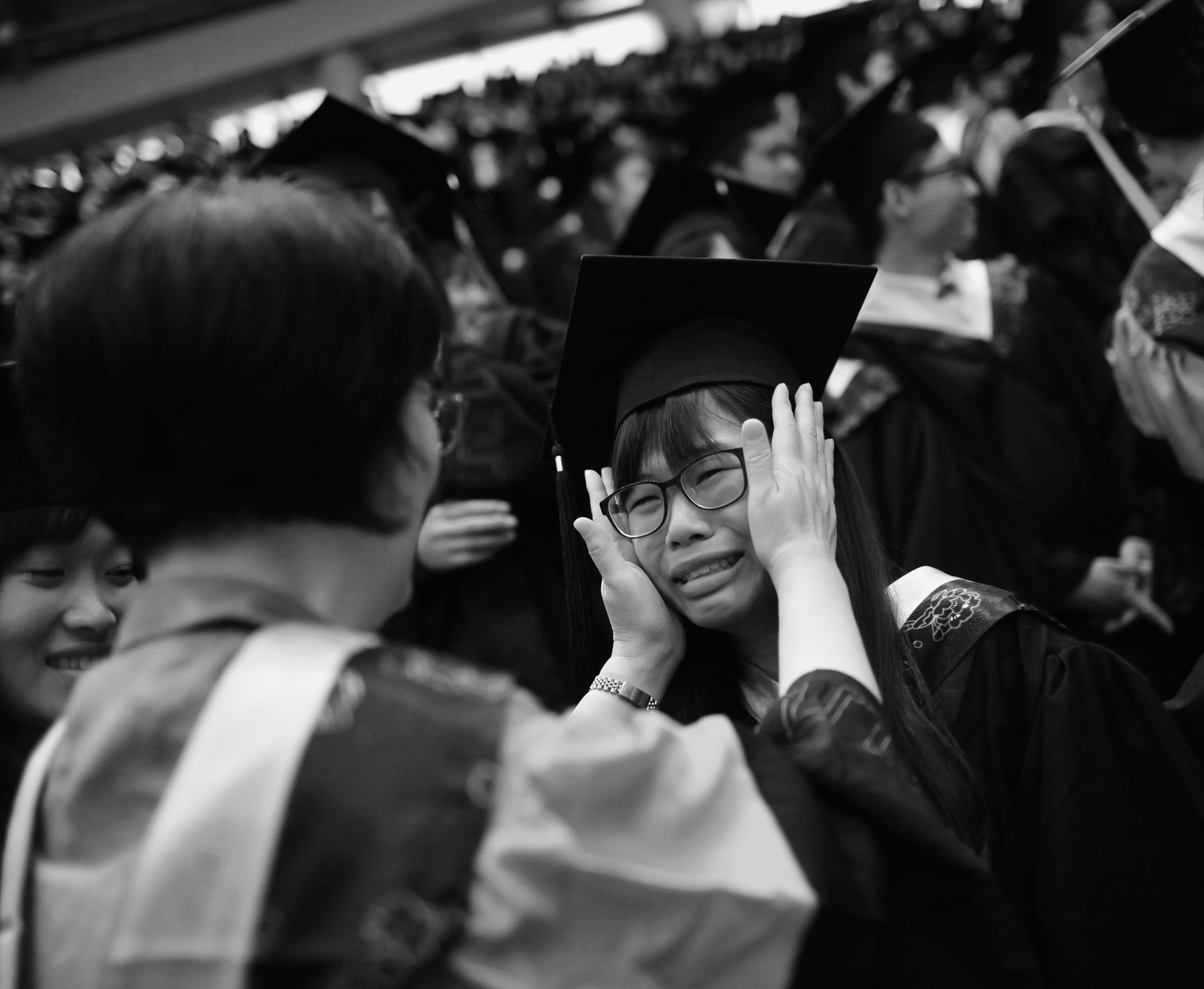
Above: A weeping graduate is comforted during her graduation ceremony at Fudan University in Shanghai last June. Women often have to achieve higher entry-level grades than their male counterparts to reach university and are blocked from some courses
Credit: Aly Song/Reuters
In another example, Beijing’s People’s Police University told the BBC that it limits the number of girls admitted to 10-15 per cent of the student body because, apparently, there are fewer jobs open to them after graduation, since most people in China expect police officers to be male.
Meanwhile, certain language courses, such as Arabic and Russian, have raised the bar for women with the argument that the countries where these languages are spoken are not receptive to women, so there would be a reduced likelihood of jobs at the end of the degree for these graduates.
Dong Qi is a headhunter in Beijing. She is often asked by companies for only male applicants
The argument that certain degrees and, in turn, jobs can be done only by men is largely unchallenged in Chinese society. Index spoke to secondary school student Yin Meimei, who attends a prestigious boarding school in Chengdu, Sichuan province. She has studied hard for the gaokao and hopes to score a top mark, which will enable her to major in Korean at university. But she is aware that in order to obtain a place at a top college in China, she needs to score higher than her male peers, and therefore she’s looking at the option of studying in South Korea instead. Yin is also good at science and yet she has never considered subjects like engineering.
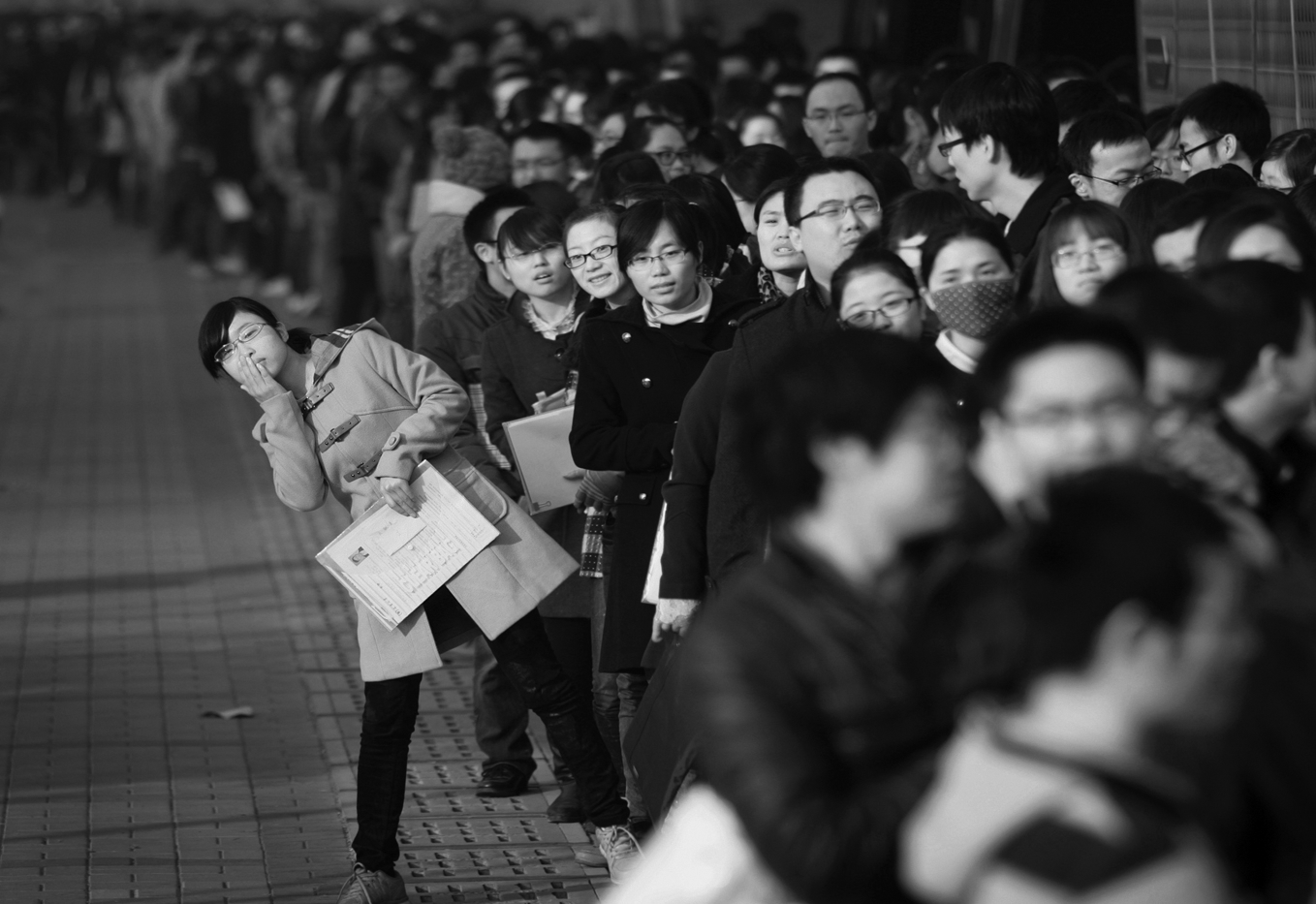
Above: Over 6,000 job-seeking graduates line up at a job fair at Tianjin University in the north east of the country
Credit: (left) China Stringer Network/Reuters
“I’m a girl. I cannot do these subjects. They are dangerous and require strong men,” says Yin when Index asks her about it.
These arguments conceal the real reason behind the unfair quotas. Chinese girls are consistently scoring better than boys in the admissions tests, leading to a higher percentage being admitted compared to men. Universities are, therefore, instituting a form of affirmative action in favour of less qualified boys. In short, women have become victims of their own success.
Chinese women have done extremely well in terms of education over the past decade. The ratio of female admissions stood at 51.9 per cent in 2013, rising from 43.8 per cent in 2004, according to figures from the ministry of education. However, China is still unprepared for women to have an equal footing to men.
Discrimination against women in China starts before they’re even born. Within the context of the one-child policy, a combination of sex-selective abortion and female infanticide has led to a ratio of 100 girls to every 118 boys. Gender bias continues throughout their lives. As the university quotas highlight, it’s a question of employment too. In China’s workforce it is normal for women to be banned from certain jobs because of a perception that they are only suited to men.
Dong Qi is a headhunter in Beijing. In an interview with Index, Dong says she is often asked by companies for only male applicants. These jobs are usually in the fields of engineering or involve foreign travel. But even industries more commonly associated with women impose gender restrictions. In January, news circulated of a young woman in Beijing, Cao Ju, taking a private tutor company, Juren Academy, to court after it refused to employ her for a teaching job because she was female. The case was the first of its kind. While these practices go on constantly, they’re very hard to fight.
Images circulate of women wearing university graduation gowns who are unable to wed
This is part of a bigger problem. The Chinese government closely controls the number of outlets through which people can voice their grievances. Gender Watch is one of only a few NGOs devoted to raising awareness about gender inequality. And they’ve got their work cut out. Xiong says that after they shaved their heads, they approached several lawyers to seek advice. The lawyers said they would offer legal aid to any clients wanting to fight barriers against women. But finding victims to represent has been difficult. One girl reached out to Xiong on Weibo. She did not get into her first-choice university and discovered she had higher grades than men who did. She got into her second choice though and in the end decided against pursuing the lawsuit out of fear that the government would rescind her university offer.
“The government has a tight grip on civil society. These gender biases have permeated society from pre-birth. They require a top-down initiative, but so far the government is doing the exact opposite. When you boil it down it’s really a one-party problem,” says author and academic Leta Hong Fincher. Her recent book, Leftover Women: The Resurgence of Gender Inequality in China, explores the topic of pressure on women to leave the workforce, get married and fulfill more traditional roles.
In 2013 the education ministry issued a new regulation saying that only a few universities could legitimately discriminate against women
“I see a concerted backlash against the tremendous educational gains for women,” Hong Fincher tells Index.
“There’s no indication that the Chinese government is concerned about a drop in female labour participation. On the contrary, you see in the rhetoric of ‘leftover women’ messages to go back to the home.”
Hong Fincher’s book outlines the effects of a government-sponsored effort to guilt-trip women into marrying early. Chinese women are labelled leftover if single and over the age of 27. Images circulate of women wearing university graduation gowns who are unable to wed. These educated women are the subject of ridicule. The images are internalised by women. They affect their ambitions and deter them from being more vocal when confronted by discrimination.
In the two years since the women shaved their heads and the issue gained real traction, there has been some progress. In 2013 the education ministry issued a new regulation saying that only a few universities could legitimately discriminate against women. Then, during the annual National People’s Congress meetings in March this year, some representatives raised the issue again. These actions will be of comfort to some, but not to all. China has plenty of policies in place that enshrine principles of equality. The country is founded on the Maoist principle that women hold up half the sky alone. What’s lacking is a government commitment to enforce these principles and, as these examples highlight, when it comes to China progress is not always linear.
Are you planning a family?
Women are regularly asked for personal information about their lives when job hunting, writes
Wei Jia, 30, has been working in human resources since she graduated from college in Beijing.
“Employers usually ask female candidates about their love life and family situations. Some press for intimate details about their marriage and pregnancy plans,” she tells Index.
While Wei herself has faced these difficult questions during her job search two years ago – she has been married for six years with no children – she has asked them herself when interviewing other women. These private matters are often of concern for companies in assessing how big a liability a female employee is, as companies are required to pay women maternity allowance and give maternity leave. Article 13 of China’s labour law states that women and men hold equal employment rights and that the bar for employment standards should not be raised for women.
“Jobs that require you to travel often or entertain clients would of course prefer men, or single women with no family obligations,” says Wei. Men, however, never face the same scrutiny over marital or familial obligations.
At 29, Feng Junying will soon be graduating from Beijing Jiatong University’s MBA programme. She thinks of these questions as routine, and finds it humorous how far into her personal future human resources personnel have ventured. “During my last interview at a bank, they asked me where my boyfriend lived, what province he was from, and if we had plans to move in together,” Feng says. “I don’t define myself or what I can do with my career by whether or not I have a boyfriend.”
Complicating the matter is the change to China’s one-child policy made late last year. The change allows couples to have a second child if one partner is a single child. Though this may seem a progressive shift in policy, a possible side-effect is further pressure for women during job interviews. The state-owned news agency Xinhua ran a story in March 2014 about a mother of a 10-month-old daughter experiencing difficulty finding a job. Employees were reluctant to hire her after discovering that she was a single child. The company feared she would have another child under the new policy, as it’s a common assumption that women will try for a son if they first have a daughter.
“The two-child policy may cultivate even more sexism in the work environment,” according to the Xinhua article – adding that such discrimination, while rampant, is also almost impossible to prove, as companies will cite other reasons for why a woman is not hired.
Feng is now currently interviewing for jobs. She finds questions about a woman’s family plans unproductive but also inevitable.
In the meantime, there are plenty of discussion boards online guiding women on how to navigate the issue. Users on Chinese online forum Zihu.com address a woman’s enquiry: “What’s the best way to answer the typical questions women face during job interviews, concerning marriage and children?” The general consensus seems to be that women need to keep talking about the issue.
©Hannah Leung
Above: Chinese mothers with just one daughter could be discriminated against by employers
Credit: (right) iStock/Getty/yuyanga