



Abstract

New technolgies and methods of distribution had changed the face of the nineteenth century printing industry and created new, wider readerships. As a result, World War I was the first conflict in which the mass media played a significant role.
In 1914 Britain witnessed for the first time the new phenomenon of national governments adopting the techniques of advertising to promote war aims, both domestically and globally. Reported in daily newspapers weekly journals, publicised through posters, and pamphlets and commercial advertising
It is arguably little wonder that World, War I became known as the first “total war” - executed at first hand by soldiers conscripted en masse and experienced by entire populations on the home front. While our own historical vantage point allows us to consider the war with knowledge of the consequences and effects it had on society, it must also be situated on a continuum with an earlier phase. World War I was born out of a long nineteenth century that witnessed increasing industrialization and urbanization and the rise of mass media. Thus, when war descended on Europe, printing, the archetype of mass production, became as relevant as the manufacturing of munitions. Reaching large numbers of people, propaganda posters conveyed the war aims of the British government, and aimed at persuading civilian populations that their collective effort would be essential to securing victory.
But perhaps surprisingly given the relative sophistication of the British advertising industry by 1914 and the scale of the propaganda campaign by 1918, the adoption of a full-scale poster campaign was at the time a step taken tentatively by the British government. The poster campaigns of political parties for the 1910 general election had established a premise for large scale canvassing, but posters were an object of criticism. Abundantly displayed in public spaces, the erection of signs and hoardings provoked an organised public reaction in the form of the National Society for Controlling the Abuses of Public Advertising, its membership list containing a number of notable names including William Morris and Rudyard Kipling. (Although opinions differed; The Times argued in 1892 that: “They cause a great deal of pleasure to a great many persons who live very dull lives, and in a very large number of instances their surroundings are already so hideous that they cannot be made worse”). But it was the poster’s tendency to importune passers-by with commercial appeals that attracted criticism; it was thought to be in poor taste. Once war broke out, the poster gained a new, legitimised role as a vehicle for official propaganda, freeing it from the usual air of hostility and distaste.
When war descended on Europe printing became as relevant as the manufacturing of munitions
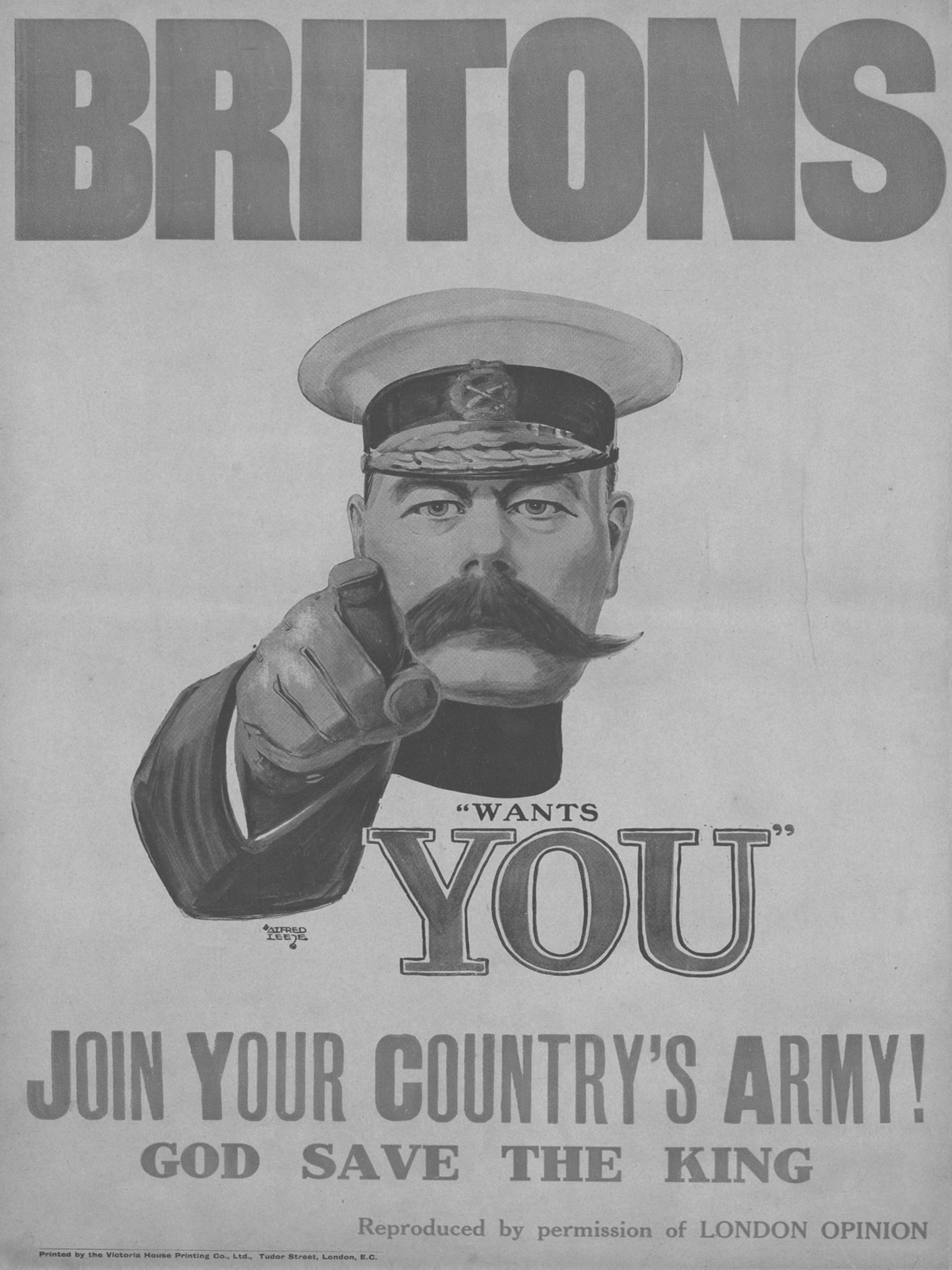
ABOVE: The iconic World War I propaganda poster designed by Alfred Leete
Credit: London Opinion/Victoria House Publishing/IWM London
One of the first aims of Britain’s propaganda machinery was to convince a divided nation of a justification for war. In the years leading up to 1914 Suffragette militancy, industrial action and the issue of home rule in Ireland had taken form in social unrest. With the German invasion of Belgium on 4 August 1914, Britain established a noble cause, with newspaper headlines lamenting “Poor Little Belgium”; not only had Germany violated an international treaty in their invasion of neutral land, according to press reports they were showing no remorse as they committed alleged acts of atrocity upon the innocent nation. Fully aware of the usefulness of the Belgian cause in garnering support for British involvement, the earliest declarations of war aims were almost always made in speeches about Belgium. On the day that Britain declared war, Sir Edward Grey implored: “If, in a crisis like this, we ran away from our obligations of honour and interest with regard to the Belgian treaty, I doubt, whatever material force we might have at the end, whether it would be of very much value in face of the respect we would have lost.” Early visual propaganda presented images of Belgium as an innocent child or a woman ravaged by “the Hun”, and recruitment posters implored men to “Remember Belgium” and asked, “Have you any womenfolk worth defending?” The violation of Belgium was one of the most powerful inducements for men to enlist, with government propaganda promoting a feeling that this was a justified war against a monstrous enemy.
And it was not only government-produced material that featured this kind of imagery. Charity materials made for the Red Cross and the Belgian Canal Boat Fund, amongst other organisations, drew on similar gendered rhetoric to garner support, portraying images of displaced women and children. By placing an emphasis on gendered representations of domestic safety, the meaning of war could be explained in humanitarian terms. It was not uncommon to see prominent members of government on the boards of wartime charities, implementing a type of government policy by proxy. The distinctions between a recruiting poster that aimed to sell the army and a charitable advertisement soliciting donations became fewer as the aims of different concerns became symbiotic. With the press also justifying the war in terms of the sanctity of the law and the safety of civilians, Britain’s involvement became difficult to dispute.
The parties in the 1910 general election used poster campaigns for large scale canvassing
Just as the issue of gaining support for the war necessitated adopting the plight of Belgium as a selling point, convincing the British public of the idea of conscription called for another of the government’s most extensive campaigns. The German and French armies were made up of conscripted soldiers, but by contrast, the British Army was smaller, and consisted of professional soldiers and volunteers. The notion of conscription was deeply opposed in British society, it being somewhat paradoxical for the British to claim to be fighting for freedom in the name of liberal democracy, with an army made up of men who had been forced to fight. Instead, men had to be sold a picture of life in the British army that would encourage them to join. Had the government introduced conscription before doing so, it is likely that the war wouldn’t have received the support it did from the British public. The Parliamentary Recruitment Committee (PRC) was established to sell the idea of conscription to the British public, and between October 1914 and July 1916 they produced some of the most memorable images of World War I.
The earliest recruitment posters were adorned with only the Royal monogram and the words “England expects every man to do his duty”, but as the campaign progressed techniques of persuasion became increasingly sophisticated. Members of the advertising community worked with the government to help the state appropriate advertising techniques to sell the war effectively. The war cabinet relied on advertising experts such as Hadley Le Bas, Thomas Russell and Charles Higham to ensure campaigns achieved the desired result. Relationships between British and American advertisers allowed ideas to filter across the Atlantic, and British advertising mirrored the persuasive techniques used in the United States. Poster such as “Daddy, what did YOU do in the war?” emotionally manipulated the viewer, playing on personal relationships and basic human anxieties. These tactics were sharpened as war went on, and were crucial in the attempt to attract men to the war machine.
The distinctive design of Lord Kitchener’s penetrating glare and pointing finger in the famous World War I recruitment poster is one of the most enduring wartime propaganda images. The poster instructs potential recruits that “Kitchener needs YOU!”, referencing then Secretary of State for War Lord Kitchener, a national hero whose exploits in the Sudan were lauded in the press and celebrated in the popular adventure fiction of GA Henty. However, although we now think of this as one of the most common propaganda posters used for recruitment, archivist Nicholas Hiley has convincingly argued that his image may not have been as prevalent during the war as claims have led us to believe. The image we know today was actually originally designed by graphic artist Alfred Leete, for publication on the cover of London Opinion magazine. Little reference is made to Leete’s design in the files of the PRC, or in the war office or the public accounts of David Allen and Sons’ wartime work, indicating that it was never actually used as a propaganda poster during the war. Instead references to Kitchener’s face appearing “on every hoarding” may well refer to another poster produced in July 1915 showing the war minister’s stern glare beside the searching question “Does the call of duty find no response in you until reinforced?” The later poster was issued in two different sizes, and had a large print run of 145,000, making it the most numerous of all the PRC posters. It was hung in the PRC’s Downing Street office and mentioned in the official summary of the committee’s work, neither of these honours being conferred to the London Opinion poster.
Money making propaganda
By July 1916, the introduction of conscription rendered the PRC obsolete and with little hope of an end to the war in sight, the government’s propaganda campaign shifted towards maintaining morale. Propaganda efforts focused on the “Call to arms” to encourage industrial activity, the conservation of food, and economic appeals. Throughout the war, the aim was never to change opinion, but to maintain interest. Thus, once the initial excitement had passed, more emotionally manipulative techniques were necessary. This change in tone was often reflected in an increased use of guilt as a method of persuasion. In appealing for male and female munitions workers, the posters maintained a positive outlook, exclaiming “We’re both needed to serve the guns!”. Towards 1916, when the government’s need to raise money increased, the worker’s honour was called into question. One poster implored, “You earn more than he does” to encourage workers to purchase war savings. The close ties between commerce and government became increasingly clear through seeing commercial interests directly promoting government agendas. Waterman’s Fountain Pens encouraged their customers to use “the finest writing instrument for signing your application for National War Bonds” and Quaker Oats exclaimed that, “A £5 Bond hits the Kaiser harder than 5000 words”. The tone of economic appeals changed, becoming more forthright and graphic. Frank Brangwyn’s poster reading “Put strength in the final blow”, which portrays a British soldier pinning a German soldier to the ground with his bayonet, is unusual in its depiction of the violence of war. The image links our financial investment with the soldier striking the blow, our money giving him the strength to commit his violent act.
The ultimate aim of Britain’s poster propaganda campaign was to maintain support and interest in a long and drawn out war, and it did so by adopting the techniques of advertising to seduce its audience on a social and cultural level. Propaganda was an instrumental link between the state and the masses, and it allowed Britain’s war aims to penetrate all facets of daily life. Facilitated by the relationships between government, the press, and the advertising industry, the war was inescapable. It featured in breakfast cereal advertising and it adorned the walls and hoardings along the commute to work. In many ways the twentieth century began in 1914 - not for the political, social and technological changes the war brought about, but for the beginnings of the media and consumer driven society we live in today.