




Abstract

Gambia has a new journalism school but it is still one of the most dangerous places in west Africa for journalists to work.
In Gambia, where there is a great deal of political uncertainty and free expression is constantly undermined by a volatile environment, it is often journalists and political opponents that are the most most vulnerable.
Following the July 1994 military coup on the 22 July 1994 that ended the 30-year rule of Gambia’s immediate post-independence leader Sir Dawda Jawara’s 30 years of democratic rule, many Gambians were confident that the tiny west African nation has would develop a thriving democracy unencumbered by corruption and cronyism.
But 19 years later such hopes are all but dead. Coup leader Yahya Jammeh is still in power, the president of a government notorious for violations of human rights. His regime has a shameful record of arbitrary arrests, suppression of the press, and intimidation of journalists.
This autumn a group of Gambian human rights activists led by Amadou Scattred Janneh, a former information minister who was sentenced to life imprisonment by the Jammeh regime, held a protest at the Ritz Carlton Hotel in New York where Jammeh was staying while attending the United Nations General Assembly. The protesters called on Jammeh to answer for human rights violations in Gambia, particularly those relating to journalists.
Three days after the demonstration, a prominent member of Jammeh’s ruling party, the MP Pa Malick Ceesay, sent a message to Omar Bah, editor of the US-based Gambian dissident online newspaper American Street News (ASN), threatening to harm his parents, who live in Gambia.
Gambian journalists have fought hard for freedom of expression. And there has been some good news in the past 12 months. In March the first journalism training institute in nearly half a century of independence came into being when the Gambia National Training Authority accredited the Gambia Press Union’s pioneering journalism school, set up with help from the Danish International Development Agency. The Gambia Press Union called the accreditation of the centre an “unprecedented development in a country that has never had a formal structure for journalism education,” according to Panapress.
The European input was welcomed by Gambian journalists – but it has not been without strings. In January 2013, the European Union demanded that the Jammeh regime repeal authoritarian media laws, give foreign diplomats access to prisons and abolish the death penalty.
There can be no doubt that the Gambian regime’s attitude to freedom of expression is draconian. In April, Jammeh’s government got the Public Utilities Regulatory Authority to ban the use of free internet phone services using voice over internet protocol (VoIP).
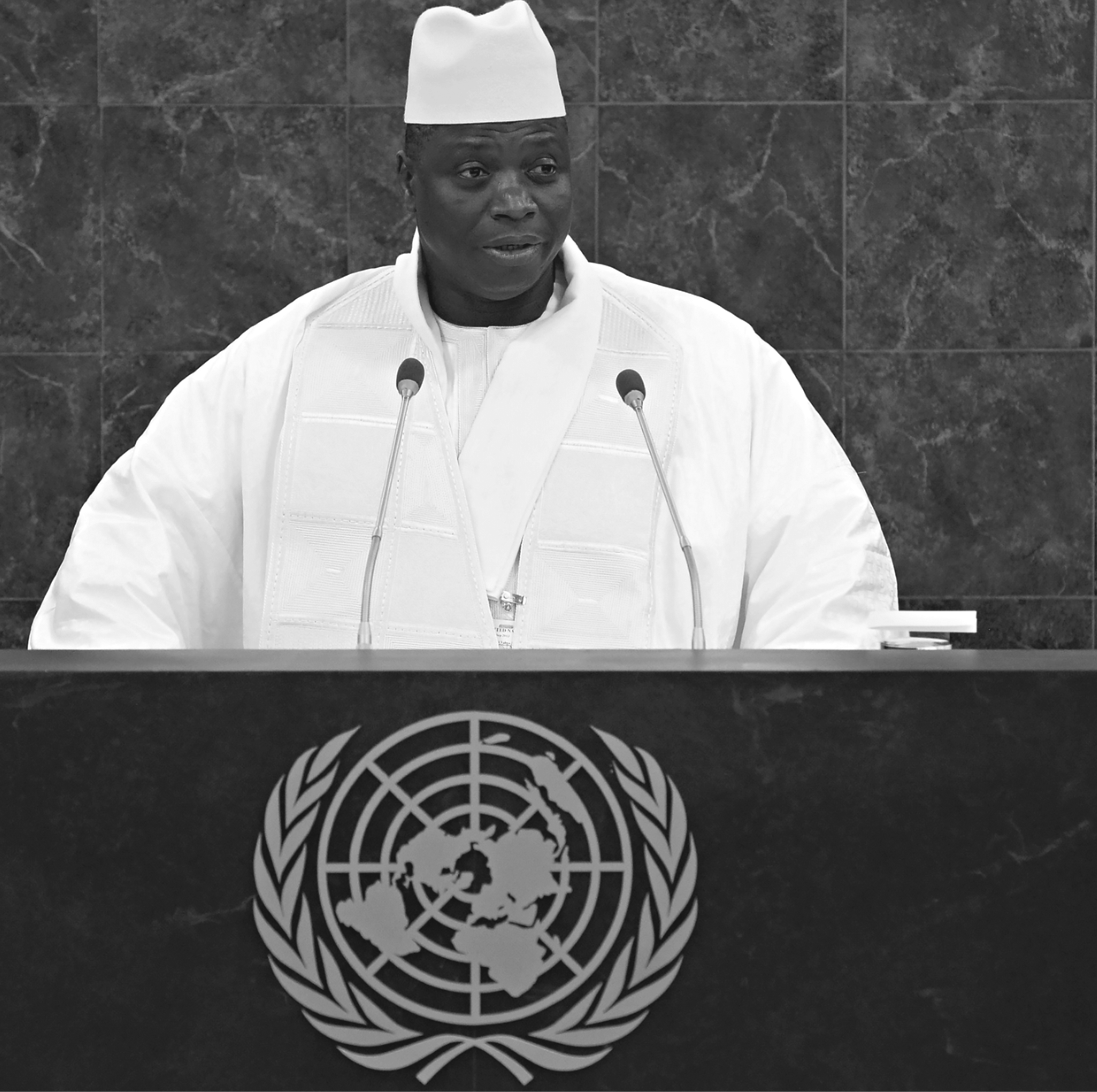
Above: Gambian President Yahya Jammeh addresses the 68th United Nations General Assembly at UN headquarters in New York
Credit: Andrew Burton/Reuters
The government warned that anyone using VoIP phone services was depriving the country of revenue from international and national calls – and was therefore committing an economic crime. It subsequently stepped back from the ban, but still imposed a stiff charge on internet cafes to register for use of VoIP.
Worse, however, was to come. In July the government pushed through legislation imposing sanctions on government officials and other individuals who gives stories to Gambian online news outlets outside the country – with a penalty of a 15-year jail term or a fine of more than £50,000 (US$ 79,695) for miscreants.
Fatou Camara, a former press officer for the president and prominent popular television presenter, was arrested in September and detained by the Gambian National Intelligence Agency for more than 72 hours without charge. She was subsequently held in prison for the best part of a month but has now managed to leave the country.
According to American Street News, Fatou’s arrest and detention was the result of her involvement with the Senegalese musician Youssou N’dour’s Television Future Media, a Senegal-based TV station that often reports critically on the Gambian dictatorship.
Yahya Jammeh’s regime has a shameful record of arbitrary arrests and intimidation of journalists
Also, in July, Freedom House condemned amendments to Gambia’s Information and Communications Act – passed by the National Assembly – which penalises those who spread “false news or information” against the government. These amendments further restrict freedom of expression, press freedom and internet freedom in Gambia and demonstrate the government’s open hostility towards the media.
Another stain on Jammeh’s record is religious tolerance. In August 2012, a prominent Islamic scholar and imam, BaKawusu Fofana, abruptly fled the country and sought refuge in Casamance in southern Senegal after being detained for nine days, and, he says, tortured. In December that year, another outspoken imam, Baba Leigh, was seized by Gambian authorities.
Leigh’s arrest was linked to his criticisms of the regime’s execution of nine prisoners by firing squad in August 2012, which caused international outrage. The killings were condemned by the African Commission on Human and People’s Rights, the European Union, Amnesty International and the Senegalese government. Leigh was released from custody in May after protests from European and African governments and human rights organisations.
There are no signs of improvement on the horizon if further pressure is not applied externally. Meanwhile Gambian journalists struggle against all odds to make their voices heard.
