




Abstract

Investigative reporter Eric Schlosser talks to
There aren’t many books that change attitudes, but Eric Schlosser’s Fast Food Nation was one of them. The questions it raised about what we eat, where it comes from and how fast food chains make their money had an extraordinary public impact. It made a large group of people who had never worried before about the food industry think seriously about it. And it was turned into a film.
He did what many journalists aspire to do but find it increasingly difficult to achieve; write something that challenges public attitudes, or pressurises a government to change a law.
But Schlosser says that what inspired him to write Fast Food Nation was not a desire to make people worry about what they put in their stomachs, but an urge to highlight the plight of people working in the food industry.
There is an echo here of the author Upton Sinclair, whose fictionalised expose of the Chicago meat-packing industry, The Jungle, was published in 1906. Sinclair’s novel was a massive success. It helped create the public pressure that led to the Meat Inspection Act and an early incarnation of the Food and Drug Administration. But Sinclair said he was disappointed that the public focused on food, not the plight of the workers, after reading his book.
Schlosser says Sinclair is one of his heroes, and that’s not surprising. Schlosser has a lot in common with the early 20th-century “muckrakers” whose forensic work dug out detail and stories that left the public horrified. And the link to Sinclair doesn’t end with Fast Food Nation; Schlosser was executive producer on Paul Thomas Anderson’s film There Will Be Blood, starring Daniel Day-Lewis, which is based on Sinclair’s Oil.
Schlosser’s new book, Command and Control, is on a very different topic: the history of nuclear weapons. But his approach is familiar. He is a detail geek, nothing if not persistent. The endnotes stretch to nearly 100 pages, which would not be out of place in an academic textbook. He conducted no fewer than 100 interviews with people about an accident involving a Titan II intercontinental ballistic missile near Damascus, Arkansas, that came close to disaster.
He says he has spent so long working on food and nuclear weapons because both stories are about unaccountable power and safety. “In writing about nuclear weapons, it’s a similar story about power – bureaucratic institutions that wield enormous influence, whose operations are largely in secret and are fundamentally undemocratic.”
Above: One of the highpoints of investigative journalism, the Washington Post’s Watergate reports. Here former Attorney General John Mitchell takes the witness stand
Credit: CSU Archives/Everett Collection/Alamy
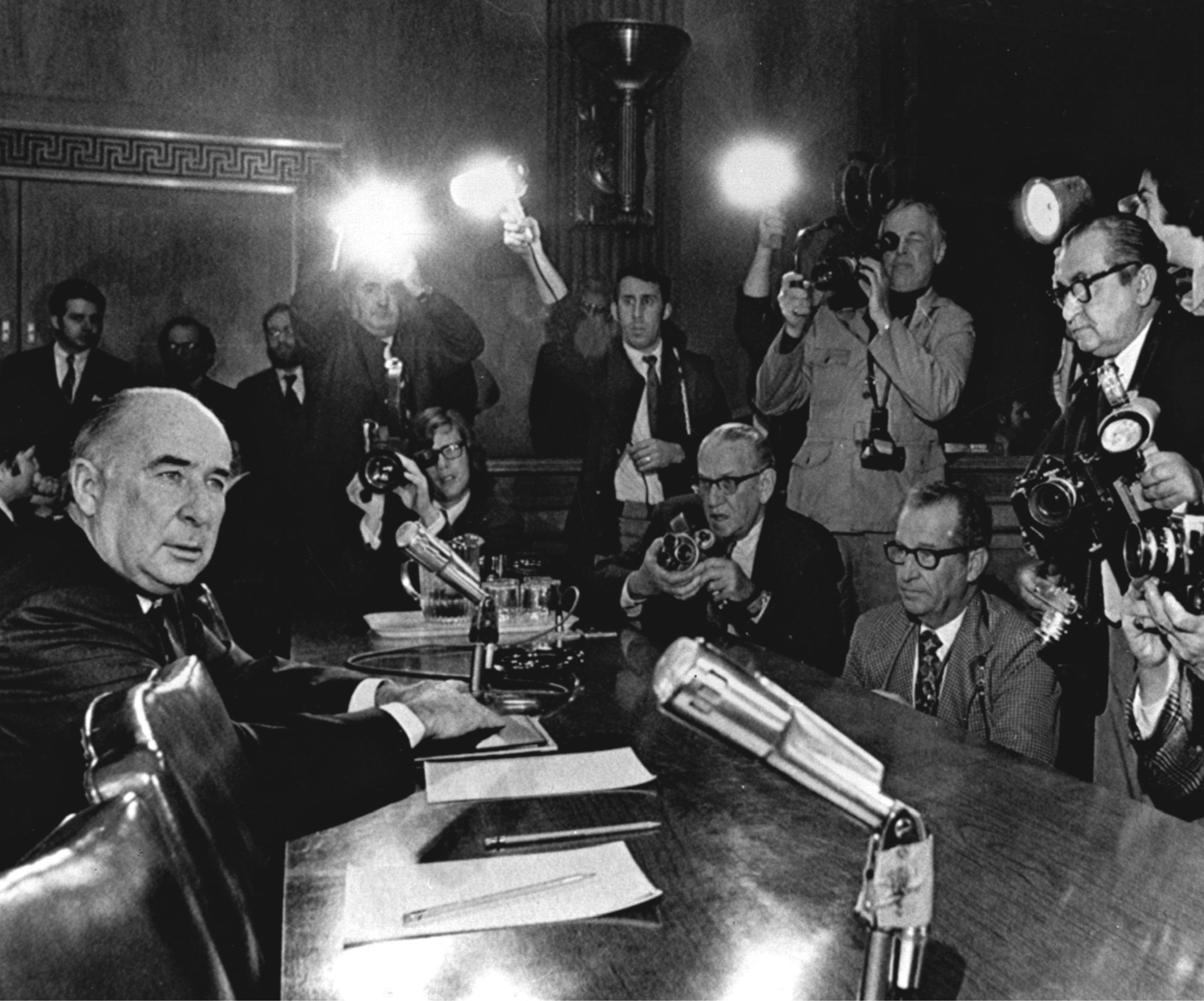
He spent six years researching Command and Control. How could he afford that? He says that after the film of Fast Food Nation he got a decent advance, and that he was lucky. “There’s so much less support today for investigative journalism than before,” he says. “My role as a journalist has been an old-fashioned notion of exposing injustices, of exposing the workings of powerful institutions in the belief that this knowledge is essential to democracy and that people deserve to have it.”
Command and Control appears at a time when the debate about investigative journalism and national security is dominated by the story of the whistleblower Edward Snowden. Schlosser has considered the implications. He says that an unnamed expert, with high security clearance, read a draft of the book and advised whether any detail could expose or harm the defence of the US. His motive for publishing, he adds, was to get the US government to make a clearer assessment of the risks of owning nuclear weaponry, and to be able to learn from earlier mistakes.
Schlosser says that the Titan II incident in Damascus, Arkansas, could have helped inform decisions afterwards. “What is most concerning to me is the lies that were constant through the Cold War were that there was no risk of an accidental detonation, that there was no risk of a weapon being stolen, that there was no risk of our own personnel using our weapons without permission. Those were lies.”
He says: “Again and again, what had been censored was information that threatened to embarrass national security bureaucracies, not information that threatened the national security of the United States. So secrecy is repeatedly used as a way for powerful bureaucracies to maintain control of discussion of these issues.”
There is no real reason for the detail that he discusses in his book to be kept secret, he says. The details are now historic, and therefore the public and policy-makers can learn from them without risk. “Basic decisions of national security policy are made by a small handful of officials in Washington DC without the input of public debate. There is something fundamentally authoritarian and anti-democratic about the management of nuclear weapons. My book is an effort to restore some semblance of democracy to this system. This is information I think it’s crucial for people to know.”
“There can be an interesting debate about who is more qualified to determine what threatens the national interest – government officials, journalists, ordinary citizens – but I think each of us has to take personal responsibility for what he or she reveals, and I take that responsibility. I’m not going to reveal my sources and I tried really hard not to reveal anything that threatens the security of the United States – and I don’t think I have.”
Journalists, he believes, take a kind of Hippocratic oath both to “do no harm” and to protect their sources. “I think that there is an important role for mediators of information. I think it is irresponsible to release documents that could lead to people being harmed. I think some of the WikiLeaks things should have been more carefully scrutinised so that the names of people who work for the United States may not be put in physical jeopardy.”
His reaction to Snowden’s revelations is one of shock at the incompetence of the US government. “What’s unfortunate is that the United States government is responsible for this problem – it has far too many secrets and far too many people with the security clearances able to access those secrets. One of the most significant things that has come out of the Snowden case to me is the revelation of how incompetent the government is at maintaining its own secrets.”
“Again and again, what had been censored was information that threatened to embarrass national security bureaucracies, not information that threatened the national security of the United States”
Schlosser is concerned about the future of reporting. “I am a member of an endangered species unfortunately. There has never been a greater need for investigative journalism and yet there’s a declining supply of it. I’m hoping that the transition from print to digital media will occur more quickly so that there are means of paying journalists through the delivery of digital media. What’s horrible about what happened is that a small number of news aggregators have been able to get online first, and more cleverly get online, and pioneer a certain kind of parasitic news delivery: sites which don’t pay journalists, which use the work of journalists that has been paid for by mainstream media organisations without paying the actual journalists. So we’ve created a feeling that news should be available for free. The notion that it should be available for free I think is insulting to the people that do it.”
He doesn’t want to discourage people from entering journalism because there is a wealth of subjects that need to be delved into, but compared with his first years in journalism, when The Atlantic supported him to go off diary and embark on long investigations, the likelihood of finding those opportunities as an unknown name are limited. “I encourage people who are going into journalism to really learn how to write but to also learn how to use a video camera and learn how to edit.”