




Abstract
When the editor of popular Indian newspaper The Hindu was pushed out after two years, commentators asked whether this signalled a move to turn the clock back and make the newspaper a family-run affair once more, writes
When Siddharth Varadarajan was appointed as the editor-in-chief of popular Indian national newspaper The Hindu two years ago, it was taken as a signal of a change of pace and attitude. It was expected to signal a move away from the old days of the family-run enterprise towards a business-like future where an experienced editor would make editorial decisions based on journalistic values. Two years later, Varadarajan is no longer the editor-in-chief, and all the indications are that this is a backwards-move.
In late October, Varadarajan was ousted from his post. This took place after the old guard at publisher Kasturi and Sons Ltd voted to overhaul the management of the newspaper. The move was spearheaded by its chairman Narasimhan Ram, who used his casting vote to carry the day. Varadarajan, who was re-designated as contributing editor and senior columnist, resigned after the announcement.
This is a troubling and unfortunate precedent in a country where so many institutions, ranging from private enterprises and companies like Reliance and Tata to the Congress Party, are largely still centred on or run by a single family. And the media is no exception. Other media families include the Sahu Jain family, who own the Times Group and its parent company, Bennett, Coleman & Co Ltd, which publishes the Times of India, the biggest selling English newspaper in India and indeed the world. With The Hindu being a reputed newspaper and publishing house, it begs the question, will it again be a professionally run news publication or does the Kasturi family, its members and their interests still hold sway?
Unfortunately, it seems the latter maybe true. Varadarajan was the first editor in The Hindu’s 135-year history to be appointed from outside the Kasturi clan, and this tenure has only lasted two years. The Hindu is viewed in India as less populist than many other national newspapers, a serious publication dedicated to thoughtful reportage and investigative journalism with a left-of-centre slant. This is very much needed in a country where the news media continues to be dominated by the brash and brazen Times of India, infamous for its puff pieces or advertorials, along with an army of chest-thumping and jingoistic 24-hour news channels.
It is likely that The Hindu will continue in its sober vein but the removal of Varadarajan does not seem to be a step in the right direction. Initial signs do not look very promising.
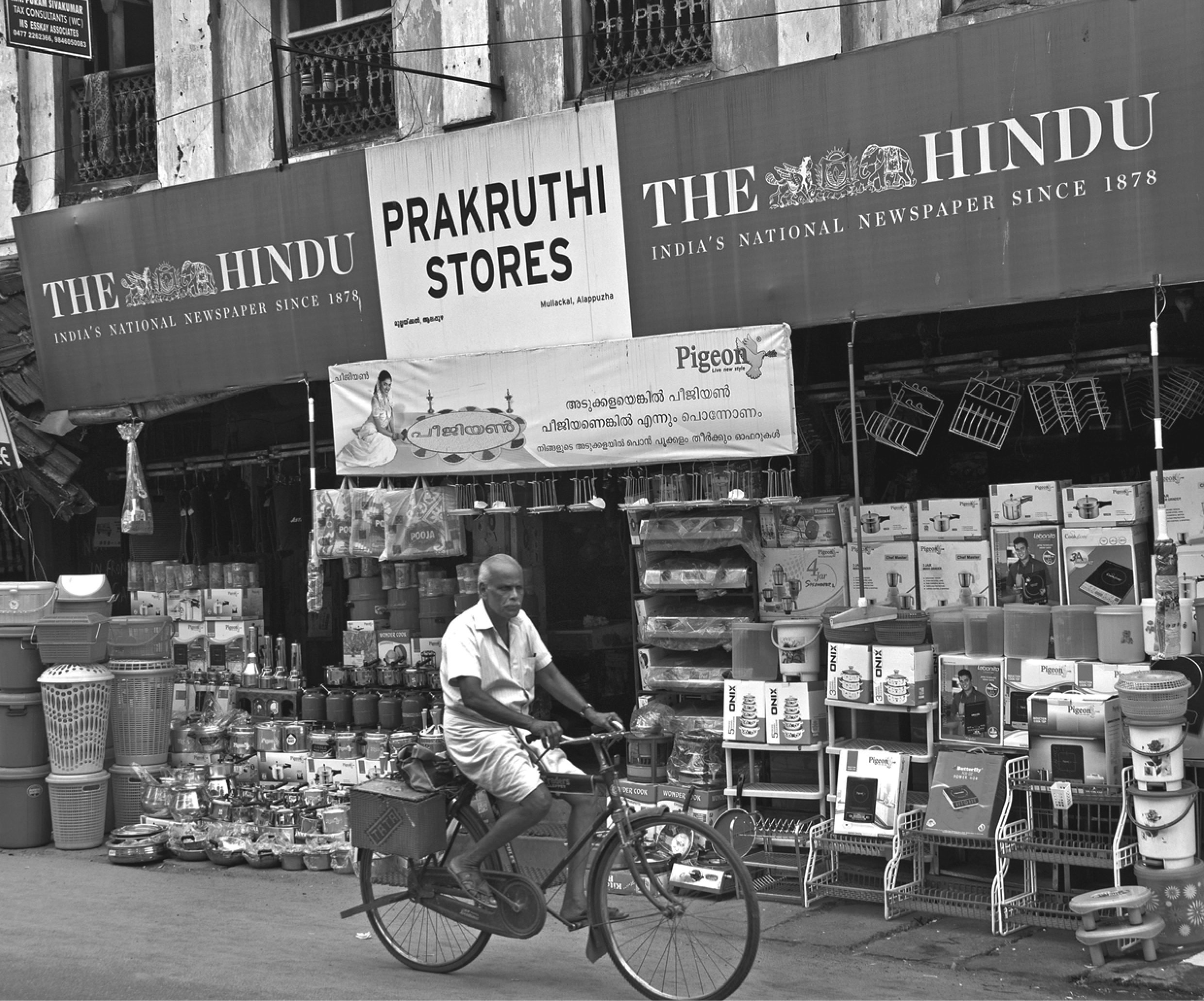
Above: A shop in Alappuzha, Kerala advertises The Hindu, viewed as one of India’s less populist newspapers. In its 135-year history, it has only enjoyed two years of editorial management from someone outside the Kasturi family clan
Credit: Peter Horree/Alamy
The 48-year-old editor had made an immediate impact, making The Hindu a more readable and tougher newspaper, with a penchant for hard-hitting investigative journalism. It is one of the only Indian newspapers that has a correspondent based in Africa, appointed during Varadarajan’s two years in charge. It was also one of the very few national papers that included a vast amount of reportage and stories on the Maoist insurgencies taking place in eastern and central India.
As a backdrop to this drama, it is important to remember that next year India will be holding its first general elections in five years. Narendra Modi, who is the opposition Bharatiya Janata Party’s candidate for Prime Minister, looks set to win. But Modi is one of the most polarising figures in India at the moment, infamous for his alleged role in the Gujarat Hindu-Muslim riots of 2002. Since then he has been elected as the Chief Minister of Gujarat for three elections in a row and is now expected to be the next leader of India.
One statement in particular showed how divisive Modi is even at The Hindu. A couple of days after Varadarajan’s resignation, Narasimhan Ravi, the newspaper’s new editor-in-chief, was quoted in the Indian business publication Mint as saying that [under Varadarajan’s editorship] the “newsdesk was given standing instructions not to take any stories on Narendra Modi on page one”. Varadrajan’s resignation also triggered further drama. On 21 October, the newspaper’s website explained that changes in the editorial management were due to “recurrent violations and defiance of the framework of the institution’s longstanding values on the business side, and recurrent violations and defiance” of the newspaper’s editorial values.
So many institutions are largely run by a single family. And the media is no exception
With Modi’s popularity increasing and his profile growing, it seems Varadarajan ruffled more feathers than those of the newspaper’s management. Both Ram and Ravi have denied these allegations, but Varadarajan commented in an interview on the Best Media Info website that he and his team may have trod on some “big toes”. “Toes that were expecting puff pieces and not hard reporting from The Hindu. Those toes will probably be feeling relieved now,” he said.
Unfortunately, the Hindu is not known to be the most harmonious board, and over the years it has had a fair few spats. There was hope that with Varadarajan, it would evolve into a more professionally run magazine. On one level, it may seem this is just another feud, and normal service will resume, but with allegations of “recurrent violations” and the Modi issue, these signs could be a prelude to a change in tone for the newspaper.
Over the last year, some public figures have come under fire for their criticism of Modi. This is a worrying sign, a trend we are seeing being played out in every nook and cranny of the country. So as we look forward to next year’s election, we hope The Hindu and the wider Indian media will put journalism ahead of politics, as India needs strong journalistic values now more than ever.