



Abstract

A controversy over when to fly the Union Jack above Belfast city hall has culminated in a small but significant crackdown on civil liberties in Northern Ireland, says
Northern Ireland should really have gone away by now. We’d all agreed, surely. There was a peace process and then there was an assembly and everyone gets along now. Well, not quite gets along, but they’ve learned to live with each other.
That’s what the rest of the world told itself.
One spring morning earlier this year, I came across a procession in London’s Whitehall. A small group, overwhelmingly made up of middle-aged white men, was marching towards the Houses of Parliament, waving Union Jacks. The march had been called by an offshoot of the English Defence League, the South East Alliance, and was the first incursion of Belfast’s ongoing “flags” (or “flegs” for those who took it less seriously) controversy into the British capital.
The flags issue blew up in Belfast in December 2012. The city council was set to vote on the apparently innocuous question of whether to fly the Union flag on just 18 specified days per year – in line with most town halls in the UK – rather than every day.
Councillors cannot have imagined what would happen next. As they voted, hundreds of Protestants gathered outside to protest. A mob attempted to storm the city hall. In the following days, a video of a middle-aged woman screaming “No surrender!” through a broken window went viral around the world. The protests went on throughout the winter. The summer saw loyalist clashes with police – not unusual, but certainly given extra vim by the flags controversy. As I write, there are still spill-over protests against the perceived threat to “PUL” (Protestant, Unionist, Loyalist) culture.
Why did this happen?
The correctly held opinion is that the flag movement blew up because of a loyalist working class competing for increasingly squeezed resources in austere times. The dismissive opinion is that these people are always fighting about something, and this is just the latest thing. The clever opinion is that the loyalist paramilitary groups that traditionally held sway in Belfast’s Protestant neighbourhoods have lost their grip, and a new wave of young people, who don’t remember the horror of the long, bloody conflict, have stepped up, looking for their own bit of excitement.
Above: Protesters outside Belsfast City Hall, Northern Ireland, February 2013
Credit: Roger Bradley/Alamy
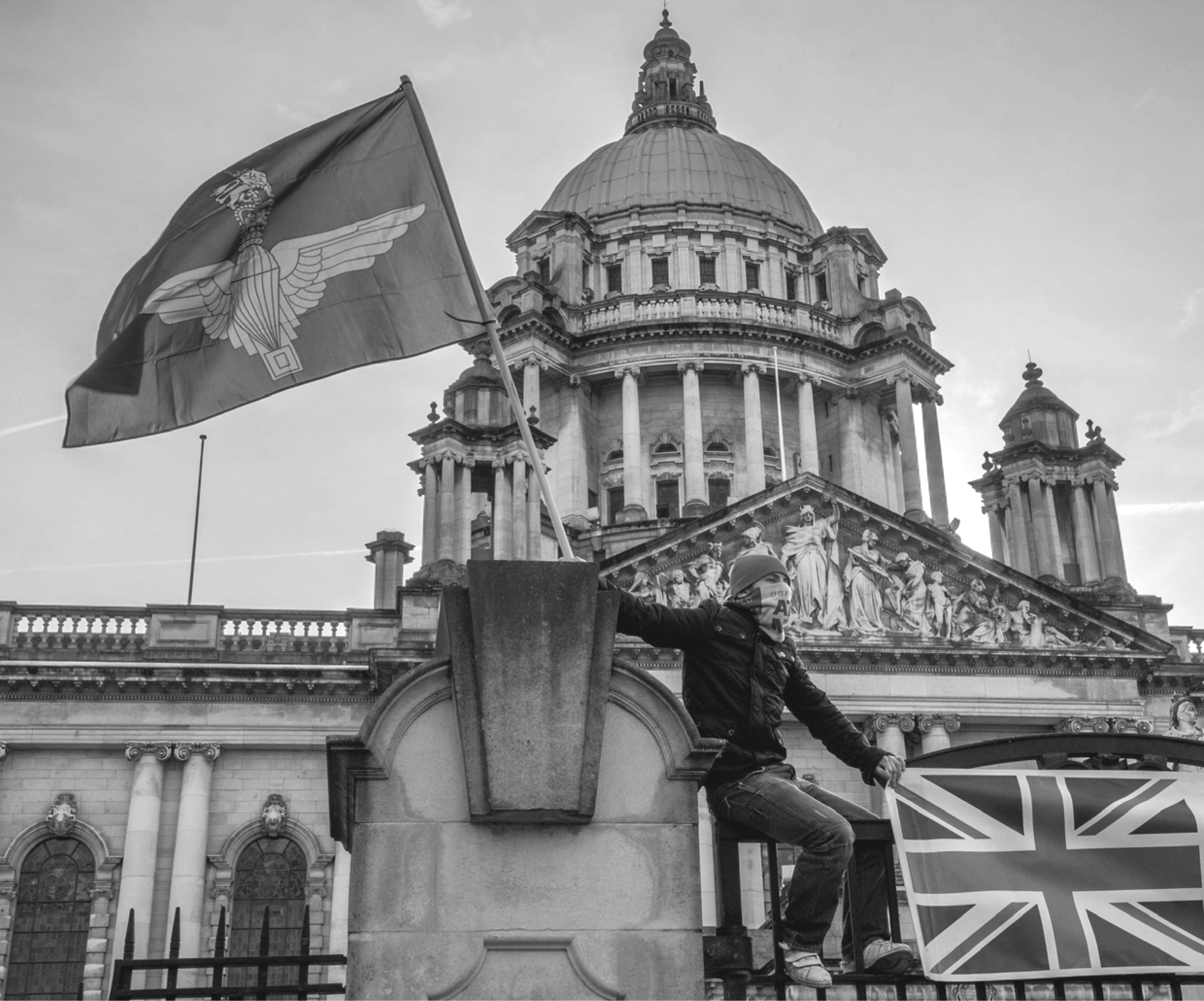
Certainly, the city councillors who voted on what seemed a minor piece of housekeeping cannot have envisaged this.
Which is not to say that this is an entirely organic movement. Students of Northern Irish politics will recognise some of the key figures among the “fleggers”. At their head is Willie Frazer.
Frazer is a middle-aged, bespectacled Armagh man who, it must be said, looks an unlikely leader of a street movement. In the late 1990s, he was the founder of the Families Acting for Innocent Relatives (FAIR) campaign, which claimed to stand for victims of the Provisional IRA in south Armagh. Frazer’s own father, an Ulster Defence Regiment officer, was killed by the IRA. Frazer was also the man behind the Love Ulster group, which was supposedly set up to promote PUL culture. That movement’s highlight came in 2006 when an attempted loyalist march through Dublin, the capital of the Republic of Ireland, sparked a riot.
Alongside Frazer was a young born-again Christian called Jamie Bryson. Bryson, from the picturesque town of Donaghadee, County Down, came to prominence in September 2012 with the publication of the first in a trilogy of ebooks called 50 Shades of God, marketed as an appeal to get young people interested in Christianity. The Amazon blurb for the book makes rather grand claims:
“Hailed by some as a God inspired ‘turn it all upside down’ blueprint and dismissed by others as a book to be kept out of the public domain.
“One church said ‘this book should be banned, it is too radical and has the potential to inspire too many minds for radical change.’ Read for yourself and make your own mind up. How dangerous can one man’s opinion really be?”
But aside from the Bible-bashing, Bryson had form in loyalist politics. He had been prominent in the North Down Somme Society (the Battle of the Somme is prominent in loyalist mythology), and at one point co-founded a political party with some fellow “community workers”.
Authorities have been all too willing to cast free expression aside when those who question the peace process settlement are involved
According to Northern Irish political website Slugger O’Toole, other major players included Mark Gordon, a reformed glue-sniffer who is now a Protestant pastor, and Jonny Harvey, a former RAF pilot who was a member of a group called Ulster Protestant Voice before joining the Progressive Unionist Party a year ago.
This strange crew managed to prolong the crisis over the course of 2013. At the beginning of the protests, it was clear the authorities did not have a handle on what was happening. The flag protests continued throughout December 2012, and were blamed for a slump in Belfast city centre business in the run-up to Christmas, as shoppers stayed away. Water cannons were deployed against the protesters as the police struggled to douse the flames of what appeared to be spontaneous anger against the police, republicans, the Stormont government – and, most of all, the non-sectarian Alliance party.
The Alliance delegation on the city council had been responsible for the suggestion that the flag be flown on 18 specific days (nationalists had wanted the UK flag removed from the city hall entirely, Unionists had wanted it to stay in place all year round). This was perceived by the flag protesters as a terrible betrayal, in spite of the fact that Alliance is not an avowed Unionist party.
Alliance party offices were attacked and attempts were made to set it on fire, while the party’s one MP, Naomi Long, received death threats.
While the attacks on Alliance eventually abated, the movement went on. In April, Frazer set up the Protestant Coalition, a pressure-group-cum-political-party, along with Jim Dowson, an anti-abortion activist and former British National Party (BNP) fundraiser. Apart from flags, the group’s main activity seems to be posting a variety of statements on Facebook, desperately garnering likes and shares with pictures of the royal family and cute dogs – really – and occasionally getting blocked from the social network website. The multiple deletions and reinstatements have led Protestant Coalition leaders to claim that Facebook, which has its European headquarters in Dublin, is riddled with republicans who are prejudiced against Protestant loyalists.
Watching the various contortions, cock-ups and conspiracies embarked upon by the leaders of the flag protests can be darkly amusing. In March, Gordon announced that Bryson, who was in police custody, was about to embark on a hunger strike. Hours later Bryson asked police to order an Indian takeaway meal for him. In September, Willie Frazer turned up at court dressed as Islamist preacher Abu Hamza, in protest at being prosecuted under a law he said had been created to counter jihadist terror. Bryson, for reasons unclear, dressed as singer Jon Bon Jovi. Northern Ireland’s budding internet satirists, among them the people behind “Loyalists Against Democracy”, have been having the time of their lives with the protesters.
But while it is easy to laugh at Frazer and friends, what is happening to them is troubling. The leaders of the protests have been repeatedly arrested and jailed throughout the year. Frazer’s protest against charges of “encouraging offences with an address” was equal parts ridiculous and well-founded. As Northern Irish commentator Newton Emerson tweeted: “As usual, the real problem with Willie Frazer is that he has a point.”
Bryson and Frazer have been subjected to some bizarre restrictions: Bryson at one point was barred from talking about the flags controversy in public. The two men are not allowed to speak on the phone.
The progress made in Northern Ireland since the Good Friday agreement of 1998 has been remarkable. But the process does not brook dissent from those outside the mainstream who have not signed up. The power-sharing executive means that there is essentially no official political opposition, as parties that previously represented extremes (the Democratic Unionist Party and Sinn Féin) now govern together.
From Bryson and Frazer to Suzanne Breen, the journalist who was hounded by the Northern Ireland police while reporting on the actions of dissident republicans, Northern Ireland’s authorities have been all too willing to cast free expression aside where those who question the peace process settlement are involved.
The flags protesters are not ideal poster boys for free expression, but then there is rarely such a thing. Northern Ireland will have to find a way to include even dissenters in the new settlement, or these anguished, incoherent and occasionally violent cries will become louder and more frequent.