




Abstract

ABOVE: : A woman walks along a road just outside Kabul
Credit: Mohammed Ismail/Reuters

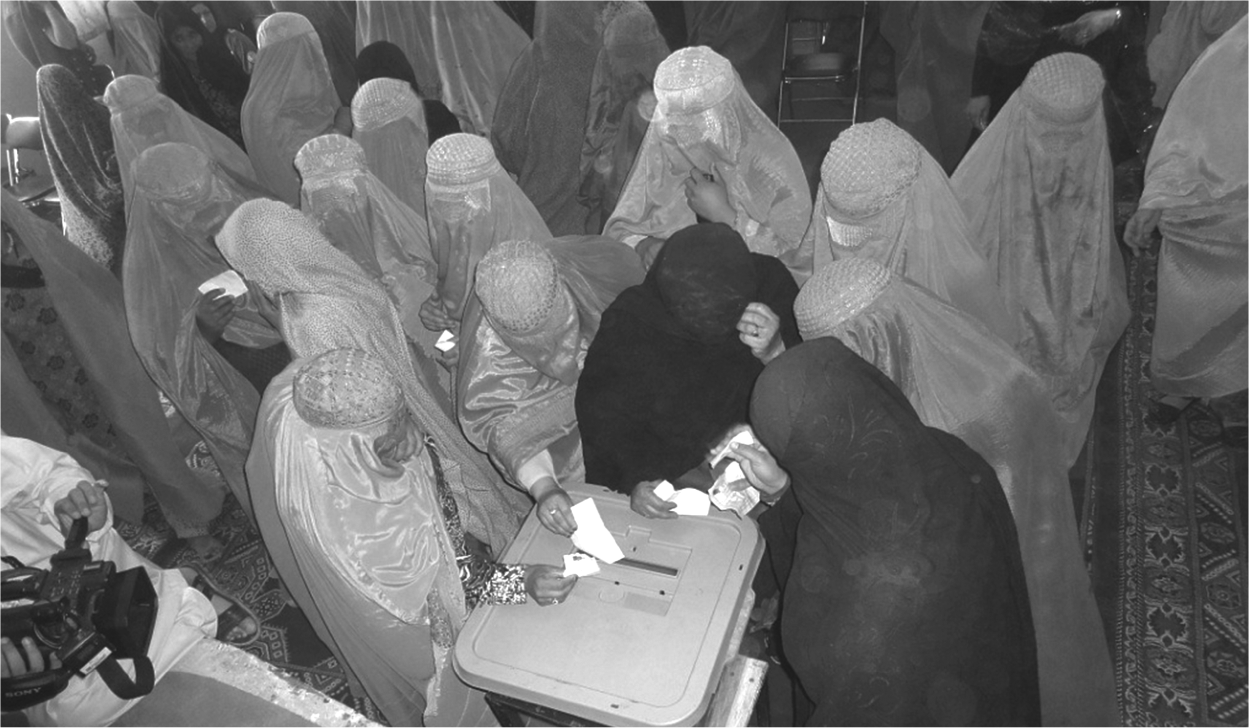
ABOVE: Afghan women voting at an election in Gereshk
In this section
Afghan heartland Charlotte cross and banu khetab 72
Battle chief moves on rachael jolley 79
A land without justice or truth abdulla duduev 83
Thought police Peter Kellner 88
Russia, freedom and the media Andrei Aliaksandrau 88
What free speech means in Russia 93
Reign of terror Dina Meza 95
War on the media Jeremy Dear 99
American dreams Matthew Shears 106
Risky business Andrew Wasley 109
Just months before troops pull out,
I was shocked when I heard about the murder of Islam Bibi in July 2013. A 37-year-old mother of three living in Helmand, Lieutenant Bibi (to use her hard-earned rank) had joined the Afghan National Police some nine years earlier. I met her back in 2009, when I was in Helmand reporting on the work of the UK Task Force. She told me she wanted to make a difference in her country, she wanted to defeat the Taliban, she wanted to stop them ever coming back into power. She’d suffered threats and intimidation, even from her own family, over what she was doing, but she was determined. There were just seven female police officers in 2009. Following a recruitment campaign by the British military, today there are more than 30.
Lieutenant Bibi was a trailblazer, a woman who led the way and stood up for what she believed in, on behalf of all the women who don’t have a voice. Lieutenant Bibi pushed against the attitudes of conservative relatives and neighbours, in a place where women are usually regarded as second-class citizens. In some of the more remote, rural areas, women are considered lower down the social scale than goats. Goats after all bring in money; women, denied an education and the right to work, do not. But outspoken women in conservative Helmand make certain people angry. She was shot dead, murdered as she left her home in the capital, Lashkar Gah. An extraordinary woman, on an ordinary day, gunned down in broad daylight.
I first arrived in Helmand in August 2006. As an officer in the Territorial Army, I volunteered to deploy for six months to what was then dubbed “the most dangerous place on earth”. My job was to try to understand the local population, so I spent much of my time just talking to Afghans. It was five years since the official fall of the Taliban, but I was struck by the fact they were still there, intimidating women from the shadows. At the girls’ school in Lashkar Gah, I listened while the headmistress told me the Taliban had threatened to cut off her fingers if she didn’t give up her job.
Fouzia was the head of the women’s centre in Lashkar Gah, a small tatty building where women gathered for mutual support. They learnt skills there, like sewing and IT, so they could start small tailoring businesses or find a job. The women would travel to the centre wearing the burka, afraid of being seen. Their fears were not unfounded. Fouzia would hide her handbag beneath the burka’s flowing robes, so nobody would recognise her. She’d already been attacked a few months earlier. A man on a motorbike rode up beside her car, emptying his AK47 into her driver.
They were terrified that a female suicide bomber would try to attack their centre. A female military policewoman taught them how to search burka-clad women for explosives or other weapons. We started a project to build them a security wall, and a guard post.
A few years later, I visited Fouzia again. The Provincial Reconstruction Team (civilians who work for the Department for International Development, the UK’s Foreign and Commonwealth Office and USAID), known as the PRT and attached to the UK military task force, had built them a brand new women’s centre in a safer part of town. Projects were going on all over Helmand, to help women get an education, acquire skills and find work.
A small radio station in the centre of Lashkar Gah now employs a group of female journalists, who disguise themselves on their way to work.
In some of the more remote, rural areas, women are considered lower down the social scale than goats. Goats after all bring in money; women, denied an education and the right to work, do not
Women still face so much resistance, but progress is gaining pace. The Afghan Tailoring Company is female-run, employing 30 skilled and unskilled female workers. They’ve learnt about marketing, increased their range of clothes, and opened a shop-front to increase passing trade.
In February, a business development programme sent 11 women from Helmand on business planning training in neighbouring Kandahar. And of 14 vocational training programmes across Helmand, five are exclusively for women, teaching tailoring, embroidery, computing and English. In the last two years, nearly two thousand graduates have been women.
ABOVE: Charlotte Cross with women from the Afghan National Police
Credit: Charlotte Cross

Women are also slowly breaking into politics. In June 2013, the PRT hosted a local election. More than five hundred women turned up, the largest turnout of female voters in a local election in Helmand. They chose four women to serve with the local government, having their say on education, security and job creation. Two women from Helmand also sit in the national parliament in Kabul, representing the specific interests of women.
Teaching in Helmand can be a dangerous occupation. Teachers have been beheaded in front of their class
In Helmand’s second largest town, Gereshk, the District Community Council (DCC) was the first in Helmand to include seats for women, and more than a thousand women voted at the 2012 DCC elections. Just a few years ago, it would be unthinkable to have any sort of training for men and women together. However, over the past two years Gereshk has seen several human rights and other trainings well attended by both men and women. The female DCC members say their experience on the council has helped create a space for women to be represented and express their opinion – in public – on a wide variety of topics.
What about education, so despised and suppressed under Taliban rule?
Where the local people say they need and desire a school, the British military has helped where it can, giving building expertise or help with a grant. In 2009, on a cold and rainy winter’s day in the small town of Spin Majid, I visited a couple of large tents, packed with children. There were so many children there weren’t enough desks, and many were sitting cross-legged on the floor. It was market day, so the teacher wasn’t there, but an older boy had taken over the class and was teaching reading and writing. The children were transfixed and concentrating hard. They told me they wanted to be engineers, teachers and doctors, and they wanted to rebuild their war-ravaged country. The tents were eventually replaced with a proper school building.
In Musa Qala, to the far north of Helmand, the American Marine Corps took over from the British in 2010. They too were doing what they could for girls’ education. In one of the most strictly conservative towns in Helmand, I visited a tiny school of about 20 girls, desperate for an education. Their teacher was an American-Afghan, who grew up in Kabul. She taught the girls whatever she could a few times a week. She told me that what the Taliban had done to her country made her cry.
Building the school is usually the easy bit. Persuading the local government to fund it, supply books, tables and chairs – that is more difficult. Harder still can be finding the teachers, especially female teachers, to work in the face of threats and intimidation. Teaching in Helmand can be a dangerous occupation. Teachers have been beheaded in front of their class. The journey to and from school is hazardous; children and teachers could be attacked at any time. Families who want to educate their daughters often send them to live with relatives in Lashkar Gah, where the schools are safer.
The only education open to girls under Taliban rule was secret classes in people’s homes. Now, the government says half of Helmand’s schools are open, teaching 30,000 girls. While only a fifth of the teachers are female, of the 340 future teachers enrolled in Helmand’s training colleges nearly 70 per cent are female.
Every time I go back, I’m struck by how much has changed. Women now have the right to vote, the right to work, and they have many more freedoms than when I first arrived in 2006
Progress for women is strongest in the principal towns of Lashkar Gah and Gereshk. In the rural areas, life is much harder. Patrolling across the fields, or through the mud-walled villages, even in the bazaars, you’ll very rarely see women out and about. Plenty of small girls, with their ragged, brightly coloured, sparkly clothes, kohl round their eyes and henna in their hair. But older girls and women are hidden behind the high compound walls of their homes.
In some of these challenging areas, girls and boys are taught the national curriculum inside the home, through the Community Based Education programme. Just over 1,000 girls are currently educated in this way.
Helmand is, however, just a small part of Afghanistan. What happens there may not happen in other provinces, and the capital Kabul seems worlds apart. Last year, I visited Kabul’s training centre for the Afghan National Army (ANA), which now proudly boasts the all-female “Malalai Company”, containing 30 or so women recruits. Some of them have told their families they are there, and are supported; others keep what they’re doing hidden in case of reprisals, including beatings.
In command of them is a British female army officer. They take inspiration from her, and she from them. The female ANA are trained separately from the men, and are viewed as something of an oddity. They are held back, destined for administration posts, and find it difficult to voice opinions in such a patriarchal working environment. Nevertheless, like Lieutenant Bibi, these women are trailblazers.
As with so much in Afghanistan, progress is made in small, quiet steps. Often the outside world doesn’t even notice. Every time I go back, I’m struck by how much has changed. Women now have the right to vote, the right to work, and they have many more freedoms than when I first arrived in 2006. They are an inspiration to their daughters, who clamour to go to school, aspiring to careers as doctors, teachers, engineers.
I know many Afghan women warily reflect on the gains they’ve made, and worry about what will happen when NATO pulls out post-2014. Without foreign support and money, will the Taliban and those who share their beliefs sweep back into power, and undo all that’s been achieved in the last decade? I cannot answer that. But what I do know is that Afghan women have already achieved change for themselves, against brutal opposition, and it would be difficult for anyone to reverse it now. Their determination should not be underestimated.
Over the years, I’ve found it hard to report on or write about this subject, because I’m constantly told the British military didn’t go into Afghanistan to protect women’s rights. I do accept that. But from what I’ve seen in Helmand, it’s a very fine side effect of the British campaign.
Living under the Taliban ………………………
I am an Afghan and lived through the civil war and the Taliban regime. Although I had to leave in late 1998, I was going back and forth to support community development programmes in different provinces of Afghanistan. I then returned in 2001 and stayed until the end of 2011. I worked as a women’s rights activist and development practitioner in civil society and government projects. I also had my own NGO for women empowerment. It was challenging to be a women’s rights activist in Afghanistan. I remember one time in 1998 I was supposed to provide training in office work to women in one of the urban districts of Kabul. A woman from the area informed the Taliban of the plans. On our way, my colleague and I saw a car following us. My 12-year-son was my male escort, which is called mahram and I had to have him or my uncle, brother or husband escort me. This was compulsory, based on Taliban rule. I first told my colleague we should go to another location, but then decided to get out of our taxi. I told the driver to go home and that I would send him a message later. I walked a different route, along a narrow street where the Taliban car was not able to follow me. I went to the home of a local woman and told her to send her son to tell the participants that the training would not happen that day but not to mention anything about who we were. At the original location, we would have been surrounded by the Taliban as they had been informed about us by their female spy from the community. These were days of fears and difficulties. If we had a knock on our door, I was terrified. If a member of the Taliban walked toward us, we would change our direction. I witnessed the Taliban hit women on their heads in the marketplace because they had nail polish on their feet. One of them fell down, and the other crushed her hand on a metal fence while she was running to escape. In spite of all the challenges, the results and successes interested me most. I believe that if there are supportive spaces for women, they will always find ways to help themselves and others, and to work in harmony with their brothers. Our organisation brought change by engaging with the Taliban. We had to show them that in order to survive, women needed food, and that in order to buy food, they needed to work. It was only after consultations between women and the Taliban that 50 factories, which were closed in Mazar in 1999, were reopened, providing work and food for women. I believe that you can achieve change when you work with people who believe in the philosophy of that process. That’s what we did; we engaged with those who believed in change. We have a Dari proverb that says “Koh agar Buland ast Sari khud ra darad”, which means “the mountain is high but there is a way to reach it”. We have gained a lot from international support and our people”s contribution. We women do not want to lose our space in our society; we have already lost our children, our husbands, fathers, brothers, nephews and cousins. But people feel disappointed and hopeless because there is no clear picture of what will happen in Afghanistan. Afghanistan’s future development needs continued attention from the international community. If its security is not stable it will allow terrorism to continue, which will create harm in other parts of the world. It is not the people’s fault; they have suffered from over 40 years of war and destruction of their homes and their lives. They deserve more than 80 years of support. Destruction is quicker than rebuilding. Pulling out the troops in 2014 should not result in leaving the people of Afghanistan alone. The Afghan people deserve education, stable economic empowerment and democracy.
