



Abstract

UN Special Rapporteur on Freedom of Expression
I personally believe that the rapporteurs make the council a more effective body because they give it the agility it wouldn’t normally have. And yes, you can analyse a situation at a meeting in Geneva but it’s not the same as if you sent someone out, either to search for information on certain events, or to search out for new theoretical developments and academic progress into the issues. This is exactly what we do.
Normally thematic rapporteurs will issue a report every year, developing new doctrines. All rapporteurs are appointed by the human rights council and present a yearly report to the council. But some of them (like myself), because of the position of the council, also present to the general assembly. So I report in June to the council and in October to the general assembly.
Two reports, in June 2011 and in October, were on the internet and freedom of expression, developing different aspects of the same topic. In June it was more on the freedom that should be exercised over the net and non-intermediary liability and non-intervention; and in October it was a follow-up on that, but with emphasis on accessibility because of the millennium development goals – access to content free of censorship on one hand but also access to connectivity and infrastructure on the other. (For more on the millennium development goals and free expression, read James Deane’s article in this issue, pages 128–130.)
In 2012, my reports were on protection of journalists in June and on prevention of hate speech in October. This year I’m presenting my June report on state surveillance and communications – privacy and freedom of expression – and in October I will present my report on national security and the right to access to information and the right to truth for victims.
Rapporteurs can also engage in technical cooperation with states and I have done that this year in two different countries, as I have done many times before. I was in Honduras by invitation of the government to look at the new legislation on telecommunications; I have done this in the past in Uruguay and Argentina. I recently returned from Egypt, where I looked at the law on civil society organisations and how to register them, which is very closely linked to freedom of expression and freedom of association.
You can’t. The idea is that the states have joined the UN voluntarily, have ratified international conventions of human rights and it is a self-imposed obligation. What you do at the council is draw attention to those rogue nations that may not be fulfilling their own obligations, their voluntarily accepted obligations.
Rapporteurs can send an appeal, what’s called an allegation letter, to ask governments for information on a specific case; we can send urgent appeals when necessary, or we can issue a press release. All of this is essentially to make states understand where they have made a mistake and that it should be corrected. And it is sort of the moral pressure of the international community that moves the state. There are no enforcement capabilities and the UN never pretended to have any – that still belongs to the judiciary.
There has been somewhat of a setback for freedom of expression around the world. And the reason is we’re now facing the challenges that new technology has put forward – that is, the internet. And this happens every time there is a technological leap. When television was invented there was a suggestion that it was an invasion of homes and it would alter the culture of people and family values and nothing of that sort happened.
Respect cannot be imposed by law
I believe the internet is an open space and is a major leap forward. And the difference between the internet and broadcasting is that television and radio allowed you to go beyond boundaries, even borders, but only in one direction: from one communicator to a broad public. Internet brought a new stage: interaction. You have one communicator that millions of people can access simultaneously; they can respond in real time or can interact amongst themselves in real time. And that totally changed the game because it also would allow freedom of association and freedom of assembly to be practised easily.
Now with that development – I call it a ‘public space’ where we all meet and relate – there are limitations, like in all freedom of expression, but the limitations are the exception when it’s being misused. The problem with that is that the internet became very fast and more powerful than anyone expected, and it grew rapidly. And with the examples of Tunisia and Egypt, it has provoked fear in political leaders, especially authoritarian leaders, but even democratic leaders.
So there’s a big temptation to curtail some of the freedoms that were easily recognisable and accepted before – and to impose new restrictions, especially with surveillance, which is why I am doing my report on surveillance. People are afraid of the internet. I believe the internet can be monitored like telecommunications could be monitored before, but with the participation of the judiciary, through a court order and under the supervision of a judge. What is not permissible is to have state political or administrative authorities make a decision under oath with no supervision. This is happening around the world; it is a real challenge.
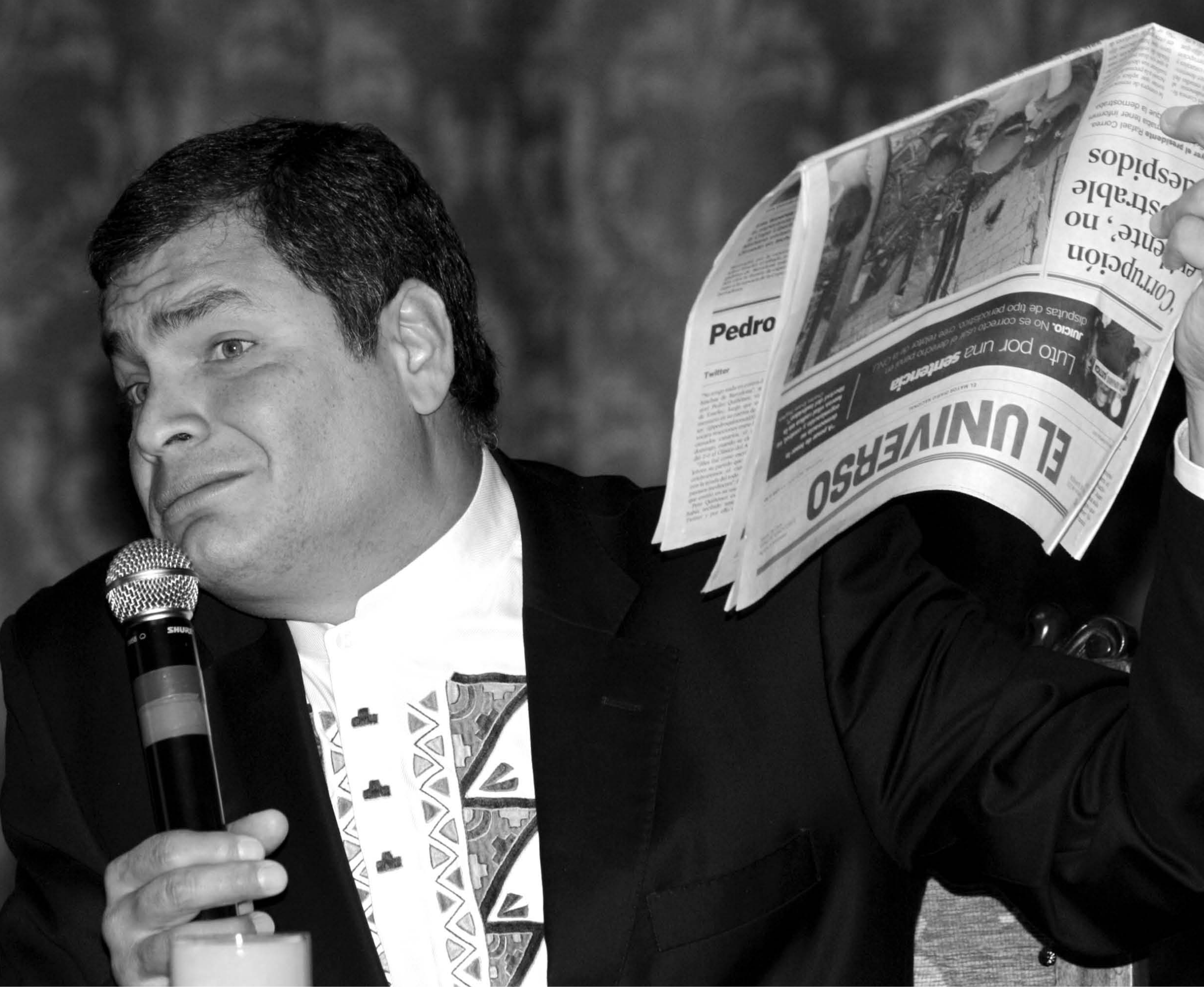
ABOVE: Ecuador’s president Rafael Correa holds up a copy of El Universo, 22 November 2011. Correa successfully filed a defamation suit against two of the newspaper’s journalists in 2011. In February 2012, the president issued a pardon
Credit: Dolores Ochoa//AP
The second challenge, which goes hand in hand with this, is that there is a growing use of defamation laws, which I have proposed should be decriminalised. Defamation should exist for the protection and the honour and reputation of individuals in qualified cases. It should not exist for public officials; it should exist for common citizens as a civil action, where a court can order a correction of facts, or for public apology or issues like that. It should not be a criminal case, but that is how it’s being used by politicians around the world to intimidate the press and to jail journalists and bloggers around the world.
So these are the two major issues where I find a setback. There’s also an increase, by the way, in violence against journalists. Because all media has an online version, the power of the media has grown enormously. So now we see harassment of journalists even in countries that are not necessarily at war, like in Mexico or Honduras, where the question of battling drug lords is so serious that it generates an atmosphere of violence.
Ecuador’s president Rafael Correa had a lawsuit out against two columnists at El Universo and he got a $40m court decision which, basically, had it been imposed, would have closed the newspaper, because no newspaper can pay a US$40m fine. And for the two journalists, they had three years in prison and $1m each in fines. No journalist has $1m to pay a fine in Latin America. Eventually he pardoned them, but the fact was that this was an act of intimidation.
I never compare countries to one another. I think that countries have to be compared to themselves and to their own record. Are they improving or are they deteriorating? But what I can say is that this is a phenomenon happening across the board, around the world.
First of all, there can be no defamation of religion because defamation is to protect the honour and reputation of a person or individuals only. And religion – something that is part of the spiritual, intellectual, theoretical debate – should be open to more debate and more discussion.
Religion should be open to more debate and discussion
I personally believe profoundly in a culture of respect for all ideas, for all philosophies, for all schools of thought and for religion. But respect cannot be imposed by law. Respect is a cultural matter that you educate children and society as a whole about and to build what UNESCO calls a ‘culture of peace’. Not by imposing criminal sanctions. My experience has shown me that those who talk about limiting discourse on the basis of religion are actually protecting the status quo and those in power.
To read Frank La Rue’s reports on hate speech, access to the internet and online freedom, plus future reports, visit http://www2.ohchr.org/