



Abstract

Journalists, activists and ordinary citizens continue to face censorship and threats for speaking out. Amnesty International’s
In January 2013, a Vietnamese court convicted 14 bloggers, writers, and activists on subversion charges. Some had written in support of freedom of expression and multiparty democracy. Others were members of a Catholic group that has campaigned against land seizures and corruption.
The 14 were arrested after they returned from a training session held in Bangkok in 2011, organised by a pro-democracy group that is banned in Vietnam. For these acts, deemed to be ‘activities aimed at overthrowing the people’s administration’ and ‘undermining national unity’ and similar crimes, they were sentenced to prison terms that ranged from three to 13 years.
This was the largest such crackdown in Vietnam in recent years. But this kind of repression
Indeed, human rights violations of this kind are business as usual in much of the world. On 22 May, Amnesty International published its 2013 annual report, an overview of human rights developments during the previous calendar year. Thumbing through its pages, it quickly becomes clear that free expression, assembly, and association are under threat in every region of the globe.
Restrictions on assembly
A favourite technique to stifle dissent is the imposition of burdensome or otherwise unreasonable restrictions on demonstrations and other peaceful public gatherings. In Belarus, for instance, the Law on Mass Events requires the organisers of public gatherings to report financial sources and prohibits publicising events until official permission is granted, sometimes only a few days beforehand. Uganda’s government banned demonstrations ahead of its 50th anniversary of independence. Algeria has prohibited all demonstrations since at least 2001.
In one of 2012’s more unexpected moves along these lines, authorities in the Canadian province of Québec introduced widely criticised emergency legislation, placing a series of restrictions on public gatherings in the early part of the year. Police arrested more than 2000 people after what began as student protests over a proposed hike in tuition fees expanded in scope. In the words of an account published in the Guardian, the protesters were ‘strikingly diverse’: ‘Sensibly dressed forty-somethings wearing hiking boots and kagools intermingled with long-haired students wearing only shorts. Men and women pushing young children in prams were flanked by hipsters on fixed-gear bikes.’
Although the crowds in Montréal and other cities were large, they were not particularly disruptive; city and provincial authorities may have been most perturbed by the clanging of the pots and pans that many demonstrators carried, in a nod to protests in Chile against Augusto Pinochet in the 1970s and many others since. The emergency measures were suspended in September after a change in the provincial government.
Another common tactic to suppress free speech and assembly is to use the law as a means of retaliation against those who seek to take part in protest. Just before planned demonstrations in April last year, for example, Swaziland’s attorney general abruptly informed a trade union that it was unlawfully registered, even though it had previously received confirmation of its registration from the acting commissioner of labour.
In many countries, retaliation takes the form of criminal charges, including accusations of engaging in terrorism or otherwise threatening national security.
Sri Lanka, where authorities equate dissent with treason and have for many years mounted an all-out assault on free expression, is something of a standout in this regard. Activists, journalists, lawyers, and members of the judiciary who speak out about abuses of power or call for accountability for human rights violations face harassment, threats of prosecution, and in some cases arbitrary detention under the Prevention of Terrorism Act. Several political activists appear to have been subjected to enforced disappearance.
A less obvious example is Ecuador, where indigenous and campesino leaders have been subjected to unfounded charges of terrorism, sabotage, and homicide; criminal prosecutions; arbitrary arrests; and strict bail conditions in an attempt to discourage them from voicing their opposition to laws and government policies. In most cases, fortunately, judges have dismissed these charges as baseless, but by the end of 2012 three leaders were still facing trial and subject to bail restrictions. Three others were convicted last year on such charges.
And South Korea has used vaguely worded provisions in its National Security Law to detain or charge those who engage in online debate over the country’s relationship with North Korea. For example, Park Jeong-geun was sentenced to 10 months in prison (suspended for two years) for satirically retweeting messages from a banned North Korean website
In Ecuador, indigenous and campesino leaders have been subjected to unfounded charges of terrorism, arbitrary arrests and strict bail conditions
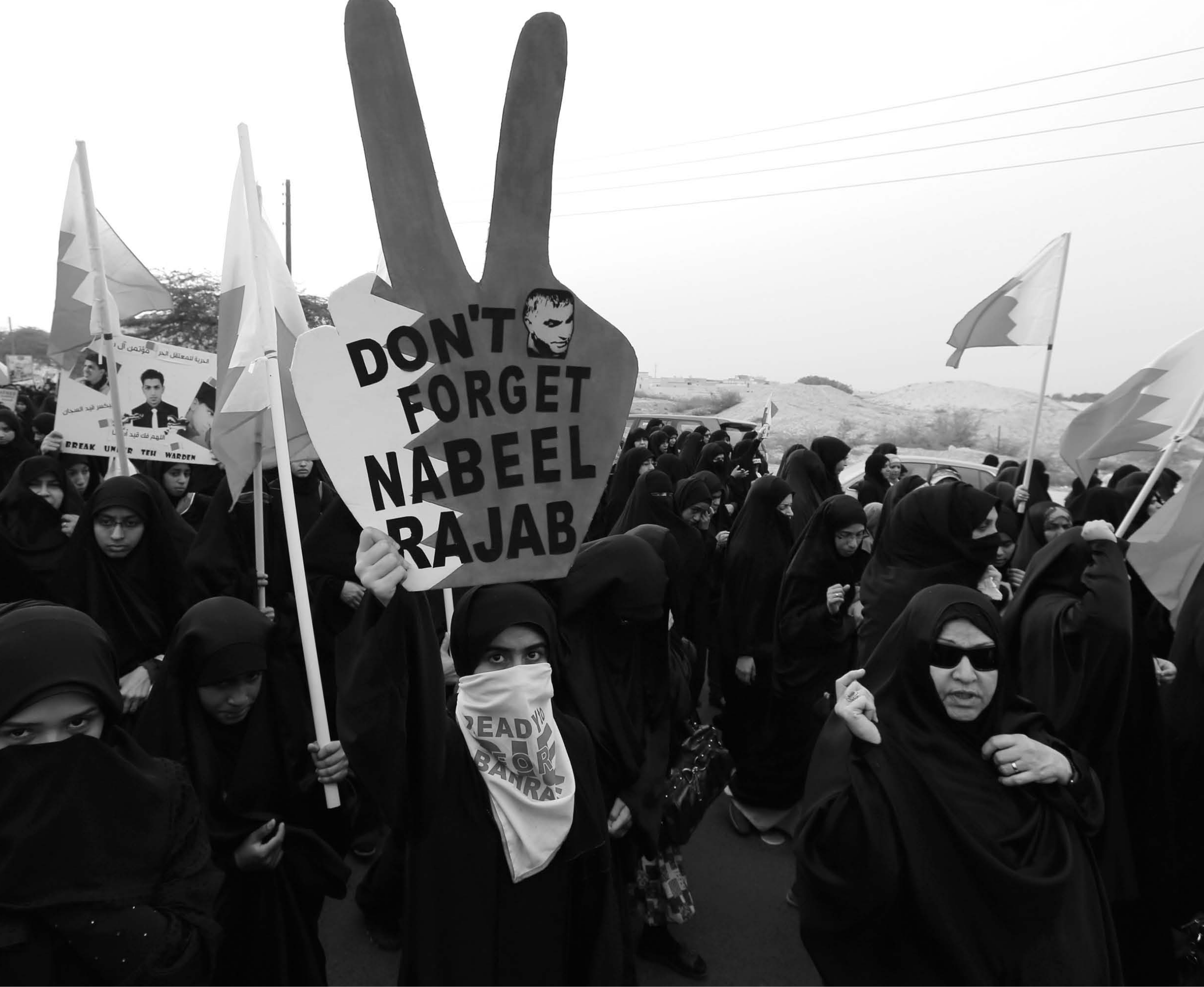
Following the wave of popular uprisings in the Middle East and North Africa beginning in early 2011, many countries in the region have maintained tight controls on speech and assembly, subjecting those who step out of line to detention and prosecution. Authorities in Bahrain have continued to crack down on protests and dissent, and protesters who had been sentenced in connection with mass popular protests in 2011 remain in prison. In particular, a dozen leading critics of the government are serving prison terms ranging from five years to life. In Jordan, security forces detained hundreds of protesters who were calling for political and other reform; many were beaten on arrest or while they were detained. Authorities in Kuwait increased restrictions on assembly and expression, including by prosecuting some social media users. Saudi Arabia imposes similar measures.
ABOVE: A protester holds a sign in support of human rights activist Nabeel Rajab, Budiya, Bahrain, 5 April 2013. Rajab was arrested in May 2012
Credit: Hamad I Mohammed/Reuters
Other examples of such practices elsewhere in the world include:
In Chad, the chief editor of the biweekly newspaper N’Djamena Bi-Hebdo received a one-year suspended sentence in September and was fined the equivalent of US$2000 for ‘incitement of racial hatred’ and ‘defamation’ after the newspaper printed extracts from a petition issued by the Union of Trade Unions of Chad (UST). Three leading members of the UST received similar sentences. The newspaper itself was banned for three months.
In Ethiopia, journalists and political opposition members who have called for reform, criticised the government, or are linked to peaceful protest have been sentenced to lengthy prison terms on terrorism charges.
More than 50 peaceful protesters who opposed a nuclear power plant in southern India were charged with sedition and ‘waging war against the state’.
In Indonesia, at least 70 people from the regions of Papua and Maluku were in prison for peacefully expressing their views, including five Papuan political activists who were convicted on charges of ‘rebellion’ and sentenced to three years’ imprisonment for their involvement in the Third Papuan Peoples’ Congress in October 2011.
A variation on this theme is the charge of insulting the ruler or state institutions. Thailand’s use of its lèse majesté laws to stifle dissent is notorious. Belarus, Egypt, Jordan, Morocco, Qatar and the Republic of Congo, among other countries, have deployed similar charges against opposition leaders, journalists, and other perceived critics over the last year.
In a similar move in Pakistan, the courts have threatened to bring criminal contempt proceedings against journalists for reports critical of the judiciary. In a positive development, Bolivia’s Plurinational Constitutional Court ruled in September that the crime of ‘contempt for public officials’ was unconstitutional and a violation of freedom of expression.
The iron heel
Brute force is another common response to opposition. Police and others acting at the authorities’ behest frequently break up unwelcome public gatherings, whether through mass arrests or simply by dispersing crowds with truncheons, tear gas and the like.
For example, peaceful protests across Russia are routinely dispersed by police, often with excessive force. Russian authorities regard every such event, however peaceful and insignificant in number, as unlawful unless expressly sanctioned
Israeli soldiers have opened fire with live ammunition on Palestinian protesters in areas inside Gaza’s perimeter and routinely use excessive force in the West Bank, killing at least four people in 2012. Israeli security forces have also used excessive force in response to protests within Israel
And both the Palestinian Authority and Hamas have maintained tight restrictions on freedom of expression, harassing and prosecuting journalists, bloggers, and other critics. Security forces in the West Bank and Gaza have used excessive force against demonstrators, subjecting dozens to arbitrary arrest.
Elsewhere in the world, in 2012 Amnesty International documented excessive use of force by police in response to peaceful demonstrations in Angola, Cambodia, Guinea, Maldives, Mauritania, Morocco, Mozambique, Sudan, Swaziland, and Yemen, among many other countries.
Forthright censorship
A more efficient means of repression is simply to shut down particular media outlets or other means of communication.
For example, Sudanese authorities have confiscated entire newspaper print runs, prevented the publication of particular articles or opinion pieces, banned certain journalists from writing for newspapers and harassed editors in order to influence their choice of news coverage. Authorities in Benin cut the transmission of a private television channel, Canal 3, for several days after the broadcast of an interview in which a former presidential adviser accused the president of corruption.
A national radio programme in Equatorial Guinea was cut off mid-broadcast during an interview with a woman who was speaking on behalf of 18 families who had been forcibly evicted from their homes in Bata; the programme was suspended indefinitely. Officials in southeastern Guinea closed a private radio station, Liberté FM, the day before planned protests.
In Guinea-Bissau, private radio stations were shut down during a military coup in April 2012 and then allowed to resume broadcasting under strict censorship rules. The correspondent for Portugal’s state broadcaster, Radio Televisão Portuguesa, was expelled from the country in October for his critical reporting on government and military authorities.
And in Kazakhstan, the Almaty city prosecutor moved in November 2012 to close down some 40 print, online, and broadcast media outlets, accusing them of being ‘extremist’.
The smörgåsbord approach
Some countries employ all of these approaches, and a few more.
Chinese authorities react particularly harshly to opposition, using a variety of means to silence dissent
Uganda’s government banned demonstrations ahead of its 50th anniversary of independence
At least three men in the Tibet Autonomous Region were sentenced to up to seven and a half years in prison in separate cases for passing on information about cases of self-immolation to overseas organisations and media.
Authorities in China have also criminalised what they labelled ‘illegal religious’ and ‘separatist’ activities in the Xinjiang Uighur Autonomous Region and clamped down on peaceful expressions of cultural identity
And throughout China, those who work on economic, social, and cultural rights are also targeted
Similarly, Iranian authorities have maintained tight restrictions on expression, association and assembly. They have taken steps to create a controlled, national internet, and routinely monitor phone calls, block websites, jam foreign broadcasts and move harshly against those who speak out. For instance, a university student was arrested in June 2012 for criticising authorities in a book and in regular blog postings. The charges against him included ‘acting against national security by publishing lies and causing public unease’, ‘insulting the Supreme Leader’ and ‘membership of an opposition group with links to Israel’.
As if this battery of tactics weren’t enough, some countries have moved in the last year to impose additional restrictions on freedom of speech and assembly.
In Russia, where most media are already effectively under state control and prime time television is regularly employed to smear government critics, new legislation has given the state powers to blacklist and block websites publishing materials considered ‘extremist’ or otherwise harmful to ‘public health, morals, or safety’. Libel was re-criminalised in 2012. Changes to the criminal code have expanded the definitions of treason and espionage, including through the introduction of vaguely-worded provisions that cover the sharing of information with, or the providing of assistance to, foreign states and organisations whose activity is ‘directed against the security of the Russian Federation’.
Draft legislation on demonstrations and public meetings under consideration in Burundi would compel journalists to disclose sources in some circumstances and would increase the number of press-related crimes.
ABOVE: Detention of protester, Minsk, summer 2011
Credit: Siarhei Balai

Proposed reforms to the Dominican Republic’s penal code included penalties of up to three years’ imprisonment for criticising elected representatives or government-appointed officials.
New provisions in Kazakhstan’s security law came into force in January 2012, penalising individuals or organisations that ‘influence public and individual consciousness’ through the distribution of ‘distorted’ and ‘unreliable’ information ‘to the detriment of national security’.
In Malaysia, the government announced that it would repeal the 1948 Sedition Act, used to quash dissent. But it proposed a new National Harmony Act that contained new restrictions on freedom of expression. And Burma’s Ministry of Information announced in August 2012 that it was ending all pre-publication censorship procedures – but on the same day it issued a strict set of publishing guidelines that included a prohibition on criticism of state policies.
Other threats to free expression
Of course, such repressive techniques are by no means the only ways that states infringe on the rights of those who speak out. Other threats to freedom of expression and the related rights of freedom of assembly and association include public morals legislation: blasphemy laws, legislation enforcing or prohibiting particular forms of dress, and restrictions on health information – particularly information on family planning and on same-sex sexual relations.
Some countries, including Armenia and Israel, take punitive action against those who object to military service on conscientious grounds. Ham-handed and overreaching initiatives to address digital piracy are becoming more common, with potentially adverse consequences for the free exchange of information and ideas. And the list, unfortunately, goes on.
What’s clear is that when governments aren’t willing to guarantee these human rights, we all have to hold states to their obligations. We have to insist that everybody is free to express opinions and ideas, online as well as on the streets. That we have the right to express opposition to government policies and prevailing societal attitudes, including through peaceful protest. That journalists have the right to do their jobs.
To be sure, these rights are subject to reasonable, narrowly tailored limitations – on the time, place, and manner of public gatherings, for example, or to ensure that other rights aren’t infringed. Advocacy of hatred that incites violence, in particular, isn’t protected expression.
But when states go beyond strictly necessary regulation of expression, assembly, and association, we must demand immediate corrective action. When it comes to these rights, we should accept no substitutes – not in the guise of countering terror, not in the name of morality, and certainly not because it’s often easier if opposing views go unspoken.