



Abstract

With laws against blasphemy recently strengthened and Golden Dawn’s threatening tactics on the increase, artistic freedom is under threat in Greece.
Laertis Vasiliou expected some controversy in Athens when he decided to stage Corpus Christi, US playwright Terrence McNally’s 1997 play, in October 2012. The play presents Jesus and his disciples as gay men and had caused a scandal in many other cities around the world. What he didn’t expect was to find out how wobbly the foundations of freedom of speech are in Greece at so many levels – from the legal system to street politics.
‘As long as corrupt businessmen and politicians are operating with impunity, anyone will be able to silence those who don’t agree with them.’
For about a month, the actors and other workers at the Hitirion Theatre had to take precautions to protect themselves from threats against their lives and violent attacks by Orthodox religious groups and Golden Dawn, Greece’s neo-Nazi party, which has made headlines around the world for its hate speech and violent activities. Golden Dawn won 18 parliamentary seats in the June elections.
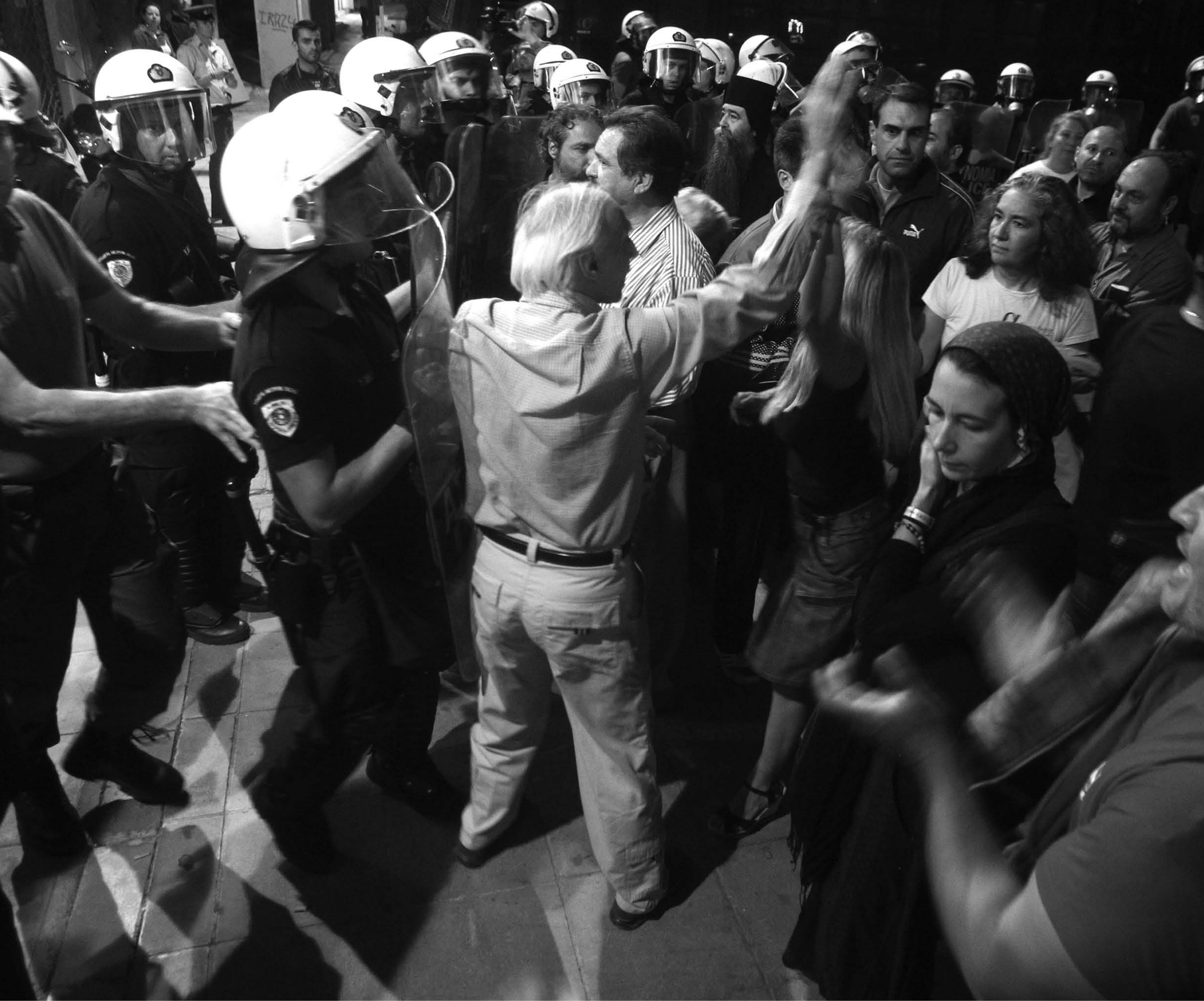
The accusation against Vasiliou? ‘Malicious blasphemy’ and insulting religion. Greek leftists, anarchists and anti-fascist groups defending the play clashed with members of Golden Dawn and the police. Questions were raised about the conduct of the police during the clashes.
When the play was staged, angry crowds tried to prevent people from entering the Hitirion, and theatre-goers and journalists were insulted, attacked and assaulted, while the police turned a blind eye.
In one instance, a Lifo magazine journalist found himself attacked by neo-Nazi thugs because he was taking pictures as he tweeted (@manolis): ‘I told them that I write for Lifo, thinking that that would protect me,’ he told the Vice website after the premiere was cancelled due to protests and clashes. ‘Instead they started yelling: “This fag works for Lifo, come and see this faggot.” They ganged up on me, started swearing at me and pulling my beard, and one of the Golden Dawn MPs spat in my face. They were all around me. I managed to leave and they kept shouting at me: “You run away, you faggot, you ass-muncher.” I looked back from half a block away, and then this other Golden Dawn MP comes over to me and he punches me in the face.’
Vasiliou and journalists urged the police to intervene during the protest on opening night, and the minister of public order, Nikos Dendias, asked the public prosecutor to go to the scene and restore order. To Vasiliou’s surprise, the prosecutor hesitated to do so, seemingly out of fear for his own safety, leaving the field open to Golden Dawn MPs to behave as they saw fit. The minister of justice asked the high court to look into why the prosecutor failed to carry out his duties, despite being asked for help by Vasiliou and the play’s actors, but these findings have not been made public.
When the police did eventually arrest a number of protesters, one Golden Dawn MP, Christos Pappas, was filmed removing one of the demonstrators from a police van. The Albanian-born Vasiliou told Index that at one point a Golden Dawn member approached him and shouted: ‘We will take your head off. We will cut you to pieces, you fucking Albanian.’
In June 2012, the play had a short run of five performances, during which there was no trouble. And in October, the public were invited to attend a rehearsal of Corpus Christi free of charge. It was shortly after that the controversy and threats began and it became impossible for performances to go ahead because those involved feared for their safety. After several attempts to stage the play and a month of almost daily protests outside the theatre, the play was finally cancelled in November.
All of this took place on Iera Odos (‘Holy Road’) – the street that ancient Athenians walked down every year to see the ‘Eleusinian Mysteries’, a major religious event, some 2500 years ago. For many it’s regarded as the place where theatre was born.
Vasiliou, who is half Greek and half Albanian, grew up in Albania but moved to Athens 20 years ago to escape the social and political decline in the neighbouring country. In February 2013, sitting in the lobby of the Hitirion Theatre, Vasiliou told Index he was thinking about the best way to deal with the lawsuit brought against him by Greek Orthodox Bishop Seraphim of Piraeus, with the support of Golden Dawn MP Christos Pappas.
Members of radical Christian religious groups and the Golden Dawn party are blocked by riot police during a protest outside the theatre where Corpus Christi was due to premier, Athens, Greece, 11 October 2012
‘The public attorney never saw the play, but he read the script and decided to prosecute me and the members of the performance instead of the writer, which is strange,’ Vasiliou said. ‘But things were even worse than that: the district attorney saw a video of our play, although I never gave permission to anyone to film it and nobody requested it.’ Vasiliou said that the district attorney based his decision on illegally-acquired material. He was called to appear before the police to give his testimony, he added, but not the official investigating the case. ‘So far, we’ve seen solidarity from the Royal National Theatre in Britain, from the Piccolo Theatre in Milano and from colleagues all over the world. But not from the state-funded theatres of Greece’, Vasiliou says.
In the last few months of 2012, similar cases came to the fore. On 25 September, a 27-year-old man from the island of Evia, whose name was not revealed, was arrested on charges of malicious blasphemy and insulting religious beliefs for allegedly posting a satirical page on Facebook mocking Geron Pastitsios (Elder Pastitsios), a monk who lived an ascetic life on Mount Athos that some consider to be a saint. He is often cited by right-wing publications.
In another case, a citizen journalist was arrested. On 28 October, ‘No’ Day, a national holiday that commemorates Greek resistance during the Second World War after the Italian army’s invasion in 1940, the citizen journalist took pictures of anti-fascist groups confronting a Golden Dawn gathering next to the official parade on the island of Corfu and posted them on Facebook.
A few months before Golden Dawn targeted Vasiliou and the Hitirion Theatre, the Trianon Cinema in central Athens was threatened by thugs from the far-right group because they didn’t like the independent and anti-fascist films it screened.
In March 2012, when the country was governed by a three-party coalition led by former banker Lucas Papademos, who was seen as carrying out the orders of the so-called troika (the European Commission, the International Monetary Fund and the European Central Bank) the law against blasphemy was strengthened, with prison sentences lengthened to six months.
Vasiliou puts the blame on the clientelism that reigns in Greece, under which he says local theatres operate. But he still expresses bitterness. ‘When our theatre was burning, just 500 metres further down the road, the National Greek Theatre was hosting a gala to honour renowned US theatre director Bob Wilson. Many gave statements of support, but they did nothing to protest against what was going on.’
‘Reactionary ideas are deeply rooted in Greek society’, he says. ‘Just look at modern Greek history. Three times in the course of the 20th century there were military juntas. We can’t just let fascism overtake the country. I’m afraid that as long as corrupt businessmen and politicians are operating with impunity, anyone will be able to silence those who don’t agree with them.’
After the Corpus Christi debacle came to an end, Vasiliou and his colleagues decided to stage British dramatist Patrick Hamilton’s play Gas Light. This time they were more careful. When they printed the promotional posters, they made sure that their faces didn’t appear on them, although in Greece it is common for actors themselves to advertise their own plays.
‘We were stigmatised. We knew that we could be targeted again and that our faces would probably have a negative effect on the performance’s marketing. A few days ago, I walked into the lobby of the theatre and found a note saying that I’m “God’s plague” and Jesus will burn me,’ he told Index.
‘One hundred and fifty thousand graduates migrated last year alone [from Greece]. People under the age of 30 are seriously considering going abroad now due to the crisis. I’ve lived through that already once in my life and I hate to see it happening again.’
He also says he is sad to see the people who are most sensitive to human rights leaving the country in search of a brighter future. ‘If they leave,’ he adds, ‘then the country has no future.’