



Abstract

As 2013 began, advocates for libel reform looked forward to the final stages of the Defamation Bill passing through UK parliament and greater protection for free speech and the public interest. But on 6 February, members of the House of Lords introduced an amendment to the bill, adding a ‘Leveson clause’ on press regulation. This brought with it the perverse possibility that the bill would introduce serious curtailment of free speech alongside its improvements, and that the government might drop the bill altogether to avoid the amendment becoming law. What will come out of the Leveson Inquiry and its ensuing report is still being contested. The bill, by contrast, has been through three public consultations and seven debates in Parliament. We know that current libel laws in Britain stifle debate and damage the public interest.
We cannot allow political tactics to destroy the work of so many people over so many years. There’s too much at stake
Since 2002, Sense About Science had been working to improve the use of scientific evidence in public discussions. We talked about vaccines, miracle cures (which are anything but), stem cells, radiation, genetic modification and climate. We marshalled researchers out of labs and senior common rooms and into public meetings, radio shows and policy debates. Along with a huge public appetite for knowing more, we also encountered heated rows, nasty slurs, media scares and political obstinacy.
Then, around 2008, we realised that this enterprise was up against something that hadn’t been apparent before, probably because of other more obvious issues, many of them to do with a reluctance to speak publicly on difficult issues owing to media frenzies.
Reporters at British newspapers and journals were asking for increasingly longer times to write about our reports if they mentioned specific medical practices, products or public figures, so that lawyers could check their copy. I recall a conversation in 2007 when a UK journalist asked us to consider dropping Tom Cruise from our light-hearted review of silly science claims by celebrities to make that process easier.
More worryingly, mechanical engineers on one of our working groups refused to say directly that an empty box being marketed as a device to protect people from radiation was just that: an empty box and nothing more. Investigative journalists dropped programmes about clinics with highly questionable practices for treating autism. Ben Goldacre and the Guardian were sued by vitamin salesman Matthias Rath for writing about Rath’s promotion of vitamins to cure HIV.
Then the science author Simon Singh was sued for libel by the British Chiropractic Association (BCA) for writing an opinion piece in the Guardian about chiropractors’ misleading claims to treat infant conditions, which he called bogus. That lit the touch paper.
Simon told us about the threat of libel in the summer of 2008, as he explored what issue the BCA had with his article. At this point it was not even clear why a membership organisation, which had a reputation only among the members who were themselves criticised in the article, could have suffered reputational damage. the Guardian offered the BCA a 500-word reply or to clarify the comments about lack of evidence in ‘Corrections and Clarifications’. The BCA turned these down and made it clear that it was suing Simon personally. At this point the Guardian stepped back, already embroiled in defending other libel claims, and Simon was on his own.
In May 2009, a preliminary hearing in Simon’s case made a disastrous ruling on meaning – that his use of the word ‘bogus’ meant he was accusing the BCA of deliberate dishonesty – which he was unlikely to be able to defend. A week later science writers, bloggers and sceptics crowded into the Penderel’s Oak pub in London to protest against the silencing of debate and to offer support. Two weeks later, at a press conference, Simon announced that he would appeal and we launched the ‘Keep Libel Laws out of Science’ campaign and called for a public interest defence to libel.
Then it all broke out. We were inundated with correspondence from hundreds of scientific researchers, patient groups, writers and publishers around the world about libel threats being used to silence scientific debate.
Many of those examples are now well known: NMT Medical against the cardiologist Peter Wilmshurst; speech specialist Francisco Lacerda’s paper on lie detectors being withdrawn after threats from the manufacturer of the devices; millions of dollars spent by the journal Nature defending criticism of a journal editor publishing his own work without peer review; consumer groups being unable to discuss the safety of products. Twenty thousand people signed the ‘Keep Libel Laws out of Science’ petition, which was launched by over 100 public figures, including Stephen Fry and Martin Amis.
We had not planned for this campaign and were actually in the middle of another on independent scientific advice. But it was impossible to ignore the danger that ‘libel chill’ posed to the successes of the previous ten years in getting scientists out into public and policy discussions. It was a practical problem. In the days following publicity about the Singh case, we struggled to find a researcher who was willing to appear on daytime television to challenge promotion of homeopathy for ovarian cysts. It was also a question of principle.
The disjuncture between the chilling effect of libel threats and the open culture of science is profound. As Edzard Ernst – who co-authored a book on alternative medicine with Simon – explained at the time, in healthcare, disagreements over evidence happen constantly, but it is inappropriate to resort to the law courts. We need open discussions about the scientific facts, and if this process is bypassed we jeopardise both free speech and medical progress.
What made the campaign possible was the support and activism that also poured forth over that summer. With the party conference season approaching, Evan Harris, at that time an Oxford MP, proposed that the scientist Richard Dawkins speak on the Liberal Democrat conference floor to a motion to support reforms to rebalance the law towards free speech. The motion was passed. Efforts at other party conferences began to win groups of supporters. But at every turn we were also told that libel reform was unnecessary, it was too complex a task, it was for the common law rather than Parliament to decide, and it was not a vote winner.
In those early days we struggled to make sense of the arguments and case law being traded back and forth. We had a series of meetings with lawyers, each time coming away questioning what the previous lawyers had told us. (Actually, that hasn’t changed!) It was through these meetings – and on a very happy day – that we discovered that Index on Censorship and English PEN had already embarked upon a year-long inquiry into the impact of our libel laws in the UK and overseas, triggered by a damning UN Human Rights Committee report. Their report, Free Speech Is Not for Sale, was due to be published in November 2009.
Evan Harris brought us together and, in December 2010, we joined forces to launch the libel reform campaign. The launch was lively but we were still struggling with the fact that libel seemed such an impenetrable subject. The UK-based ‘Jack of Kent’ blog on policy-making became essential reading to understand Simon Singh’s case as it unfolded. As a campaign we felt confident in saying that the libel laws’ jurisdiction was too wide, the defences too narrow and the costs too high, but as we began to open up the possibility of a statutory intervention in this esoteric area of common law, we had to be able to weigh the arguments, and to take the thousands of people who supported the campaign through them too.
Simon Singh (second left) with supporters including David Davis MP (right), outside the High Court, London, after Singh won his Court of Appeal battle for the right to rely on the defence of fair comment in a libel action, April 2010
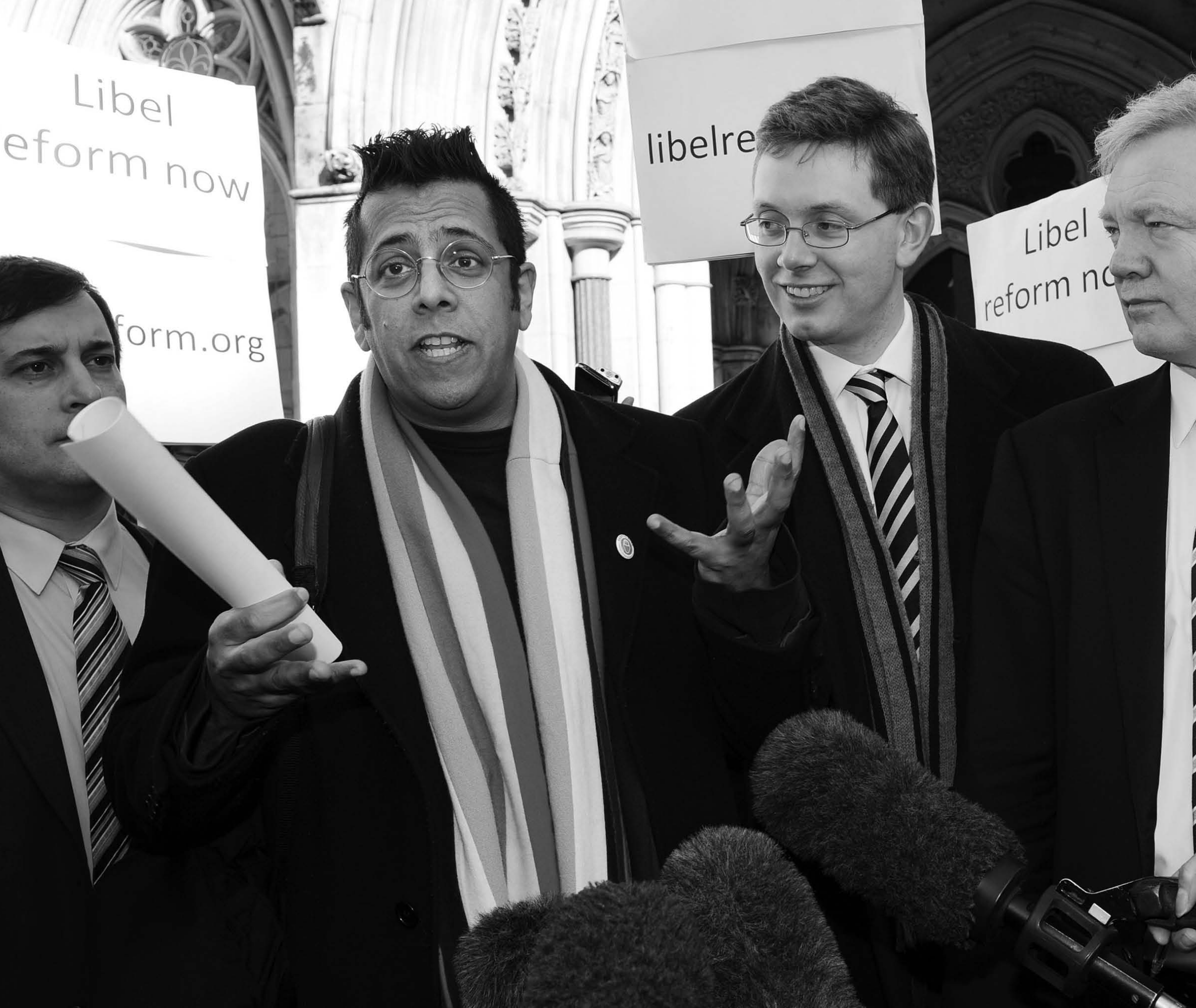
Index and PEN’s report explored ten ways in which libel laws might be reformed. These were suggestions which developed and changed a good deal over the following years of debate and study. It is testament to the insight and the cases they drew on that the legislation before us today addresses itself to the questions raised there. It is testament also to the popular and collaborative nature of the campaign that it adjusted to new insights and refined those proposals.
The trail of footsteps of people and organisations concerned about libel threats to Justice Secretary Jack Straw’s door by January 2010 led him to announce that there was, after all, a case for reviewing the law. Meanwhile, the campaign’s supporters showed imagination. The Big Libel Gig at the Palace Theatre was the brainchild of comedy writer Robin Ince, which saw performers Dara O’Briain, Tim Minchin and a host of others turn their fire on the ludicrous way in which our laws give more power to the powerful and silence critical discussion. And our supporters, now 60,000 strong, showed courage. At a mass rally of Parliament in spring 2011, as at many subsequent events and meetings, people who were unused to such public forums stood up and told parliamentarians and ministers why the law had to change. We all recall that first rally where Justice Secretary Jack Straw and shadow spokespeople from other parties each did a double take as they entered the packed room and came face to face with ‘the biggest meeting in Parliament for years’.
The Ministry of Justice set up a working group. Lord Lester, a lawyer himself, was mindful of the slow pace and long grass that had dogged previous attempts at reform. He started work on a Private Member’s Bill, which is legislation proposed by individual members of Parliament. It came after a meeting with Edward Garnier MP, a practising libel lawyer who seemed decidedly lukewarm about our campaign. Garnier said we should go away and produce a bill. I don’t think he expected Lord Lester to do so. Lester’s bill would at worst provide a pathway for Parliament to express a view on free expression where, contrary to the arguments of some leading members of the legal profession who thought Parliament had no place doing that, MPs and peers were already exercised about the cases being reported. At best, though, the government might be compelled by that strength of feeling to adopt such a bill or bring forward their own.
In the end, that is what they did. Following a spring when numerous organisations joined their voices to our campaign, thousands of people in the UK wrote to their MPs, and the hidden stories about vital discussions silenced by libel threats were never out of the news and blogs. All three main political parties added reform of the libel laws to their manifestoes in the May 2010 UK General Election – apparently it was a vote winner after all. The third reading of Lord Lester’s bill had the largest number of speakers of any bill that session. The government responded that it would produce its own bill, which it did in March 2011.
The proposals offered at first in that bill met some of the concerns about libel tourism, multiple publication and cost management, but fell a long way short of the public interest defence and relevance to the internet age. The Scrutiny Committee that looked at the bill said as much and we thought things would change, but nothing budged. It seemed that a clause that had been included on peer-reviewed scholarly publishing was supposed to satisfy those angry scientists who responded to the Singh case. But science and evidence are not some game of gentlemen. Ideas (and our understanding of what is true) do not develop in private for science any more than in any other area of debate, and working through contested ideas can be rough, one-sided and rude.
So here we are. The Libel Reform Campaign’s work is not done. The ‘Leveson amendment’ may be followed by other challenges, as this bill is seen as a handy peg on which to hang other discussions about privacy and press behaviour. We cannot allow political tactics to destroy the work of so many people over so many years. There’s too much at stake: this is a public interest bill, brought forward by the protest of citizens – a rare thing in politically cynical times – and it must succeed. We will work to ensure the bill is passed in summer 2013 as planned, and that it will include even further improvements. Labour, Liberal Democrats and Conservatives all went into the last election with libel reform in their manifestos and they must uphold these commitments. Whether we’ll have made big history or a little part of it by the time you read this, or by the time we reflect back in a few years, I cannot say from here.
I know we have shown that three small organisations, some committed individuals and a lot of public support can make sufficient fuss to change things. I know that we have won the argument that the law should be based on the public interest and not on the reputation management of the wealthy. I know we have shown that it is right that our free speech laws be made by Parliament. And when just recently I listened to presenter Dara Ó Briain explain forcefully to the minister why the government’s first draft of a public interest defence fell short, I realised something else. Whether or not the reforms of 2013 do free up expression as society needs, the libel laws are, finally, no longer the preserve of a group of highly specialised lawyers and dons. They’re a social concern. Their unacceptable effects are for us all to judge and, whatever happens, we must keep it that way.