




Abstract

Why do Western democracies fail to challenge the secretive habits of big business and banking?
Democracies have many faults. Their leaders can blunder as badly as dictators. Their citizens can be just as foolish as anyone else. A cursory knowledge of history will teach you that there is nothing inherent in the nature of the American, British or Danish people, say, that makes them superior to Iranians, Chinese or Zimbabweans. They are just as likely to follow disastrous policies, just as susceptible to manias.
Dissidents on the inside knew precisely where the company was going wrong. They were bought off or pressured into silence
After they have blundered, however, the benefits of living in an open society should assert themselves. Democracies face the truth of what they have done and see their faults clearly. They hold the guilty to account. They find new ways to ensure that they do not repeat old mistakes. In short, they reform, and show that not only are democracies freer countries than dictatorships, but that they carry within them a self-correcting mechanism.
That is the theory in any event. The practice is another matter.
Anyone looking for the reforms produced by the great crash of 2007–2008 will squint until their sight blurs. True, the regulators tightened the Basel rules on what capital banks must hold to help them through panics, and US President Barack Obama enforced the ‘Volcker Rule’ to limit big banks’ speculative proprietary trading activities. But that’s about it. Even if you do not wish to diminish these modest changes – and I accept they are important in limited ways – you have to admit that the roaring financial crisis has produced a legislative mouse.
The banks that were too big to fail have not been broken up into separate retail and casino businesses. They can still leverage deposits and call on the taxpayers to bail them out when the gambles fail. Bankers are still collecting bonuses whenever they can, even when the taxpayers have bailed them out. No one can say with confidence that the system has reformed itself.
The greatest failure, to my mind, does not lie in the loss of nerve that has produced such timid banking reforms, but in the refusal to challenge the secretive, hierarchical culture that imposed such calamitous costs on society. (And will do so again.) The omission should surprise no one. Managerial censorship in the workplace is so pervasive and so accepted that most people do not think of it as censorship at all. It seems as natural, and as impossible to challenge, as the weather. For all that, in North America and Western Europe it is the only form of censorship you are likely to experience.
Citizens of most democracies are freer to talk about politics than at any time in history. They can damn their politicians, judges and bureaucrats in the most vivid terms. They will not wake to the thump of secret police officers’ boots on the stairs. They can promulgate conspiracy theories. They can campaign for causes our ancestors would have regarded as dangerously mistaken. No censor will seek to silence them.
All seems well, until they go to work. The moment they cross the threshold, they leave a democracy and enter a dictatorship. If they speak frankly about their bosses’ failings in the office, their career suffers. If they go public, their bosses fire them. We take the authoritarianism of the hierarchical workplace so much for granted we cannot see how it jars with the modern world. As British economist Chris Dillow pointed out in 2007 in The End of Politics: New Labour and the Folly of Managerialism, when the collapse of communism approached in 1989, conservative commentators ‘told us, rightly, that no one had enough knowledge and rationality to manage an economy. But they also told us that managers had enough know-how to manage a firm’. While they condemned the hierarchical centrally planned economy, they praised the hierarchical centrally planned corporation or state bureaucracy.
The information-sharing powers that new computing technology brings ought to allow collaboration and a flattening of hierarchies. Yet executive salaries have continued to rise, despite the worst recession since the 1930s. And the omertà executives can impose on their subordinates remains as strict as ever. So complete is the triumph of an archaic managerial ideology that we do not ask obvious questions about how we reached our present condition. The best is the simplest: why did so few see the crash coming? It is extremely rare for a great crisis of capitalism to come from nowhere.
Where were the signals of distress?
Warnings from The Times and other newspapers that Victorian investors were heading for a fall accompanied the railway mania of the mid-19th century. (The Times, rather cleverly, allowed railway speculators to buy adverts and then denounced them in its editorials.) In the 1990s, when I was a young believer in orthodox left-wing politics, I rather despised the free-market ideology of the Economist on theological grounds. My opinion changed when it warned, correctly, that the delirious market in dotcom stocks was a bubble that was bound to burst.
Protest against government spending cuts, Bank of England, London, 2011
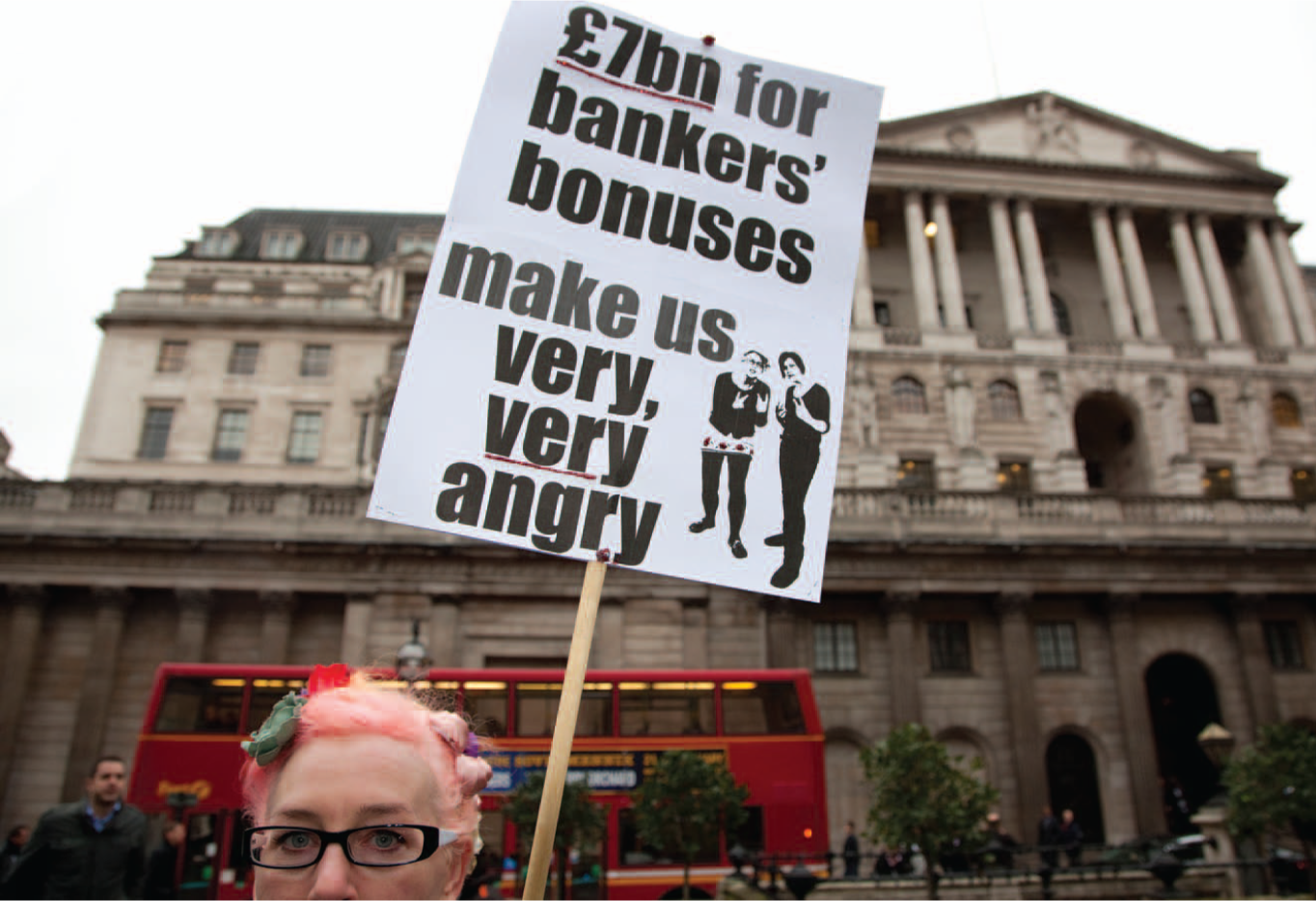
In 2007, none of the great newspapers and magazines that cover high finance saw the greatest economic disaster of our lifetimes coming. A few individuals could look back on their cuttings with pride – most notably Allan Sloan of Fortune or Gillian Tett of the Financial Times. But the odd piece by a columnist is not the equivalent of a newspaper devoting its resources to tackling one of the biggest stories in its history. In the admirably thorough manner of US journalists, the editors of the Columbia Journalism Review (CJR) cited many reasons for the media’s inability to anticipate the crash.
To anyone who worked on a newspaper in the early 2000s, one explanation rang as true as a funeral bell: ‘The financial press is … a battered and buffeted institution that in the last decade saw its fortunes and status plummet as the institutions it covered ruled the earth and bent the government’, wrote Dean Starkman in a CJR article in 2009.
Just as convincing was the CJR’s examination of how the sources of inside information had fallen silent. The Bush administration called off the regulators – but the Brits should not feel superior: the Blair and Brown administrations never set them to work in the first place. Regulators had provided journalists with leads. Once they dried up, the stories dried up as well.
Meanwhile it became fanciful to imagine that sources within banks would provide information to journalists – or indeed to regulators, bureaucrats and politicians. Technology enthusiasts tell us that the web makes secrecy nearly impossible. Apparently citizen journalists laugh in the face of censors, and publish the news that your humble correspondent and the other lackeys of the mainstream media dare not run. Really? The public knows next to nothing about the secrets of the finance sector. There is no blog running stories from inside Goldman Sachs or providing confidential information about the decisions of the Barclays management.
It is not as if insiders do not know. At AIG – the vast US company whose managers enriched themselves by providing insurance policies they thought would never need to be redeemed – dissidents on the inside knew precisely where the company was going wrong. They were bought off or pressured into silence.
And at the Royal Bank of Scotland, all senior managers knew that Fred Goodwin was a bombastic and vainglorious bully. But the then CEO warned them that if they spoke out they would be viewed as ‘Business Prevention Officers’. Carry on getting in the way, he added, and the hierarchy would mark them as fifth columnists whose naysaying was destroying the bank’s viability. At HBOS, Paul Moore, the bank’s risk manager, warned his bosses that they were taking insane risks. James Crosby, the chief executive, listened to his risk manager carefully, then fired him for warning of risks – warnings that turned out to be all too prescient when HBOS, like AIG and the Royal Bank of Scotland, went bust.
Moore was one of the most senior risk managers in Britain. Not only did he never work in banking again, he never even received a speculative call from a headhunter again. Do not think that anyone in corporate finance needs to be told the moral of that story.
‘A risk manager once told me that to raise an issue that undermined the bank’s multi-billion-dollar profits would have been to sign his own death warrant,’ said a Wall Street derivatives trader after the crash, in a review of the documentary Inside Job published by the Guardian in 2011. ‘This inability to challenge trading desks generating billions in phantom profits was endemic.’
Whistleblowing: a dangerous game
The incentives of modern society are perverse. Suppose bankers realise that their managers are making catastrophic mistakes. They have no reason to speak out, even though speaking out is in the interest of shareholders, employees and the wider public. In the good years, they will have pocketed salaries and bonuses. Even if they see that their firm is taking dangerous risks, the state will not confiscate their homes or empty their accounts if their bank collapses, but will allow them to hold on to their assets and winnings. If they have not caused trouble, they should be able to find another job in another bank. If the state coerces the taxpayer into bailing out the failed institution, they can carry on in their old job as if nothing had happened – but now draw salaries and bonuses at public expense.
Silence in a banker’s private interest brings no penalty. Speaking out in the public interest, however, means that the whistleblower will never work in banking again. Even if he can use whistleblowing legislation –and I won’t bore you with the details but it is damn hard to do – the compensation he would receive would usually be one year’s wages – pin money in comparison to the wealth the bank or taxpayers would give him if he were to bite his tongue. Perhaps the banker could go to the regulatory authorities privately, or to the press. Even assuming that they were not slumbering, his employers would fire him if they found out what he had done. And executives in rival hierarchies would ensure that he would never work in banking again.
What applies to banks applies to all public and private bureaucracies. Yet after the crash, it never occurred to the governments of Barack Obama and Gordon Brown to provide incentives to allow employees to speak up and speak truthfully, or to impose penalties on those who stayed silent. Governments did not promise to provide full compensation to bankers who revealed their corporations’ risky policies. They did not say that all workplaces should allow elected workers’ representatives on their board who might provide a fair hearing to those who suspected their managers were going haywire. Nor was there irresistible public pressure on them to reform.
There are problems in law here. Western democracies, and especially the Anglo-Saxon democracies, assume that employees have a duty to stay silent. But there is also a cultural problem. I hate to make assumptions about readers of Index on Censorship, but my guess is that you find the arguments for free speech self-evident. For most societies throughout history, they have been anything but. (And for most societies in the world today, one could add.)
Criticism of rulers and criticism of religious and cultural taboos are all punished. The culture of ‘respect’ for religious prejudice that our timid generation of alleged liberals promotes may be cowardly, hypocritical and, in its practical consequences, illiberal, but it does recognise a truth: most people find arguments that challenge their core beliefs dangerous. How much worse is the resistance to arguments that challenge their self-interest?
In any business or state bureaucracy, it is far from certain that a whistleblower will win the admiration of his or her colleagues. Even if their supposedly secret information is not false, even if they are not leaking commercially confidential information that an organisation has every right to keep private, their actions will damage their firm or institution. The scandal will delight the organisation’s private or bureaucratic rivals, and in extreme cases it will threaten the income or jobs of the whistleblowers’ colleagues.
This is a dangerous game to play. Yet we now know that the secrecy the managerial culture insists on is more dangerous still. We need to go with the grain of modernity and move to open, equal workplaces, where managers who insist on surrounding themselves with cronies, who punish those who speak out, and who put the protection of their status before all else are treated as a public menace.