




Abstract

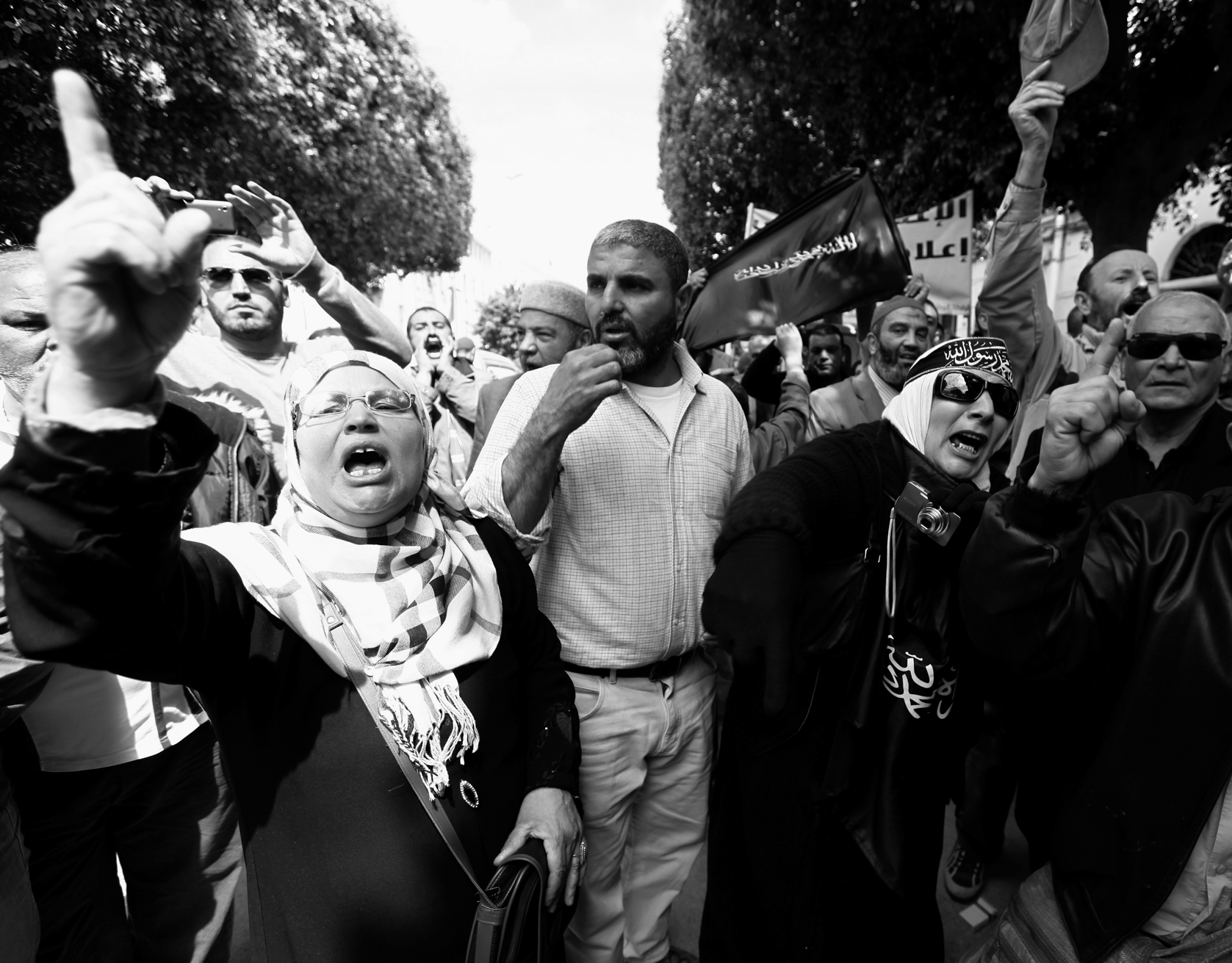
Salafists demonstrate against private television station Nessma outside a Tunis court, 19 April 2012, where the station’s owner faces charges of ‘undermining sacred Islamic values’ after broadcasting the film Persepolis
Credit: Anis Mili/Reuters
Protecting religion has become more important than supporting free speech.
Almost two years after the fall of Zeine el Abidin Ben Ali, Tunisia’s democratic transition is in jeopardy and freedom of expression is under attack. A government that fails to adequately protect free expression, coupled with a populace willing to negotiate this fundamental right, means that religious censorship is rife in Tunisia.
The 2011 Tunisia uprising gave the country’s Islamists an opportunity to question the way that secularism was brutally imposed on them by President Habib Bourguiba 56 years ago. Many have taken to the streets to demand the implementation of Islamic law or to protest against perceived insults to religion. There have been calls for laws protecting sacred religious symbols to be introduced and the country’s Muslims, whether they go to mosques or to bars, are deeply offended by cartoons of the Prophet Mohammed, the desecration of religious symbols or any criticism of Islam. These kinds of insults represent a ‘red line’ that should simply never be crossed.
Protests are a sign of a healthy democratic culture as long as they are not violent or do not infringe on others’ freedom of expression. But this has not always been the case. After almost one year of rule under an Islamist-dominated government, religiously motivated assaults on freedom of expression have multiplied.
The youth unemployment rate is high, making it easy to ignite religious feelings in destitute and often poorly-educated communities. When the privately-owned Nessma TV station aired the award-winning Iranian film Persepolis earlier this year, ultra-conservative protesters attacked the station’s headquarters and the house of the TV network’s owner. Although a large section of the population opposed the violence, many argued that Nessma deserved the legal proceedings brought against it. Most of the protesters never saw the film; they saw a short clip depicting a little girl shouting at God, circulated on Facebook – some of them just heard by word-of-mouth that Nessma had ‘insulted’ God.
The Islamist Ennahda movement, the most prominent of the parties in the country’s coalition government, has declared its intention to criminalise blasphemy and, on 1 August 2012, filed a draft bill. The bill ‘guarantees freedom of religious belief and practice and criminalises all attacks on the sacred’, without defining what might constitute an attack. It provides for the protection of sacred religious symbols, stipulating that anyone found guilty of ‘cursing, insulting, mocking, undermining, and desecrating’ Allah, the prophets, the three Abrahamic books (the Quran, the Bible and the Torah), Sunnah (the sayings and teachings of the Prophet Mohammed), churches, synagogues and the Kaaba (Muslims’ holiest shrine) could receive a two-year prison sentence and a fine of 2,000 TND (US$1,275). Drawing pictorial representations of God or the prophets may also result in a conviction.
For much of the populace, the law is in no way a top priority: jobs, social justice and the protection of human dignity come first. But as long as the law is linked to ‘protection of the sacred’, most people will not oppose or lobby against its introduction. And because Ennahda secured 40 per cent of the vote in last year’s parliamentary elections, the party has a commanding influence over decision-making and the legislative process.
In conservative societies, says Emna el Hammi, a Tunisian blogger and free speech advocate, there is a tendency to moralise. And, in the case of Tunisia, the legacy of a dictatorship that ‘infantilised Tunisians and totally disempowered them’ means that people cannot accept that everyone has the right to behave as they choose. ‘They prefer to live in a society which imposes on them, even judicially, the limits of what can and cannot be done,’ el Hammi says, adding that these limits are established within the framework of Islam and its values. It is a mentality that needs to be changed, and this will take time.
But the current plight of freedom of expression goes beyond the fact that Tunisia is a conservative society. For more than half a century, citizens lived under a secular dictatorship. Former presidents Bourguiba and Ben Ali deployed liberticidal strategies to smash up political Islam in the country. In the process, they ended up traumatising this very devout segment of society. Women were not allowed to enter the workplace or universities wearing headscarves and the state security watched and harassed those attending mosques. The dictatorship’s legacy was a religious community distressed and ill-informed about secularism, which many see as a threat to religion.
For Hichem Snoussi, the Tunisian representative of the freedom of speech organisation ARTICLE 19, the debate on blasphemy is part of what he calls ‘electoral propaganda’. He is not the only one who believes this. Islamists in Tunisia have often been accused of using religion to win the hearts and minds of pious voters who want to see their sacred religious symbols protected.
Ennahda’s decision to ‘provide legal protection to the sacred’ followed this year’s controversial modern contemporary art fair, Printemps des Arts (Spring of Arts), which took place in Tunis in June. Ultra-conservative protesters accused it of exhibiting ‘blasphemous’ artworks and led to riots across the country. Rumours that it featured a painting depicting the Prophet appeared on Facebook, igniting further protests. One protester died and dozens were injured when police clashed with demonstrators following the exhibition’s closing ceremony. Exhibition organisers, along with the artists involved, repeatedly denied the government’s accusations that the fair insulted religious symbols. Many of the works displayed at Printemps des Arts did tackle the theme of religion, and some of the work was certainly critical of Islamists, but they did not cross the red lines laid out in Ennahda’s new bill.
Since the creation of the coalition, left-wing politicians and human rights, free speech and civil society advocates have often accused the government of passivity and impunity when dealing with freedom of expression violations committed by extremist groups. No legal proceedings were brought against Islamic preacher Houcine Laabidi when he incited the murder of Printemps des Arts artists during a Friday sermon. Instead, two artists are the subject of criminal investigations following a complaint lodged by prosecutors at a Tunis primary court. Nadia Jelassi and Mohamed Ben Slama were accused of ‘disturbing public order’ under Article 121 (3) of the penal code. The controversy around Jelassi’s work focused on sculptures depicting the stoning of women, a widespread practice in countries like Saudi Arabia and Iran. Ben Slama’s artwork, in which ants emerge from a schoolboy’s bag to spell out ‘Praise be to Allah’, caused the most outcry. Jelassi, who attended court on 17 August, was told she would face charges. Slama, who lives in France, did not attend.
Ultra-conservative groups are finding it increasingly easy to attack free expression because the government allows it – it refuses to investigate free speech violations and does not hold those who break the law to account. As a result, a culture of fear and self-censorship is making a comeback in what is supposed to be the ‘new democratic Tunisia’.
If the blasphemy bill is passed, the situation will worsen and religion will continue to be used as a tool to stifle free speech. Whether the National Constituent Assembly approves it or not, religious symbols will remain off-limits for discussion, debate or artistic expression. Free speech advocates and intellectuals are aware of this threat but, unfortunately, the populace is not. For decades, Tunisian citizens were deprived of the fundamental right to free expression. Ben Ali used the pretexts of ‘terrorist’ and ‘national security’ concerns to silence dissidents, activists and protesters. Now, it seems, religion is being deployed for the same purposes.