




Abstract

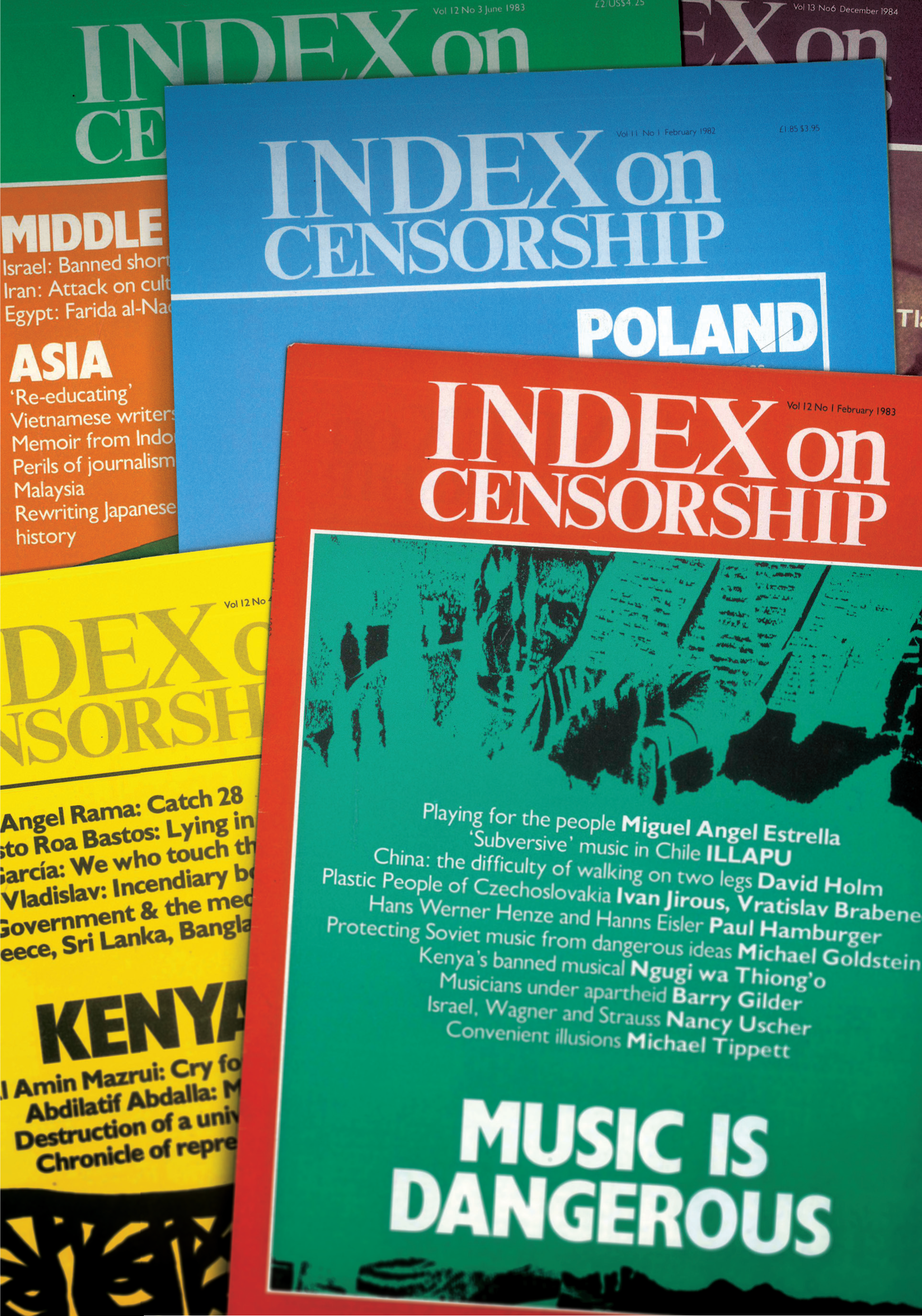
A few years after the fall of the Berlin Wall, one of Index’s funders informed the magazine’s staff that it was time to pull down the shutters and go home: job done, censorship was now a thing of the past. The anecdote is highly revealing of a certain misguided attitude towards censorship – namely, that it is a creature purely of totalitarianism, and communist totalitarianism at that. Although Cold War dissidents, from Solzhenitsyn to Václav Havel, featured significantly from the very first appearance of Index 40 years ago in the spring of 1972, when the magazine was founded in response to an appeal for help from the Soviet Union, Index made it clear from the start that censorship was a worldwide issue that featured in democracies as well as in dictatorships. ‘The problem of censorship is part of larger ones about the use and abuse of freedom,’ wrote the poet Sir Stephen Spender in the first issue.
It was Spender who founded the organisation Writers and Scholars International (WSI), the parent body of Index, to support freedom of expression. He had been moved by a letter published in The Times by the Russian dissident Pavel Litvinov, grandson of Stalin’s foreign minister, who had bravely made a stand. Spender brought together the greatest writers, artists and intellectuals of the day to send their support, including W H Auden and Henry Moore. He then enlisted David Astor, editor of the Observer, the biographer Elizabeth Longford and the lawyer Louis Blom-Cooper, amongst others, to join WSI’s council. It was the idea of Russia specialist Michael Scammell, Index’s first editor, to start a magazine.
Looking back through Index’s archive has been a revelation. It is not simply the roll-call of the greatest names in international literature (Nadine Gordimer, Mario Vargas Llosa, Samuel Beckett, Kurt Vonnegut), it is also the unchanging texture of censorship and totalitarianism, whatever the technology. There seems to be very little difference between the tactics of the NKVD, Stalin’s secret police, in 1939 and the Chinese police today.
In 1991, Index published, for the first time in English, a remarkable series of documents from the Lubianka, the KGB headquarters. This includes the devastating record of the interrogation of the celebrated Russian-Jewish writer Isaac Babel, murdered by Stalin’s regime in 1940. In a forced confession in 1939, Babel is reported as saying: ‘I wrote contrary to the interest of the masses and the Party, I fell into slanderous generalisations concerning the situation in the country and attacked the current leadership.’ Compare this with the imprisonment of the Chinese dissident Chen Wei last December, for ‘inciting subversion of state power’. There is no greater crime than challenging, or being perceived to challenge, the one-party state.
Chen Wei was a signatory of Charter 08, a manifesto for reform co-written by Nobel Peace Prize winner Liu Xiaobo. The Charter is modelled on the famous Czech document Charter 77 and Václav Havel, one of its architects and a regular contributor to Index in the 70s and 80s, remains an inspiration for Chinese dissidents. You can read one of Chen Wei’s powerful essays which led to his trial in this issue on pp. 107–113, and you can find Václav Havel’s essays and the interrogation of Isaac Babel in our archive. In celebration of Index’s anniversary, our publisher SAGE is generously making the archive of the magazine freely available online from 26 March until the end of the year. You can access the archive at http://www.indexoncensorship.org/magazine-archive.
It is a literary treasure trove and also an historic document of the extremes of human behaviour – from man at his most inhumane to his most courageous.
What’s clear is that censorship never dies, it simply changes its form. Technology can provide a route around it, but will never put the censors out of action. It is still up to the dissidents, the protesters, the whistleblowers, the artists and the writers to get the word out through their sheer determination. As Aung San Suu Kyi, one of the most remarkable freedom fighters of our time, writes in this issue: ‘When we write about our right to freedom of expression we begin to practice it. There can be no theoretical advocacy of these freedoms, there can only be practical, practising advocacy.’
Take advantage of our special anniversary discount offer of 40 per cent on an annual subscription by calling SAGE Customer Services on +44 (0) 207 324 8701, quoting 40YIOCM1. Index on Censorship has now grown into an organisation that fights for freedom of expression around the world. You can support our projects and follow the latest censorship stories around the world at www.indexoncensorship.org ❒