Abstract

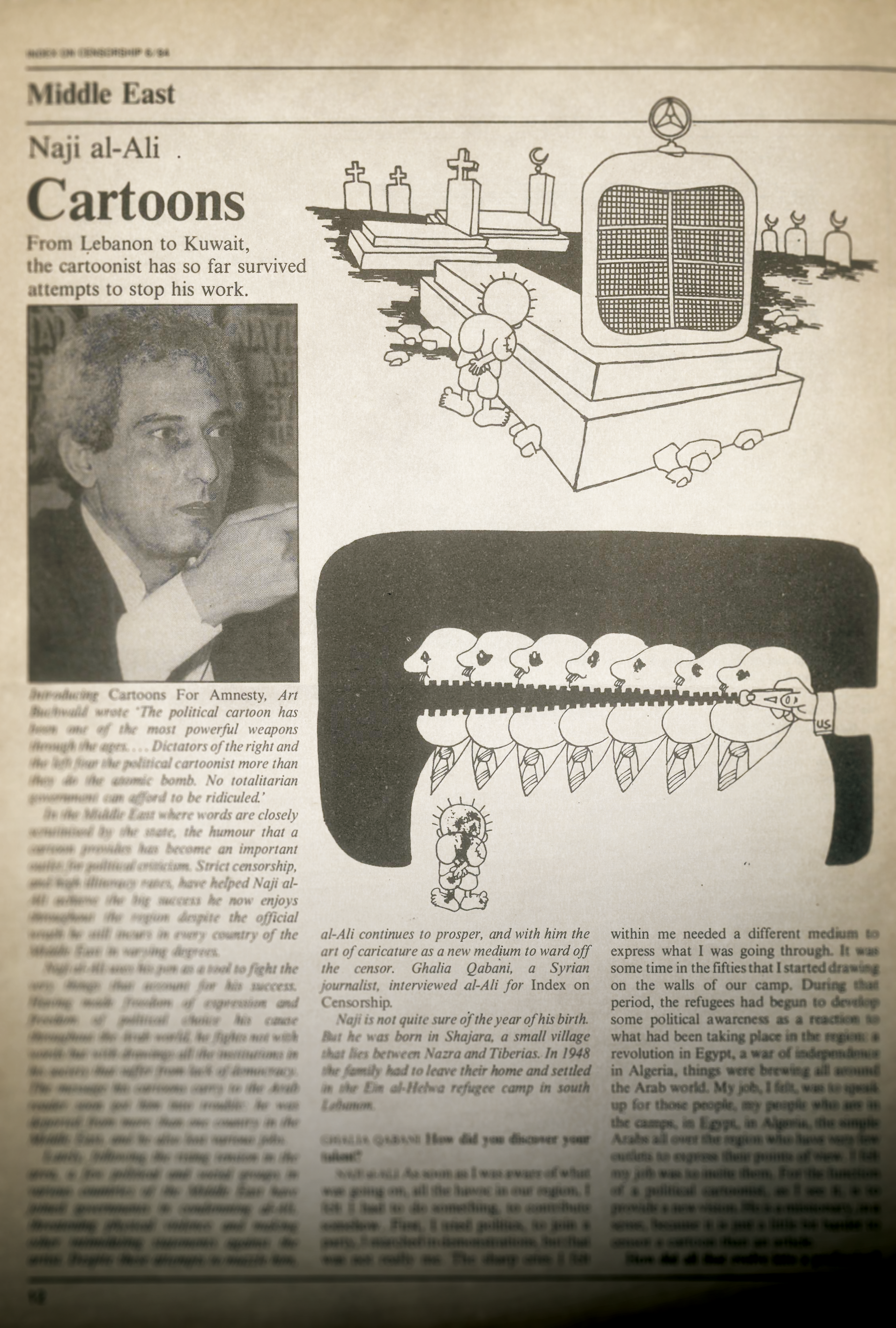
By placing ordinary Arabs at the centre of his work, fearless cartoonist
Art Buchwald wrote: ‘The political cartoon has been one of the most powerful weapons through the ages … Dictators of the right and the left fear the political cartoonist more than they do the atomic bomb. No totalitarian government can afford to be ridiculed.’
In the Middle East, where words are closely scrutinised by the state, the humour that a cartoon provides has become an important outlet for political criticism. Strict censorship and high illiteracy rates have helped Naji al Ali achieve the big success he now enjoys throughout the region despite the official wrath he still incurs in every country of the Middle East in varying degrees.
Naji al Ali uses his pen as a tool to fight the very things that account for his success. Having made freedom of expression and freedom of political choice his cause throughout the Arab world, he fights not with words but with drawings all the institutions in his society that suffer from lack of democracy. The message his cartoons carry to the Arab reader soon got him into trouble: he was deported from more than one country in the Middle East, and he also lost various jobs.
Lately, following the rising tension in the area, a few political and social groups in various countries of the Middle East have joined governments in condemning al Ali, threatening physical violence and making other intimidating statements against the artist. Despite these attempts to muzzle him, al Ali continues to prosper, and with him the art of caricature as a new medium to ward off the censor. Ghalia Qabani, a Syrian journalist, interviewed al Ali for Index on Censorship.
Naji is not quite sure of the year of his birth. But he was born in Shajara, a small village that lies between Nazareth and Tiberias. In 1948 the family had to leave their home and settled in the Ein el Hilweh refugee camp in south Lebanon.
How did you discover your talent?
As soon as I was aware of what was going on, all the havoc in our region, I felt I had to do something, to contribute somehow. First, I tried politics, to join a party, I marched in demonstrations, but that was not really me. The sharp cries I felt within me needed a different medium to express what I was going through. It was some time in the 50s that I started drawing on the walls of our camp. During that period, the refugees had begun to develop some political awareness as a reaction to what had been taking place in the region: a revolution in Egypt, a war of independence in Algeria, things were brewing all around the Arab world. My job, I felt, was to speak up for those people, my people who are in the camps, in Egypt, in Algeria, the simple Arabs all over the region who have very few outlets to express their points of view. I felt my job was to incite them. For the function of a political cartoonist, as I see it, is to provide a new vision. He is a missionary, in a sense, because it is just a little bit harder to censor a cartoon than an article.
How did all that evolve into a profession?
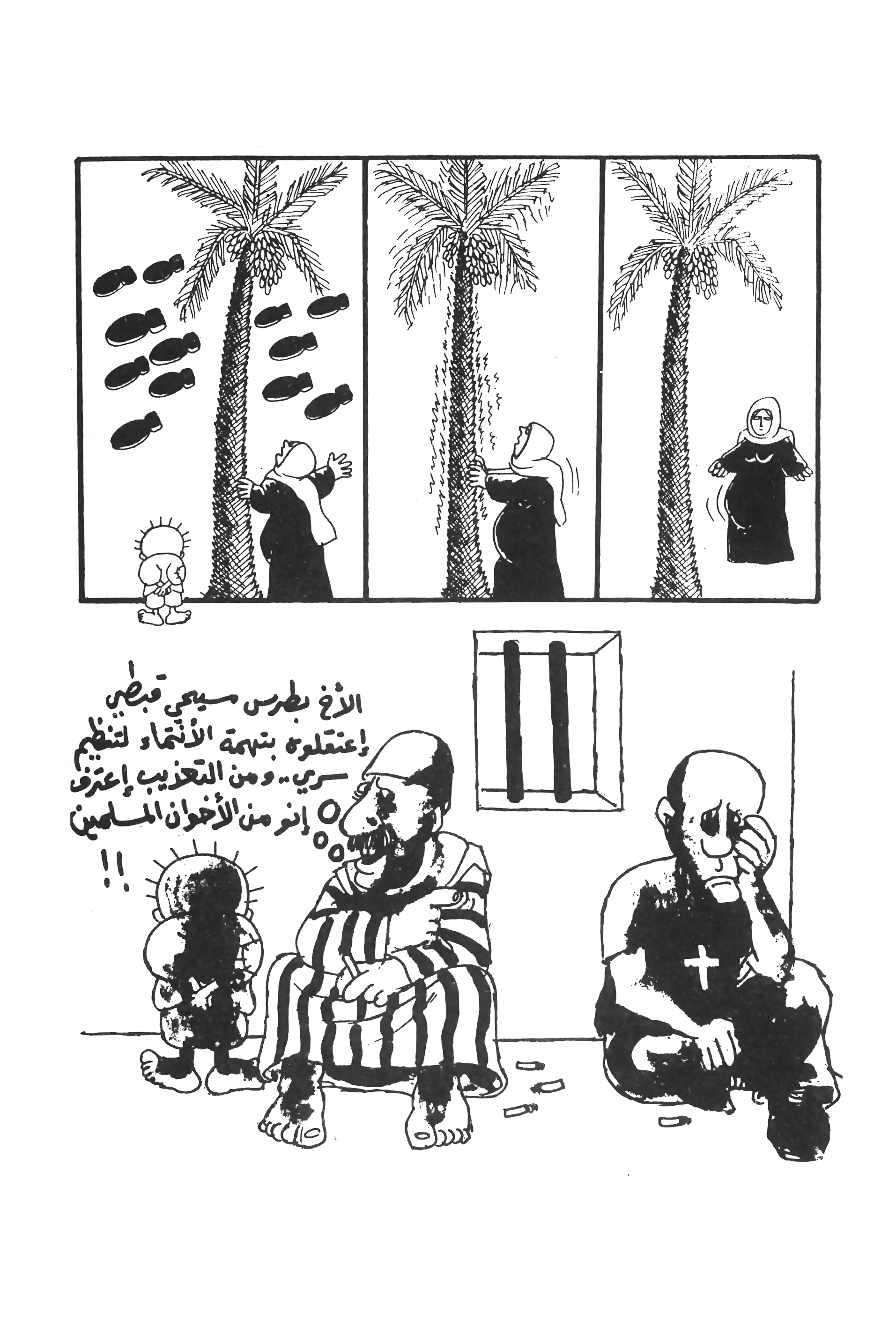
I started to use drawing as a form of political expression in Lebanese jails. I was detained by the Deuxieme Bureau [the Lebanese intelligence service] as a result of the measures the Bureau was undertaking to contain political activities in the Palestinian camps during the 60s. I drew on the prison walls and subsequently Ghassan Kanafani, a journalist and publisher of al Huria magazine [assassinated in Beirut in 1971], saw some of those drawings and encouraged me to continue, and eventually published some of my cartoons. Later I fled to Kuwait. The margin of freedom and democracy that exists in Kuwait enabled me to grow. There my cartoons concentrated on the dangers surrounding us as people.
My job, I felt, was to speak up for people, in the camps, in the region
What about your work in Beirut?
Working for al Safir newspaper in Beirut in 1971 was the best part of my life, and the most productive. There, surrounded by the violence of many an army and finally by the Israeli invasion, I stood facing it all with my pen every day. I never felt fear, failure or despair, and I didn’t surrender. I faced armies with cartoons: with drawings of flowers, hope and bullets. Yes, hope is essential, always. My work in Beirut made me once again closer to the refugees in the camps, the poor and the harassed.
‘Hanzala’, that little boy who stands in every one of your cartoons with his hands crossed behind his back as if he were a spectator at a continuing show, when and where was he born?
This child, as you can see, is neither beautiful, spoilt, nor even well-fed. He is barefoot like many children in refugee camps. He is actually ugly and no woman would wish to have a child like him. However, those who came to know ‘Hanzala’, as I discovered later, loved him and later adopted him because he is affectionate, honest, outspoken, and a bum. He is an icon that stands to watch me from slipping. And his hands behind his back are a symbol of rejection of all the present negative tides in our region. I have to admit also that as a child I was fascinated by the theatre. I loved it a lot. I had dreams of appearing on stage, communicating with people. Lately, I have discovered that my love for the theatre is still very much alive and, in fact, my cartoons are a form of theatre. That space in the newspaper is the stage that I appear on every morning. Yes, I reach out for and communicate with an audience every day without troubling them to come to me, as if I were on stage. When I found that out I felt a sense of peace and balance within me.
How do you deal with having a family, having to move house so many times, and having to draw every day?
My wife Widad is just the opposite of everything I am. She is an organised, logical person while I am disorganised, my thoughts scattered in every direction. So, you see, we complement each other perfectly. She has become my safety valve. She watches over my moods and any changes that could indicate I am beginning to forget or have ambitions at the expense of the truth. Yet she never interferes or tries to warn me of the dangers of being too outspoken.
What about the Palestinians? Many would like to censor your cartoons for you often criticise their behaviour …
I draw Palestinians as I see them. I draw Palestinian political figures, and I think it is essential for any leadership to accept criticism. I also draw rich Palestinians who scream all day about the land and about sacrifices when in fact they are more interested in their financial deals and private gains. I criticise Palestinian women who were farmers a few years back and have now turned into city ladies living in Canada and Brazil.
Does the continuous deterioration of civil liberties in the Middle East give you a sense of despair?
When I was younger I thought I would actually be able to help achieve all our aspirations for independence, unity, justice. Many died for those aspirations and things are only getting worse. That, certainly, can make one despair. But, more than ever, I feel a sense of duty to go on doing what I have to and can do. ❒
Credit: Naji al Ali