




Abstract

Dear Mr Ceausescu,
I have for some time now been following your political career with great admiration because I know that you alone decide what is and what isn’t good for Romania. This in an age when in many countries politicians still waste a lot of time by indulging in lengthy and fruitless debates in parliaments and legislative assemblies. I’m therefore convinced it is no exaggeration to say that there is no statesman in the world today who would show so personal an interest in his citizens as you do.
I have just learned about your latest measures from the daily press. Having ascertained that the Romanians eat too much and that, as a result, a full third of the population suffers from diseases due to obesity, you have proposed a diet consisting of ten eggs, ten dekagrams of butter and a kilogram of meat per citizen per month. You have also decreed that room temperatures should not exceed 15 degrees Celsius, being well aware that citizens of a socialist state must not be too delicate. Your order that lifts should only operate from the third floor up will likewise help to improve the physical fitness of your people, just as the decision not to use refrigerators in winter and to switch the TV off at 10pm every night, except on special occasions such as the days when the nation is celebrating a birthday – yours, your wife’s, or that of some other member of your family.
It is to be regretted that some of your citizens seem not to understand the wisdom of these measures you have decided to take, so that it is necessary for the police to step in and keep a watchful eye to make sure that people don’t overheat their homes, use their fridges in winter, or consume too much energy on illumination, cooking, ironing, or watching TV. It is only the irresponsible attitude of a few individuals that makes it necessary to resort to blocking up their points.
Bucharest, 31 December 1989
Credit: NAF Dementi
I, however, am an optimist and believe that before too long everyone will realise that they can only hope to see a brighter tomorrow if today they switch the lights off early. It is no secret that you and all your family have to work very hard. Your son Nicu is minister for youth, your brothers Ion and Hie are in charge of the Ministries of Planning and Defence respectively, another brother, Nicolae, heads the Ministry of the Interior. Moreover, your wife is your first deputy.
It is well known that altogether 50 members of your family have to devote all their time, energy and talents to the job of running Romania, with its 22 million inhabitants. That makes it almost half a million citizens per member of your family, and that is a record that cannot be equalled anywhere in the world today. Not even Flick in West Germany, Heineken in Holland, Grundig or Ford can measure up to you in effectiveness. Duvalier achieves only minimal output with his employees, Idi Amin has gone bankrupt, and Khomeini has too many shareholders and still cannot make a go of it.
I mention all this only because I think that your latest idea – to register all typewriters in the country – requires a little more elaboration. Allow me therefore to discuss this interesting measure and to make a few suggestions as to how it could be improved.
First of all, it is absolutely essential also to register chalks, pens, crayons, pencils, brushes, as well as ink, varnishes and sprays (insofar as these are obtainable in your country), and other material such as paper, notepads and exercise books. And talking about paper, you mustn’t forget wrapping and toilet paper. Also all kinds of material used to cut out, stick on or otherwise position letters of the alphabet. I am referring to newspapers, sacks, textiles, scissors, glues, drawing pins, needles, pins and nails.
However, people can use other means too to express anti-State or otherwise harmful sentiments. By means of the Morse code, for example, which can be transmitted with the aid of light. For that reason I would recommend the registration of lamps, chandeliers, torches, bulbs, batteries, spotlights, lanterns, fireworks, as well as mirrors. More primitive methods such as smoke signals can also be used to convey anti-State slogans, for which reason I would restrict the sale of matches, candles, lighters, as well as cigars and cigarettes.
Furthermore, you must not forget all the objects that can be used to transmit sound signals. No citizen should thus be in a position to obtain without permit bells, whistles, and musical instruments (percussion, wind and string – for short distances). The number of musical instruments owned by all orchestras and ensembles should be checked without delay, and reliable musicians issued with music passports.
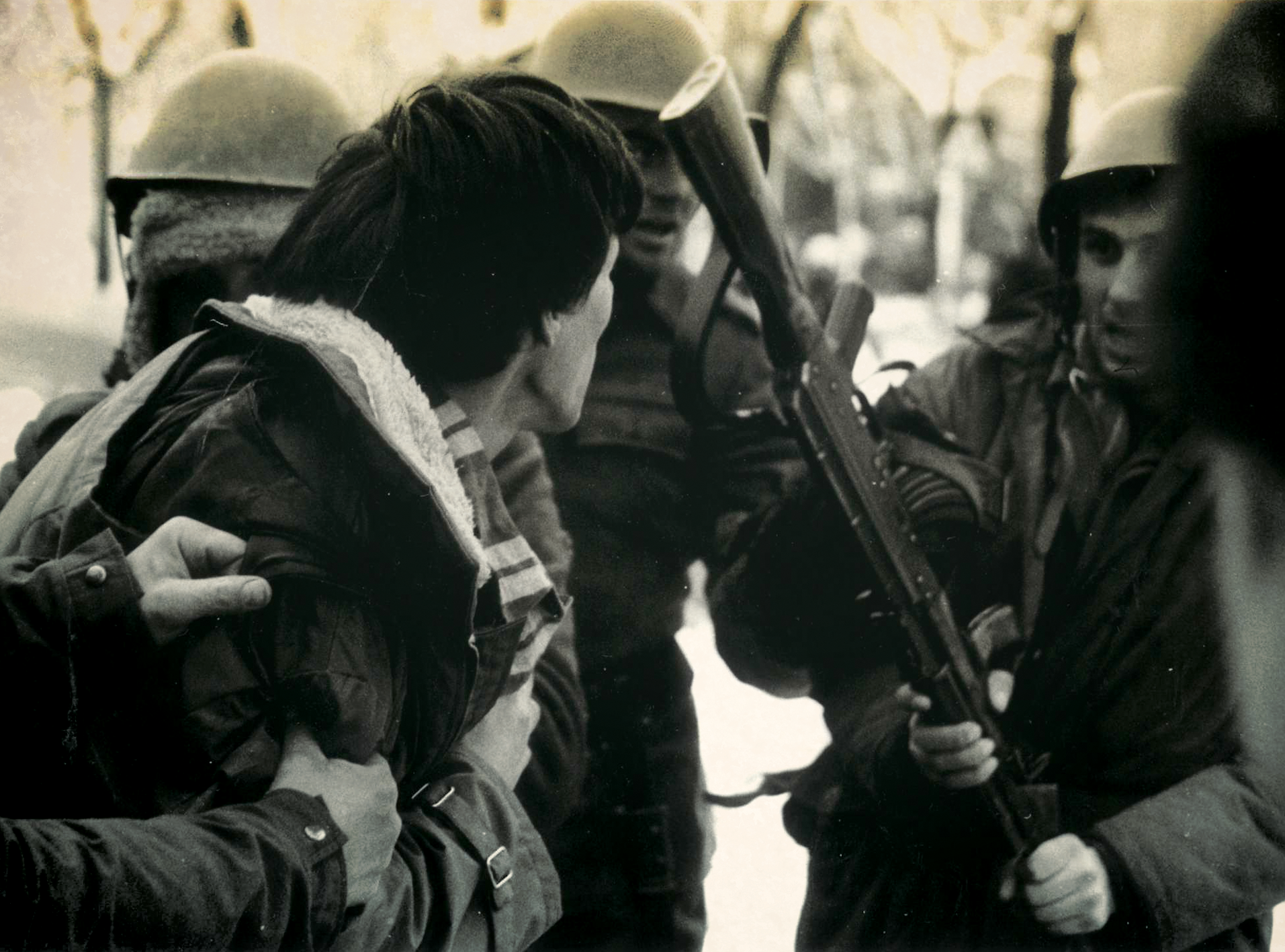
All this, however, is still not enough. People wishing to express some anti-State thought can be extremely ingenious, as I discovered in Prague in 1968, when the arrival of Soviet troops gave rise to what I might call a festival of anti-State creativity. The lesson we learned then was that citizens can make use of empty tins, dustbins, boxes, barrels, as well as tyres and building materials such as bricks, breeze blocks, beams and planks. Tools to be found in any storeroom must also be included in this category: pliers, picks, hoes, shovels, drills, scythes, even sickles.
Furniture, too, can come in handy. All you need is a few tables, chairs, hat stands, benches or wardrobes and you can put together a slogan. Nor should farmers and farm labourers be left out. They can achieve the same result with the aid of sugarbeet, potatoes, marrows, any kind of vegetable and also all larger – ie legible – species of fruit. Even the smaller fruits, such as redcurrants, blueberries and raspberries, can be made use of for writing, if not on walls, then certainly on tables. Similarly, pots and pans, saucepans, lids, plates, in short all kitchen utensils, crockery and even cutlery offer similar possibilities.
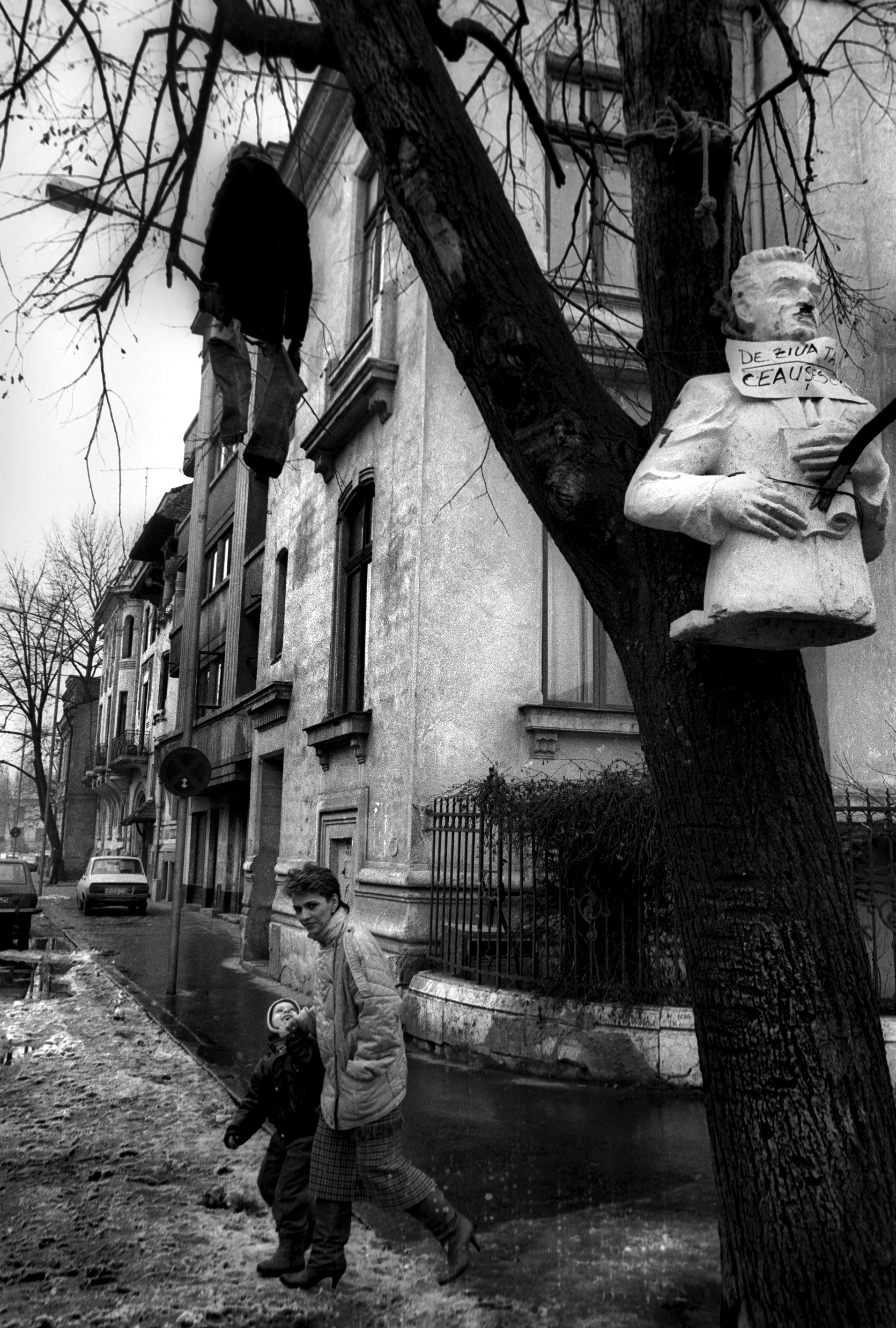
Effigy of Ceausescu, Bucharest, January 1990
And, alas, we cannot exclude medicine bottles and pills, including vitamins, while foodstuffs too can be misused. Sausages, salamis, hams, loaves of bread, rolls, butter, yoghurt, ice cream, beer and other bottles – all this is potential communication material, just as various personal items such as lipsticks, compacts, make-up kits, purses, watches, and chewing gum.
Finally, I must draw your attention to yet another object – the book. Or rather books. I know that these are carefully censored before they ever get to the bookshops, libraries, schools or scientific institutes. But it is not their content which concerns me here. The very shape of a book makes it an ideal tool for the compiling of words or whole sentences, so that all an inventive anti-State person needs, for instance, is a pile of your own, ideologically absolutely innocuous autobiographies, or some other officially sanctioned works, from which to compose an unsuitable slogan.
I am well aware that any systematic measures to prevent the spreading of anti-State ideas in the way I have outlined above would be extremely costly. I realise that it would require the appointment of special censors in every office, factory, institute and cooperative. They would also have to be sent to other sectors, such as the railways, road transport, and district and regional administration, and above all every street and house. Not to mention the armed forces and the police.
If I take into account the cost of the reporting and systematic registration of all individual objects, to which has to be added the expense incurred in setting up and operating the central censorship offices and control commissions, it occurs to me – as I sit here typing on what is as yet a free, unregistered typewriter – that there would be a far simpler and cheaper solution, which I take the liberty of offering for your consideration. I suggest that we solve the problem rationally and simply by abolishing the alphabet. That is the only way we can achieve socialism quickly and without risk.